You have just passed your driving test and you need a car for a few days, for a weekend or for the university term. The first question is always the same: can I actually rent, and above all which car am I allowed to drive without risking a fine? In Italy the answer changed on 14 December 2024, when the reform of the Highway Code came into force, and today it is considerably more generous than before. This guide gives you the exact figures, where to read them on the vehicle logbook in two minutes, and how renting works with Revirent24.
Let us clear up the main point straight away: no Italian law forbids a newly licensed driver from renting a car. The restrictions concern the vehicle you may drive, not the contract you may sign. Everything else depends on the rental company's own terms, and on that front we are among the most open operators in the area.
Who counts as a new driver under Italian law
The Italian Highway Code does not use the word neopatentato loosely: it defines a precise period, the first years from the issue of the licence, during which special restrictions apply. For a category B licence that period is three years and it runs from the date you passed the driving test. No application and no paperwork are needed: the restrictions apply automatically, as article 117 of the Highway Code states.
In practice this means that if you obtained your licence less than three years ago you are a new driver in the eyes of the law, even if you have been driving every day for thirty-six months minus one. And if your licence was issued on your eighteenth birthday, you remain a new driver until you turn twenty-one.
What changed on 14 December 2024
Law no. 177 of 25 November 2024, the reform of the Highway Code, rewrote paragraph 2-bis of article 117 and substantially changed the power limits for category B licence holders. The amendment came into force on 14 December 2024 and applies to those who obtained their licence from that date onwards.
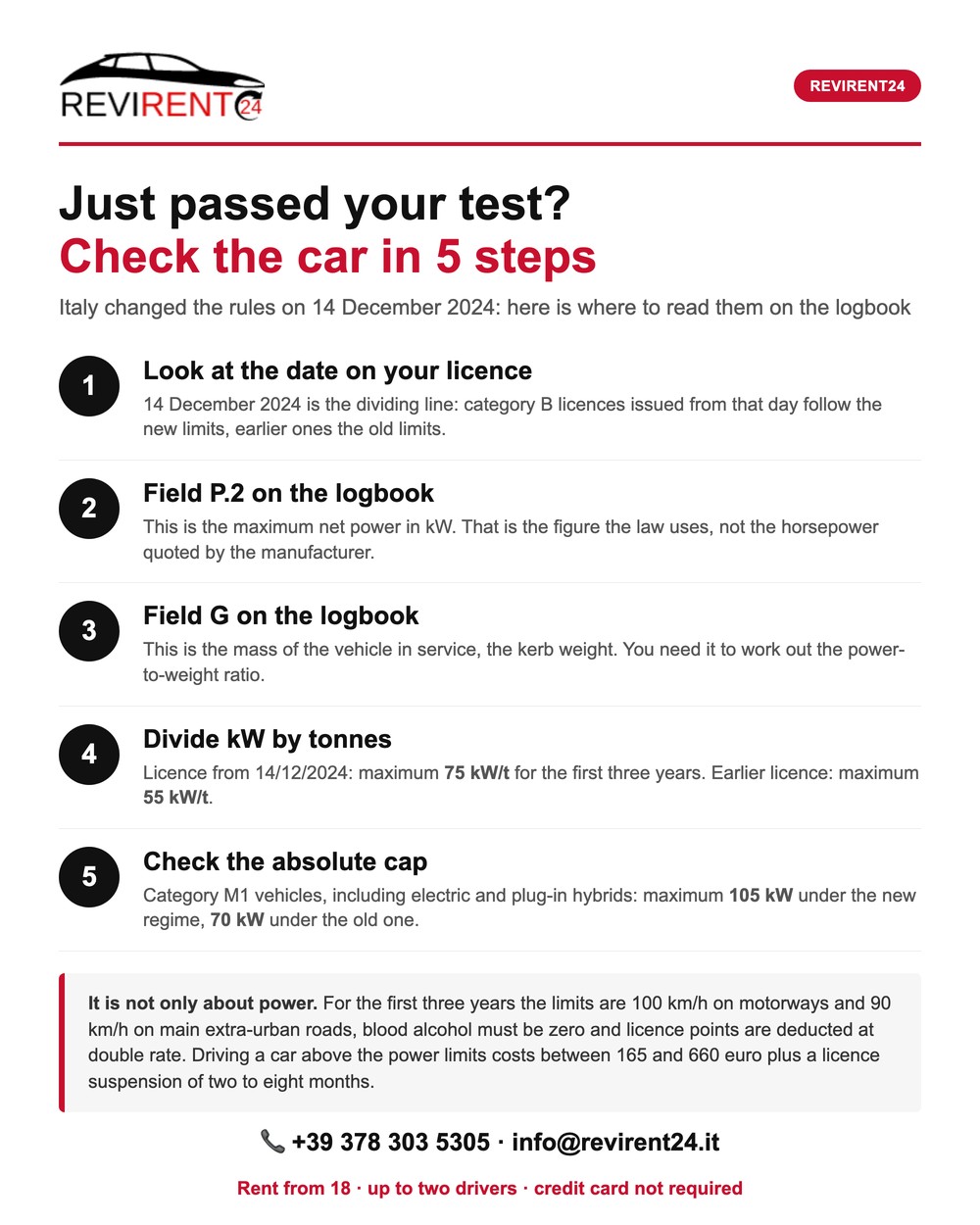
This creates a situation that causes a good deal of confusion, because two regimes now coexist. Drivers who held their licence before 14 December 2024 remain subject to the old limits; those who obtained it afterwards follow the new ones. Before looking at any table of engine outputs, therefore, the thing to check is the issue date printed on your licence.
The power limits: 75 kW/t and 105 kW
For anyone who obtained a category B licence from 14 December 2024 onwards, during the first three years from issue it is not permitted to drive vehicles with a specific power referred to the kerb weight exceeding 75 kW per tonne. For category M1 vehicles, that is ordinary passenger cars, a second limit applies: maximum power may not exceed 105 kW. That second cap also covers electric and plug-in hybrid vehicles, which the previous wording treated differently.
The step up from the past is substantial. The old text set the ratio at 55 kW per tonne and the absolute cap at 70 kW, roughly 95 horsepower. Moving to 75 kW/t and 105 kW, around 143 horsepower, considerably widens the range of cars a new driver may handle and comfortably includes almost every current supermini and hybrid city car.
One detail many people get wrong: both limits must be met, not one or the other. A light but powerful car can sit below 105 kW and still break the power-to-weight ratio, and conversely a heavy car may have a comfortable ratio yet exceed the absolute cap. Both lights have to be green.
The two sets of rules side by side
| What the law sets | Category B licence obtained before 14/12/2024 | Category B licence obtained from 14/12/2024 |
|---|---|---|
| Power-to-weight ratio | maximum 55 kW/t | maximum 75 kW/t |
| Maximum power, M1 vehicles | maximum 70 kW (about 95 hp) | maximum 105 kW (about 143 hp) |
| Electric and plug-in hybrids | treated separately | same 105 kW cap |
| Motorway speed limit | 100 km/h | 100 km/h |
| Main extra-urban road limit | 90 km/h | 90 km/h |
The comparison shows why it is worth pausing on the date: the very same car can be perfectly legal for someone who has held a licence for one year and off limits for someone who has held one for four, if the issue date fell before the cut-off.
How to check a car in two minutes, logbook in hand
You do not need specialist websites or apps: all you need is the vehicle registration document, commonly called the logbook. The fields are coded at European level and read the same way on any car registered in the Union.
- Field P.2 is the maximum net power, expressed in kW. This is the figure the law uses, not the horsepower quoted in brochures.
- Field G is the mass of the vehicle in service, what everyday language calls the kerb weight.
From there it is a single division: power in kW divided by mass in tonnes. A car with 74 kW and a mass of 1,180 kg gives 74 divided by 1.18, roughly 63 kW/t. Below 75 kW/t and below 105 kW: drivable under the new regime. Not under the old one, because 74 kW already exceeded the 70 kW cap.
A second example shows the double check at work. A car with 110 kW and a mass of 1,400 kg works out at about 79 kW/t: it breaks the ratio and it breaks the absolute cap too. It cannot be driven by a new driver under either regime.
Not just power: the speed limits
The first three years from obtaining the licence also bring two lower speed limits than the ordinary ones, applying to categories A2, A, B1 and B. On motorways you may not exceed 100 km/h, on main extra-urban roads 90 km/h. These are personal limits, not vehicle limits: they stay the same whatever car you are driving, even if you are the second driver on a rental and the first has been driving for twenty years.
For anyone starting from here that is a practical consideration. From Chiusi station towards Florence or Rome you travel on the A1 motorway, and keeping to 100 km/h means allowing a few extra minutes on top of what the satnav suggests. Worth knowing before you book dinner.
Alcohol: for new drivers the limit is zero
There is one last point that is often discovered too late. The permitted blood alcohol level in Italy is 0.5 grams per litre, but for drivers who have held a licence for less than three years and for those under twenty-one the limit drops to zero. That is not a polite form of words: a single glass can trigger the offence.
In an area like ours, which lives on wineries, tastings and long dinners between Montepulciano and the Val d'Orcia, planning makes the difference. The simplest way to give up nothing is to name two drivers on the same rental: whoever tastes does not drive, and the evening ends well for everyone. We covered this in our guide to car rental in Montalcino.
Licence points: deducted at double rate
Every Italian licence starts with twenty points. For those who obtained it after 1 October 2003 without already holding another category B or higher licence, however, the points deducted for each individual offence are doubled if the offence is committed within the first three years from issue. That is the rule in article 126-bis of the Highway Code, and it is why a new driver can reach zero far faster than expected.
The good news is that the same article also provides a reward: over those three years, each year completed without committing offences that carry a points deduction is worth one extra point, up to a maximum of three.
What choosing the wrong car costs
Driving a vehicle above the power limits is not a technicality. Article 117, paragraph 5, provides that an Italian licence holder who breaches paragraphs 2 and 2-bis is liable to an administrative fine of between 165 and 660 euro, together with the additional penalty of a licence suspension of two to eight months.
In plain terms: a one-week holiday can turn into half a season on foot. Two minutes with the logbook are well spent before you get behind the wheel, especially if the car is not yours.
The exceptions the law allows
Paragraph 2-bis sets out two situations in which the power limits do not apply. The first concerns vehicles used in the service of disabled people, when the person holding the relevant permit is on board. The second concerns accompanied driving in the strict sense: the restrictions do not operate if, acting as instructor, the passenger beside the new driver is no older than sixty-five and holds a valid licence for the same category obtained at least ten years earlier.
Note, however, that the instructor exception applies to the power limits only. The zero alcohol limit and the doubled points deduction remain with whoever is at the wheel, accompanied or not.
Renting as a new driver: what really changes
Here the legal part ends and the contractual part begins, and it is worth keeping them apart because they are often confused. Italian law sets no minimum age for renting and does not prevent a newly licensed driver from signing a rental contract. Companies set their own terms, and on this the market varies enormously.
The large international chains almost always apply higher age thresholds, young driver surcharges and a requirement for a credit card in the driver's own name: three barriers that are often insurmountable for someone in their early twenties. A local operator works differently, because it knows the area and because it meets the customer in person.
How it works with Revirent24
Our terms, published in full on our frequently asked questions page, are designed precisely to remove those barriers.
- Minimum age 18. We do not ask you to wait until twenty-one or twenty-five.
- Up to two drivers on the same contract, which helps when one of the two is a new driver and the other is not.
- Credit card not required. Without a credit card a security deposit of 500 euro applies, released when the car is returned. We accept VISA and Mastercard, not American Express or Diners. We explained the whole process in our guide to car rental without a credit card.
- No mileage limit. Kilometres are not counted and not charged separately.
- Insurance cover including third party liability, fire and theft, collision damage and driver injury, with the excesses set out in the FAQ.
One point depends on the individual vehicle rather than on the contract: the car assigned to you must fall within the power limits that apply to your licence. That is why, when you book, it helps to tell us straight away when you obtained your licence. From the date we know which regime applies and we can point you to the compatible vehicles, with no surprises at the desk. If you want a preview, our cars are listed on the car park page.
Short term or long term
For a weekend or a week, short term rental is the natural choice. Things change if the new licence coincides with the start of university, a first job or a move: in that case long term rental becomes interesting, because it bundles the vehicle, insurance, servicing and road tax into a single monthly payment.
For a new driver the formula has one further advantage: it avoids buying a car that in three years, once the restrictions expire, may already feel too small. Our price list is updated regularly and includes a number of city cars and hybrid superminis, exactly the segment that falls comfortably within the parameters. Here too, the precise logbook check is something we do together before signing.
Where to collect the car
There are five collection points covering the area between Tuscany and Umbria: Chiusi-Chianciano Terme railway station, Montepulciano, Città della Pieve, Chianciano Terme and San Casciano dei Bagni, the last by prior phone call. The updated list is on our offices page.
Chiusi station is the most convenient way in for anyone arriving without a car: it sits on the historic Florence to Rome line and every regional train passing through stops there, along with some Intercity services. If you are flying in, the full route is set out in our guide to car rental from the airports. Our offices are open Monday to Friday from 8:30 to 13:00 and from 14:30 to 19:00, and on Saturday from 8:30 to 13:00.
Three mistakes to avoid
Trusting horsepower instead of kilowatts. The horsepower figures in advertising are rounded and sometimes refer to different versions. The number that counts is the one in field P.2.
Assuming the new limits apply to you. The 75 kW/t and 105 kW figures only cover licences issued from 14 December 2024. If yours is older, your numbers remain 55 kW/t and 70 kW.
Thinking rentals are a world apart. A contract does not suspend article 117: if the rented car exceeds the limits, the penalty falls on whoever was driving. Before collection it is always worth running the check we suggest in our guide on what to check before picking up a rental car.
Frequently asked questions
Can a newly licensed driver rent a car in Italy?
Yes. No rule forbids it. The terms depend on the rental company: with Revirent24 the minimum age is 18 and a credit card is not compulsory.
How long do the restrictions for new drivers last?
Three years from obtaining a category B licence, both for the speed limits and, under the new regime, for the power limits.
What are the current power limits?
For licences obtained from 14 December 2024: a maximum of 75 kW per tonne of kerb weight and, for M1 vehicles including electric and plug-in hybrids, a maximum power of 105 kW. For earlier licences the figures remain 55 kW/t and 70 kW.
Where do I find power and kerb weight on the logbook?
Maximum net power in kW is in field P.2, the mass of the vehicle in service in field G. The ratio is obtained by dividing kW by tonnes.
What speed may I drive on the motorway?
During the first three years from obtaining the licence the limit is 100 km/h on motorways and 90 km/h on main extra-urban roads.
What do I risk if I drive a car that is too powerful?
An administrative fine of between 165 and 660 euro and a licence suspension of two to eight months.
Can I have a glass of wine with dinner?
Not if you have held your licence for less than three years or you are under twenty-one: in that case the permitted blood alcohol level is zero. The practical solution is to name a second driver on the contract.
Do I need a credit card to rent?
No. Without a credit card a security deposit of 500 euro applies, released when the vehicle is returned.
Can I add a second driver who is also newly licensed?
Yes, the contract allows up to two drivers. Each of them must respect the limits attached to their own licence.
The quickest way to get going
If you have only just passed your test, the most useful thing you can do is make a three minute phone call. Tell us when you obtained your licence, when you need the car and where you are starting from: we will tell you which vehicles fall within your limits and reserve the right one for you. We are at via Cardete 12/14 in Città della Pieve, on the phone and on WhatsApp at +39 378 303 5305, or you can write to info@revirent24.it. All our contact details are on the contact page.