
In summary
The things you need to know right away
- The car survives, the licence does notLetter c) of paragraph 2 rules out confiscation where the car belongs to a person extraneous to the offence, but in the same passage it doubles the suspension: above 1.5 g/l, two to four years.
- Three thresholds, not a single limitAbove 0.5 g/l it is an administrative offence, above 0.8 g/l a crime with a fine and detention, above 1.5 g/l the most serious band. For new drivers and under 21s the limit is zero.
- If you cannot drive, the car does not stay thereParagraph 2-quinquies provides that the car goes to a garage where no other suitable person can drive it, with recovery and transport costs falling on the offender.
In this guide (13)
- 1The Code punishes the driver, but it also looks at who owns the car
- 2The three thresholds of article 186: where the fine ends and the crime begins
- 3Above 1.5 g/l a rental car is not confiscated, but the suspension doubles
- 4Refusing the breath test is not a way out
- 5The asymmetry nobody notices: on refusal the doubling does not apply to everyone
- 6New drivers, under 21s and professional drivers: the limit is zero
- 7Ten points that count as twenty for a new driver
- 8At night the fine rises, but only where it is a crime
- 9With an accident the penalties double and the impoundment does not reach you
- 10The car does not stay where you are stopped, and the tow truck is on you
- 11The insurer compensates the injured party and then comes back to you
- 12Alcolock, codes 68 and 69: what changes for anyone wanting to rent
- 13What to ask Revirent24 before you set off
In a rental car there is no confiscation, because the vehicle belongs to a third party extraneous to the offence. But the very provision that rules out confiscation doubles the length of the licence suspension: not one or two years, two or four. The three thresholds of article 186, refusing the breath test, the points that count double for a new driver and what actually happens to the car.
Of all the rules that apply to someone driving a rental car in Italy, the one about alcohol is the most misunderstood. Not because the limit is unclear, but because almost everyone starts from the wrong assumption: that if the car is not yours the consequences are lighter, since the car cannot be taken away. It is true that it cannot be taken away. And that is precisely why the licence is suspended for twice as long.
This article sets out what article 186 of the Italian Highway Code actually says, threshold by threshold, and flags the points where having an owner who is not the driver changes the outcome. These are details written into the statute, not interpretations: each one is cited by paragraph so you can check it.
The Code punishes the driver, but it also looks at who owns the car
The first paragraph of article 186 is a single sentence: driving while intoxicated as a result of consuming alcoholic beverages is prohibited. The prohibition applies to the driver and to nobody else. There is no separate rule for someone driving their own car, a company car or a rental car, and the blood alcohol level is measured the same way in all three cases.
Ownership of the vehicle comes into play not in the prohibition but in the accessory penalties: confiscation of the car, administrative impoundment and the length of the licence suspension. Here the legislature wrote a specific rule for cases where the vehicle belongs to a person who is extraneous to the offence. On a rental car that is the normal situation, not the exception: the car belongs to the rental company, which has committed no offence.
Keeping the two levels separate is what makes the rest readable. The main penalties, meaning the money and any custodial element, do not change. The accessory penalties do, and not always in your favour.
The three thresholds of article 186: where the fine ends and the crime begins
Paragraph 2 divides the consequences into three bands based on the blood alcohol concentration measured, and the difference between the first band and the other two is not merely one of amount: it is a difference in legal nature.
Letter a) covers readings above 0.5 and up to 0.8 grams per litre and provides for an administrative penalty of 543 to 2,170 euros, with licence suspension from three to six months. This is an administrative offence, like speeding: no criminal proceedings.
Letter b) covers readings above 0.8 and up to 1.5 grams per litre and crosses into criminal law: a fine of 800 to 3,200 euros and detention of up to six months, with licence suspension from six months to one year.
Letter c) covers readings above 1.5 grams per litre: a fine of 1,500 to 6,000 euros, detention from six months to one year, licence suspension from one to two years. The amounts in force are those updated by the decree of 31 December 2020, applicable from 1 January 2021.
Paragraph 6 completes the picture on measurement: if the test returns a value above 0.5 grams per litre, the person is considered intoxicated for the purposes of the penalties in paragraph 2. Below that threshold, for an ordinary driver, there is no penalty for intoxication.
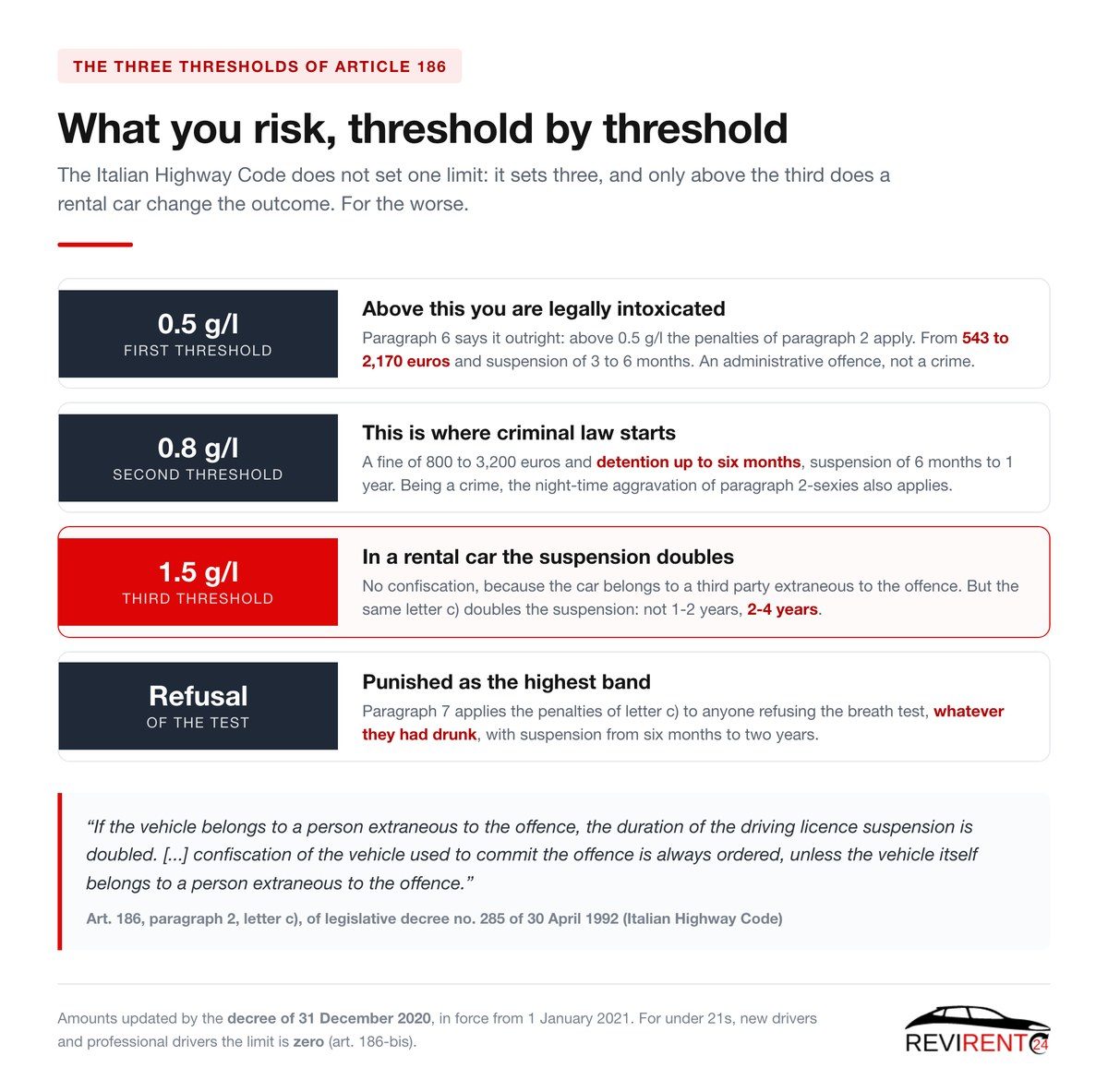
The three thresholds of article 186 and the point where a rental car changes the outcome.
Above 1.5 g/l a rental car is not confiscated, but the suspension doubles
This is the passage that justifies the whole article, and it sits inside letter c) of paragraph 2. Two sentences, one after the other, that have to be read together.
The first: with the sentence of conviction, confiscation of the vehicle used to commit the offence is always ordered, unless the vehicle itself belongs to a person extraneous to the offence. On a rental car the owning company is extraneous to the offence, so confiscation does not apply. The car goes back to the rental company.
The second, in the same paragraph: if the vehicle belongs to a person extraneous to the offence, the duration of the driving licence suspension is doubled. This is not an indirect consequence or a local practice: it is the answer the legislature gave precisely for the case where the vehicle cannot be targeted.
In practical terms, here is what it means. Someone stopped above 1.5 grams per litre in their own car faces a suspension of one to two years and loses the vehicle. Someone stopped in the same condition in a rental car does not lose the car, because it is not theirs, but faces a suspension of two to four years. The time without a licence doubles.
The widespread reading online, according to which you risk less in a rental car because the vehicle cannot be confiscated, is therefore the reverse of what the statute says. Whoever loses a car buys it back or replaces it. Whoever loses a licence for four years has nothing to buy back.
Refusing the breath test is not a way out
The second belief worth dismantling is that refusing the test is convenient, since without a measurement there is no number to challenge. Paragraph 7 of article 186 closes that door explicitly: where the test is refused, the driver is punished with the penalties of paragraph 2, letter c), that is, those laid down for the most serious band of all.
Whoever refuses is therefore treated as someone found above 1.5 grams per litre, regardless of how much they had actually drunk. Conviction carries licence suspension from six months to two years and confiscation of the vehicle under the same procedure as letter c), unless the vehicle belongs to a person extraneous to the violation. If the act is committed by someone already convicted of the same offence in the preceding two years, the licence is always revoked.
There is also an administrative sequel that gets little coverage: with the suspension order the prefect requires the driver to undergo a medical examination. Paragraph 8 sets the deadline at sixty days and provides that, if the examination does not take place within that time, the prefect may order a precautionary suspension of the licence pending the outcome. The same precautionary mechanism applies, under paragraph 9, where the test returned a value above 1.5 grams per litre.
The asymmetry nobody notices: on refusal the doubling does not apply to everyone
Here the statute holds a surprise worth reading closely, because it is a genuine difference between two situations that look identical.
Paragraph 7 of article 186, the one on refusal by an ordinary driver, mentions confiscation and rules it out for a third party's vehicle, but it does not contain the sentence about doubling the suspension. Paragraph 6 of article 186-bis, which governs refusal by drivers under 21, by drivers in their first three years on a category B licence and by professional transport drivers, does contain it in writing: if the vehicle belongs to a person extraneous to the offence, the duration of the driving licence suspension is doubled.
Translated: a newly licensed driver who refuses the breath test in a rental car runs into the doubled suspension, while a driver with many years of licence who refuses in the same circumstances does not, because for them the doubling is provided only in the case of paragraph 2, letter c), that is, when a reading above 1.5 grams per litre has actually been established. It is an asymmetry the text does not explain, and it is worth knowing because it runs the opposite way from what you would expect: it is the less experienced driver who is treated more harshly.
New drivers, under 21s and professional drivers: the limit is zero
Article 186-bis moves the limit for three categories of driver. Paragraph 1 prohibits driving after consuming alcoholic beverages and under their influence for anyone under twenty-one, anyone within the first three years of obtaining a category B licence, anyone carrying out passenger or goods transport activities and anyone driving vehicles with a laden mass above 3.5 tonnes, buses and vehicles with more than eight seats besides the driver's.
For these categories paragraph 2 imposes an administrative penalty of 168 to 672 euros for a reading above zero and up to 0.5 grams per litre, doubled if an accident is caused. Above 0.5 grams per litre the bands of article 186 apply, but aggravated: paragraph 3 increases the penalties of letter a) by one third and those of letters b) and c) by between one third and one half.
For anyone renting a car in Italy this is the single most immediately useful fact. There is no permitted glass: the threshold is zero, and the penalty starts at the first tenth of a gram detected. It is not a technical tolerance, it is a statutory threshold.
Paragraph 5 adds a severe element: the licence is always revoked, above 1.5 grams per litre, for drivers of heavy vehicles and buses, and in the event of a repeat offence within three years for all the other drivers on the list.
| Reading established | Ordinary driver | Under 21, new driver, professional driver |
|---|---|---|
| Up to 0.5 g/l | No penalty for intoxication | 168 to 672 euros, doubled if an accident is caused |
| Above 0.5 up to 0.8 g/l | 543 to 2,170 euros, suspension 3-6 months | Same penalties increased by one third |
| Above 0.8 up to 1.5 g/l | Fine 800-3,200 euros, detention up to 6 months, suspension 6 months-1 year | Same penalties increased by one third to one half |
| Above 1.5 g/l | Fine 1,500-6,000 euros, detention 6 months-1 year, suspension 1-2 years | Same penalties increased by one third to one half |
| Above 1.5 g/l in a rental car | No confiscation, suspension doubled: 2-4 years | No confiscation, suspension doubled on the aggravated term |
| Refusal of the test | Penalties of letter c), suspension 6 months-2 years | Penalties of letter c) increased by one third to one half, suspension 6 months-2 years doubled if the car belongs to a third party |
Ten points that count as twenty for a new driver
The points system adds an effect that is often discovered too late. The table annexed to article 126-bis assigns a deduction of ten points to violations of article 186, paragraphs 2 and 7. To article 186-bis, paragraph 2, that is the band between zero and 0.5 grams per litre for the special categories, it assigns five. By comparison, article 187 on driving after taking narcotic substances also costs ten.
That same table, however, contains a decisive note: for licences issued after 1 October 2003 to people who did not already hold another category B or higher licence, the points for each individual violation are doubled if the violation is committed within the first three years from issue.
Ten points doubled makes twenty. Paragraph 1 of article 126-bis allocates twenty points when the licence is issued. A new driver stopped above 0.5 grams per litre therefore finds, in a single roadside check, that the entire allocation is gone. Nor does the fifteen-point cap of paragraph 1-bis for concurrent violations help: that cap, says the paragraph itself, does not apply in cases where suspension or revocation of the licence is provided for, and here suspension always is.
On total loss of points, paragraph 6 requires the holder to sit the technical fitness examination of article 128, and the competent office orders a review of the licence. If the examination is not taken within thirty days of notification, the licence is suspended indefinitely by a final act.
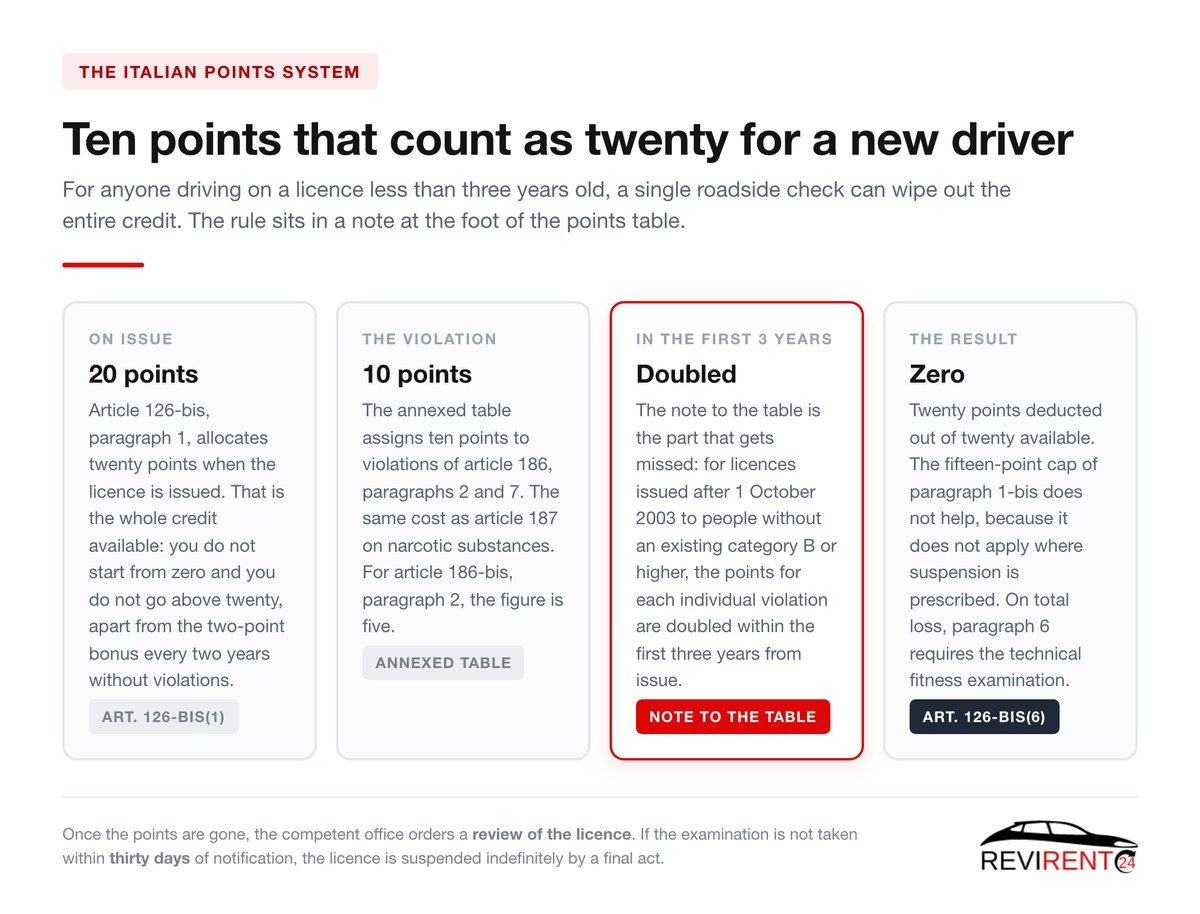
Why a single roadside check can wipe out the points on a new licence.
At night the fine rises, but only where it is a crime
Paragraph 2-sexies provides that the fine under paragraph 2 is increased by between one third and one half when the offence is committed after 10 p.m. and before 7 a.m. This is the night-time aggravating factor, and the way it is drafted deserves attention.
It speaks of a fine and it speaks of a crime. The fine is the criminal penalty provided by letters b) and c). Letter a), up to 0.8 grams per litre, provides instead an administrative penalty and does not constitute a crime. As a result the night-time aggravation does not apply to the first band: someone stopped at midnight with 0.6 grams per litre pays the same amount they would pay at noon.
From 0.8 grams per litre upwards, by contrast, the night-time hours weigh twice over: paragraph 2-septies establishes that mitigating circumstances cannot be held equivalent to or prevailing over this aggravating factor, and that any reduction in penalty is calculated on the already increased amount.
One useful clarification, because it is still widely repeated: the additional 200 euro penalty for breaching article 186 after 8 p.m. and before 7 a.m., introduced by article 6-bis of decree-law 117 of 3 August 2007, no longer exists. That paragraph was repealed by law 94 of 15 July 2009. The Fund against night-time accidents is still in place, but it is financed differently, in particular by the twenty per cent share of the fine provided by paragraph 2-octies of article 186. Anyone still listing those 200 euros is reading a cross-reference that has been out of date for more than fifteen years.
With an accident the penalties double and the impoundment does not reach you
Paragraph 2-bis applies where an intoxicated driver causes a road accident. The penalties of paragraph 2 are doubled and administrative impoundment of the vehicle for one hundred and eighty days is ordered, unless the vehicle belongs to a person extraneous to the offence.
Here too the closing clause excludes a rental car from impoundment, because the owning company is extraneous. The doubling of the penalties remains, and it stacks on top of the other aggravating factors already seen. And if the reading established for the driver who caused the accident exceeds 1.5 grams per litre, the licence is always revoked.
It is worth knowing how the procedure works where confiscation or impoundment do apply, because it also explains why the third-party clause matters so much. Article 224-ter provides that the officer seizes the vehicle in the criminal cases for which confiscation is prescribed, and orders provisional administrative impoundment for thirty days in impoundment cases. The vehicle stays under restraint while the criminal proceedings run their course, meaning for months. On a rental car this does not happen, and the reason is not a courtesy to the driver: it is protection for an owner who is not at fault.
The car does not stay where you are stopped, and the tow truck is on you
There is a short, very practical paragraph that almost nobody cites, and on a rental it makes the difference between an awkward evening and an unexpected bill. It is paragraph 2-quinquies: unless seizure is ordered, the vehicle, where it cannot be driven by another suitable person, may be transported to the place indicated by the person concerned or to the nearest garage and left in the custody of its owner or operator. The costs of recovery and transport fall entirely on the offender.
Two practical consequences. The first is that the car does not stay where it is and does not find its own way back to the depot: it ends up in a garage, in custody, and recovery plus transport are paid by whoever committed the violation. The second is the meaning of another suitable person. On a rental car that is not simply a sober friend: it has to be someone authorised to drive that vehicle under the rental contract. If a second driver was not named when the car was booked, they cannot take the wheel, and the garage becomes the only option.
That is why naming a second driver at booking, even purely as a precaution, is worth more than the convenience of sharing the driving.
The insurer compensates the injured party and then comes back to you
Two opposite and equally wrong statements circulate about insurance: that the policy lapses entirely, and that the insurer pays anyway. The mechanism is a third thing.
Article 144, paragraph 2, of the Italian Private Insurance Code establishes that, up to the full policy limit, the insurer cannot raise against the injured party any objections arising from the contract, nor clauses providing for a contribution by the insured towards compensation. The injured person is therefore compensated in full, whatever the contract says about intoxication.
The same paragraph adds, however, that the insurer has a right of recourse against the insured to the extent that it would have been contractually entitled to refuse or reduce its performance. In other words: the insurer pays up front and then comes back to collect from whoever was at the wheel. Nobody is left without compensation, but nobody gets off free either.
| Item | Who bears it | Reference |
|---|---|---|
| Monetary penalty and detention | The driver only | Art. 186, paragraph 2 |
| Points deduction | The driver only | Table annexed to art. 126-bis |
| Confiscation of the vehicle | Does not apply if the car belongs to an extraneous third party | Art. 186, paragraph 2, letter c) |
| Length of the suspension | Doubled if the car belongs to an extraneous third party | Art. 186, paragraph 2, letter c) |
| 180-day impoundment after an accident | Does not apply if the car belongs to an extraneous third party | Art. 186, paragraph 2-bis |
| Recovery and transport of the vehicle | Entirely on the offender | Art. 186, paragraph 2-quinquies |
| Compensation to the injured party | Paid by the insurer, then recovered from the insured | Art. 144, paragraph 2, Private Insurance Code |
Alcolock, codes 68 and 69: what changes for anyone wanting to rent
Since the reform of the Highway Code there is a new chapter that directly affects anyone wanting to rent a car after a conviction. Paragraph 9-ter of article 186 provides that, for anyone convicted of the offences under letters b) and c), the European Union codes 68, No alcohol, and 69, restricted to driving vehicles fitted with an alcolock device compliant with standard EN 50436, are always entered on a licence issued in Italy.
The restriction stays on the licence for at least two years in letter b) cases and at least three years in letter c) cases, running from the return of the document after conviction. Paragraph 9-quater increases the penalties of paragraph 2 by one third for anyone in that situation, and doubles them if the interlock device has been altered or tampered with or if the seals have been removed.
Paragraph 3-ter of article 125 sets out the scope of the restriction: holders of codes 68 and 69 may drive, within Italy, vehicles of international categories M or N only if those vehicles have installed, at the holder's expense, and working, a device that prevents the engine from starting when the driver's blood alcohol level is above zero. The characteristics of the device were set by the decree of the Ministry of Infrastructure and Transport of 2 July 2025, published in Official Gazette no. 171 of 25 July 2025 and in force from the following day.
Two details of that decree are worth knowing, and they point in opposite directions. Article 7, paragraph 5, establishes that installing an alcolock does not require updating the single circulation and ownership document: unlike a tow bar, the device is not a modification to be recorded on the vehicle papers. Article 8, however, requires that during roadside checks the installation seal be intact and that the driver be able to produce, in the original, the installation declaration and the calibration certificate with a valid calibration interval.
For anyone renting, the point is this: it is not a piece of paperwork to update, but a device that has to be physically installed and sealed on that specific car by an authorised installer, with the original documents in the driver's hands. The decree leaves it to manufacturers to designate authorised installers among mechatronics workshops and, in article 6, instructs the Ministry to publish the list on the Portale dell'Automobilista. Taking the wheel of a rental car without the device, while holding codes 68 and 69 on the licence, falls under paragraph 3-quater of article 125: the penalties of paragraphs 3 and 5 of that article, 158 to 638 euros with suspension from one to six months, applied at double.
If you have those codes on your licence, then, there is only one thing to do before booking: raise it with the rental company in advance, because this cannot be improvised at the handover desk.
What to ask Revirent24 before you set off
The frequently asked questions published on the Revirent24 website do not cover alcohol, and the rental conditions are not published on a page you can consult online. That is why this article contains no penalty amounts, excess figures or contractual clauses: on those points the only reliable answer comes from the staff, not from an estimate.
What is worth clarifying when you book is instead very concrete. Who the authorised drivers are, because only they can take the wheel if the person who rented the car is not in a fit state to drive. What to do if the car is towed to a garage, who to call and within what timeframe. And, where codes 68 and 69 appear on the licence, whether and how it is possible to proceed, because the device has to be installed on the vehicle before handover.
Revirent24 telephone support is available every day from 8:30 a.m. to 7 p.m. on +39 378 303 5305, and the branches in Chianciano Terme, Città della Pieve, Montepulciano, San Casciano dei Bagni and Chiusi railway station make it possible to arrange pick-up and return locally. If you are considering a longer rental you can look at the available fleet, and if you want to know exactly who may drive the car you have booked the full picture is in the article on who can drive a rental car in Italy.
One closing note, which is the real reason these rules are worth knowing. In an area like the Valdichiana, where you move between wineries, farm stays and long dinners, the decision is not made on the road: it is made when the evening is planned. The legal limit is not a glass, and for drivers in their first three years it is not even half a glass. Whoever drives does not drink, and whoever drinks gets a lift from someone named on the contract.