Roof racks, bike racks and luggage on a rental car in Italy: how far a load may overhang
A load may overhang by three tenths only if it consists of indivisible items, nothing may overhang at the front, and in the Italian Code front bike racks are reserved for coaches. All the rules of article 164, plus the extra step that applies only to a rental car.

In summary
The things you need to know right away
- Nothing overhangs at the frontArticle 164(2) sets neither limit nor tolerance for the front of the vehicle. Cantilevered front bike racks do exist in the Code, but paragraph 2-bis reserves them for hire coaches, touring coaches and scheduled service
- The three tenths do not cover suitcasesA rear overhang of up to 3/10 of the vehicle's length is allowed only where the load consists of indivisible items. Bags, boxes and suitcases are not, so at the rear they may not overhang at all.
- It stops the journey, not just your walletThe penalty runs from 87 to 344 euros, but paragraph 9 has the registration document and driving licence withheld until the load is restowed. On a rental car that document is the company's certified photocopy.
In this guide (13)
- 1The Code and the contract are two different levels
- 2How the Code looks at your luggage
- 3Outline limits: 2.55 metres wide, 4 metres high
- 4Nothing overhangs at the front, and front bike racks are a coach thing
- 5The three tenths everybody quotes apply only to indivisible items
- 6At the sides: thirty centimetres from the position lights
- 7The red and white striped panel, as it really is
- 8The plate and the lights: what catches almost every bike rack
- 9What it costs, and why the journey stops there
- 10A tow bar is not an accessory
- 11Inside the cabin: the bag that takes your movement away
- 12The moving van, and who pays alongside you
- 13What to ask Revirent24 before you load
It always happens in the car park, boot open, family watching. There is one bag too many, the bikes will not fit, and somebody says the line that starts the argument: "put the rest on the roof, it is allowed". Then one person adds that the load may overhang by three tenths, another that a striped panel is enough, and nobody can say where they got it from.
The Italian Highway Code is far more precise about this than people assume, and far less permissive. Nearly all of it sits in one article, number 164, and it says different things about the front, the back and the sides of the car. On a rental car there is one extra step that almost nobody mentions: when the load is wrong, the officer withholds two documents, and one of them is not yours.
Everything below comes with the article of law next to each statement, so you can check rather than trust.
The Code and the contract are two different levels
Before the numbers, it is worth separating two things that are almost always mixed up. It is the same distinction that applies to pets on board.
On one side there is the Highway Code, which applies to anyone driving on a public road, in their own car or somebody else's. On the other there is the rental contract, a private agreement between you and the company, which can add bans the law does not impose: many contracts, for example, forbid fitting bars or roof racks even where the Code would have nothing to say.
So complying with the Code is not the same as complying with the contract, and the reverse is equally true. The rules that follow are the Code's, and they always apply. What the Revirent24 contract allows or forbids has to be asked of the staff before you set off, because the conditions published on the site do not go into detail on this point.
How the Code looks at your luggage
Article 164 is headed "stowage of loads on vehicles" and opens with four duties that apply at all times, whatever overhangs and by how much. The load must be stowed so that it cannot fall or scatter, so that it does not reduce the driver's visibility or restrict their freedom of movement, so that it does not compromise the vehicle's stability, and so that it does not mask lighting or visual signalling devices, the identification plates, or signals made by arm.
That last part is worth reading twice, because in practice it triggers more penalties than all the rest put together. Lights and plate must stay visible. Always. We come back to it shortly, because it is the point that puts most of the bike racks sold online outside the law.
Outline limits: 2.55 metres wide, 4 metres high
Article 61 sets the maximum outline, meaning the largest space a vehicle including its load may occupy: width no greater than 2.55 m, height no greater than 4 m, overall length no greater than 12 m for single vehicles. Mirrors are excluded from the width, provided they fold.
Here comes the first piece of good news, and it is counter-intuitive. A small hatchback stands around 1.5 m tall, an SUV around 1.7 m: even with a box on the roof you remain nowhere near 4 m. A roof box on its own breaches no outline limit, and the idea that it sits "on the edge of the law" has no basis in the Code.
Where the outline really matters is under railway bridges, down car park ramps and through the arches of the old towns of the Valdichiana, where clearances fall well below 4 m. There it is not the Code that stops you, it is the sign at the entrance. And drivers with a roof box routinely forget it is up there.
Exceeding the outline, unless the trip qualifies as an exceptional transport, costs between 421 and 1,691 euros, and the journey is halted under article 164(9).
Nothing overhangs at the front, and front bike racks are a coach thing
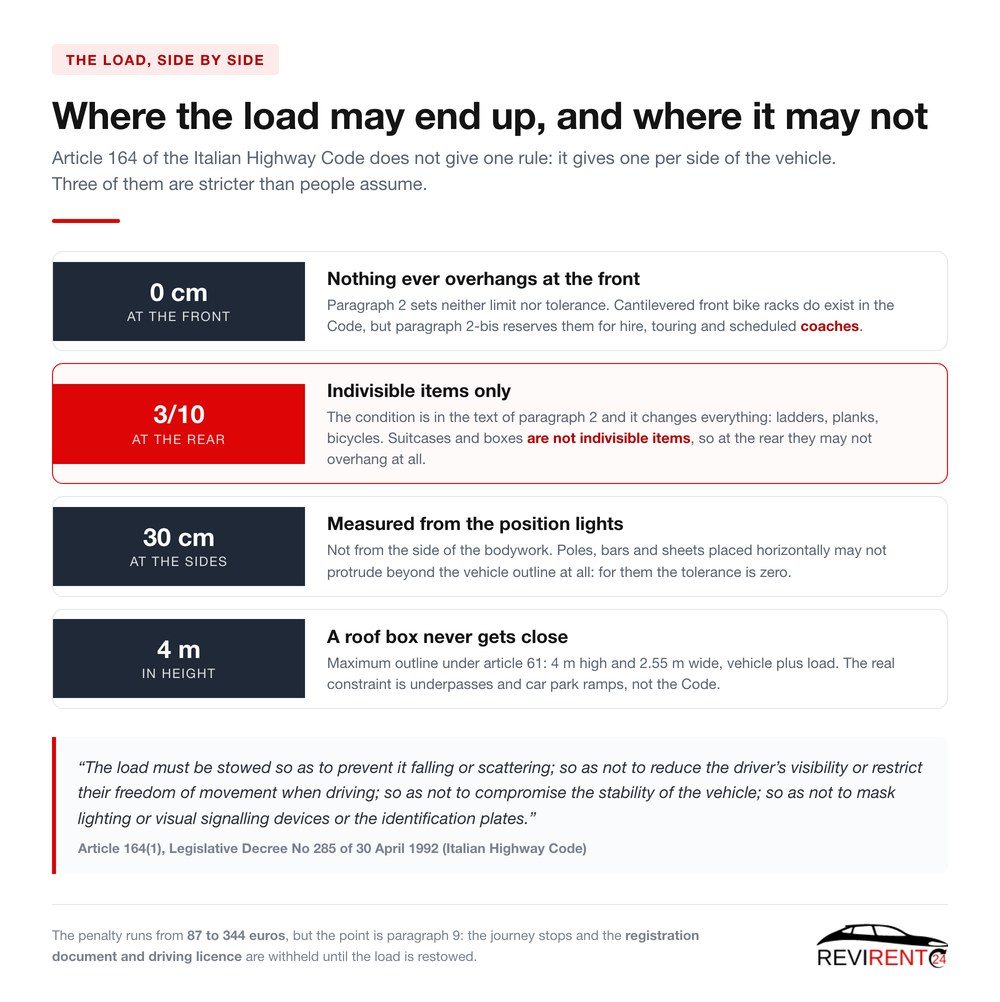
Article 164(2) is unusually blunt: the load "may not overhang longitudinally from the front of the vehicle". No limit, no tolerance, no panel that makes it acceptable. Nothing overhangs at the front, full stop.
The only exception in the Code is paragraph 2-bis, and it is worth quoting because it proves the exception exists and was written for somebody else: "in the case of hire coaches, touring coaches and scheduled service buses, by way of derogation from paragraph 2, cantilevered bicycle-carrying structures may be fitted at the front", up to a maximum of 80 cm beyond the vehicle's own outline.
Coaches. Not cars. The very same list reappears in article 61, where ski racks, bike racks and luggage racks fitted on cantilever are allowed, again, to hire coaches, touring coaches and scheduled service buses. The legislator thought about front bike racks, regulated them, and reserved them for coaches.
So if you have seen a bike rack mounted at the front and assumed it works on a car too, the answer is no: what you saw was a coach, or it was outside the law.
The three tenths everybody quotes apply only to indivisible items
This is the figure that circulates more than any other, and it is the one told worst. Paragraph 2 says the load may overhang longitudinally at the rear "if it consists of indivisible items, up to 3/10 of the vehicle's length", still within the limits of article 61.
That condition is not a detail, it is the heart of the rule. The three tenths allowance exists because some things cannot be shortened, dismantled or split across two trips. A ladder, a plank, a dinghy, a bicycle on a rear rack: objects that are what they are.
Suitcases are not indivisible items. Nor are bags, boxes, sacks and cartons. They are loads that can be packed differently, reduced or carried in two runs, and for them the three tenths allowance does not apply at all. A bag strapped above the tailgate and overhanging at the rear is outside the law even if it barely protrudes, even if it is signalled, even if the panel is brand new.
On a 4.20 m car three tenths comes to roughly 1.26 m, but only for indivisible items. The distinction is worth remembering precisely because nobody makes it.
At the sides: thirty centimetres from the position lights
Paragraph 3 deals with the flanks and introduces an unusual yardstick. Items may be carried protruding laterally beyond the vehicle's outline "provided the protrusion on each side does not exceed 30 centimetres measured from the front and rear position lights", still within the limits of article 61.
The reference point is not the side of the car, it is the position lights. That measurement has to be taken from the right place, and it is usually stricter than people imagine, because on many cars the position lights sit inboard of the widest part of the bodywork.
The same paragraph closes with a flat prohibition: "poles, bars, sheets or similar loads that are hard to perceive, placed horizontally, may not in any case protrude laterally beyond the vehicle's own outline". For those objects there is no thirty-centimetre tolerance: zero.
The red and white striped panel, as it really is
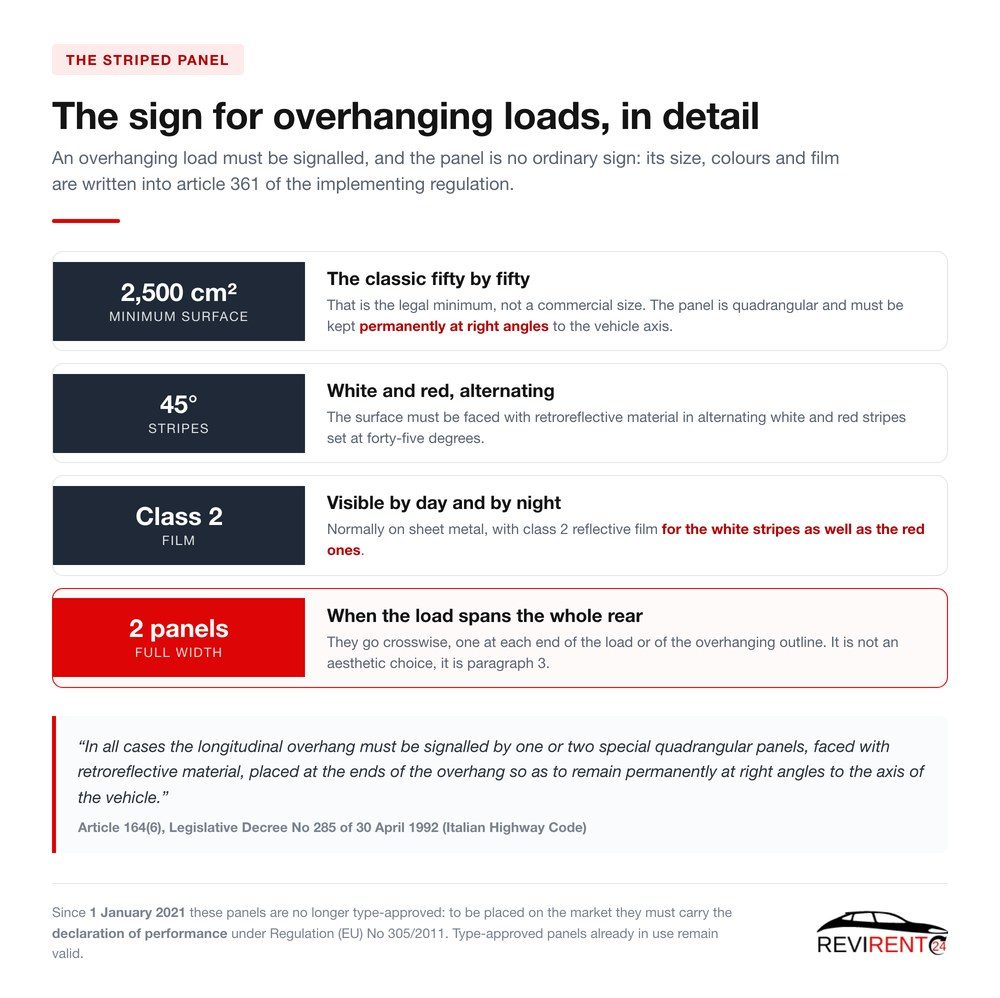
When the load goes beyond the outline, paragraph 6 requires every suitable precaution to avoid danger to other road users, and in all cases requires any longitudinal overhang to be signalled with one or two quadrangular panels faced in retroreflective material, placed at the ends of the overhang and kept permanently at right angles to the vehicle's axis.
The specifications sit in article 361 of the implementing regulation, Presidential Decree 495 of 1992, and they are more precise than people expect. The panel must have a minimum surface of 2,500 square centimetres, the classic fifty by fifty, faced with retroreflective material in alternating white and red stripes set at 45 degrees. It must be visible by day and by night, and is normally made of sheet metal with class 2 reflective film, for the white stripes as well as the red ones.
Where the load overhangs across the full width of the rear of the vehicle, there must be two panels, one at each end. That is not an aesthetic choice, it is article 361(3).
There is a further detail for anyone buying one today. Until 2020 the panel was a device type-approved under article 45 of the Code; since 1 January 2021, following the decree that updated articles 192 and 361 of the regulation, panels placed on the market must carry only the declaration of performance provided for by Regulation (EU) No 305/2011. Type-approved panels already in use remain valid and do not need replacing.
One curiosity for those who like reading sources: article 361 of the regulation refers to "article 164, paragraph 9" of the Code, but the panel duty today sits in paragraph 6. The cross-reference was left behind by later rewrites of the article, as happens elsewhere in the Code. The duty stands; it is the paragraph number that has aged.
The plate and the lights: what catches almost every bike rack
Back to paragraph 1, because this is where the real contest happens. The load must not mask lighting or visual signalling devices, nor the identification plates. A rear bike rack loaded with bicycles almost always covers both: the plate and the light clusters.
The obvious next question is whether a repeater plate solves it. In the Italian Highway Code the repeater plate does exist, but article 100 provides for it in one case only, at paragraph 4: trailer dollies, when hitched to a towing vehicle, must carry at the rear a plate repeating the towing vehicle's registration details. There is nothing comparable for a bike rack fitted to a car.
So the rule comes down to a single sentence: on a car, the plate and the lights must stay visible as they are. Serious bike racks solve this with an integrated light bar and a plate holder; the ones strapped to the tailgate, almost never. And on a rental car the plate is not your business at all, it belongs to the company that holds the registration.
| Where the load ends up | What the Code says | Reference |
|---|---|---|
| At the front | No overhang, no tolerance | Art. 164(2) |
| Front cantilevered bike rack | Hire, touring and scheduled coaches only, up to 80 cm | Art. 164(2-bis) |
| At the rear, indivisible items | Up to 3/10 of the vehicle's length | Art. 164(2) |
| At the rear, suitcases and boxes | No overhang allowed: they are not indivisible items | Art. 164(2) |
| At the sides | Max 30 cm from the position lights | Art. 164(3) |
| At the sides, horizontal poles and sheets | Never beyond the vehicle's outline | Art. 164(3) |
| In height | Vehicle plus load within 4 m, width within 2.55 m | Art. 61(1) |
| Over plate and lights | Prohibited in all cases | Art. 164(1) |
What it costs, and why the journey stops there
The penalty under article 164 sits in paragraph 8 and runs from 87 to 344 euros, amounts updated by the decree of 31 December 2020 in force since 1 January 2021. It is not a frightening figure, and indeed it is not the problem.
The problem is paragraph 9. The vehicle may not continue its journey until the driver has restowed the load, and to secure that outcome the officer proceeds to the immediate withdrawal of the registration document and of the driving licence, recording it in the report. The documents come back when the load is right.
On a rental car that sentence weighs double, for two reasons. The first is that the registration document is not yours: article 180(4) allows vehicles hired without a driver to carry, in place of the registration document, a photocopy certified by the owner, and that is exactly the sheet you will find in the document wallet of the car you picked up. What gets withheld is a company document.
The second is time. Article 362 of the regulation draws a distinction: if the load can be restowed immediately, the documents are handed back on the spot, after the officer has checked and noted it in the report; if restowing is deferred, the documents must be requested from the command the officer belongs to. Translated into a holiday afternoon: if you cannot fix it there, you are left without a licence and have to go and collect it.
| Breach | Penalty | What happens on the spot | Reference |
|---|---|---|---|
| Load badly stowed or overhanging beyond the limits | 87 to 344 euros | Registration document and licence withheld until restowed | Art. 164(8) and (9) |
| Exceeding the maximum outline | 421 to 1,691 euros | Article 164(9) applies | Art. 61(7) |
| Modifications not recorded on the registration document | 430 to 1,731 euros | Registration document withdrawn | Art. 78(3) and (4) |
| Luggage restricting movement or visibility | 87 to 344 euros | The driver answers for it | Art. 169(1) and (10) |
| Gross weight exceeded on a van | 42 to 1,734 euros depending on the excess | Above 5% the journey resumes only after unloading | Art. 167(3) and (10) |
A tow bar is not an accessory
Many bike racks mount on the tow ball, and it is the best solution: it keeps lights and plate in view and puts the weight on the chassis. The trouble is that on a rental car the tow bar is either already there or cannot be added.
Article 78 of the Code provides that vehicles must undergo inspection and testing at the offices of the Land Transport Department whenever changes are made to their construction or functional characteristics or to their equipment, and that the registration document is updated accordingly. Article 236 of the regulation adds that for a list of items, including the maximum towable mass, the change requires the manufacturer's clearance, and that the update is carried out by issuing a duplicate registration document.
A duplicate registration document for a car that is not yours, requested by you, on holiday. The route simply does not exist for someone renting. And driving a modified vehicle without the required inspection and testing costs 430 to 1,731 euros, with withdrawal of the registration document as an ancillary penalty.
The practical conclusion is simple: you ask for a tow bar when you book, you do not fit one. The same logic applies to winter equipment, which is arranged before collection.
Inside the cabin: the bag that takes your movement away
Not all of the load goes outside. In fact most trips end with the boot filled to the roof lining and the last bag on the seat. There is a rule for that too, and it is article 169.
Paragraph 1 states that in every vehicle the driver must have the fullest freedom of movement to perform the manoeuvres needed to drive. Paragraph 4 adds that passengers must take their places so as not to restrict the driver's freedom of movement or obstruct their visibility. Breaching these provisions costs 87 to 344 euros under paragraph 10.
The classic case is luggage stacked above the seat backs, which wipes out the interior mirror. A covered rear window is not in itself prohibited, provided the exterior mirrors give the required visibility, but loading in a way that costs you visual and manoeuvring control is. It is another reason to stow the luggage properly at the start, rather than badly and then "fix it" on the motorway.
The moving van, and who pays alongside you
If the load really is that big, the answer is not the car roof: it is a van. But there is a number to respect there too, and it is not the capacity in cubic metres.
Article 167 opens with a single sentence: motor vehicles and trailers may not exceed the gross weight stated on the registration document. For vehicles up to 10 tonnes, which covers every van normally hired out, the penalties in paragraph 2 apply in bands calculated as a percentage of the gross weight: up to 5 per cent, up to 15, up to 25, above 25. They start at 42 euros and reach 1,734 euros.
Two further paragraphs change the picture on a hired vehicle. Paragraph 10 provides that where the excess is above 5 per cent, continuing the journey is conditional on reducing the load: with a full van, in the middle of a house move, that means unloading on the spot.
Paragraph 9 matters even more: the penalties apply both to the driver and to the owner of the vehicle. On a hired van the owner is the company, which is drawn in by law and not by a clause in the contract. It is the strongest reason to ask for the real payload before loading, rather than guessing it by eye.
What to ask Revirent24 before you load
The Code's rules apply to any car. What changes from one company to another is the contract, and the useful questions to ask at booking are few and specific:
whether the model you have chosen already has roof bars or a tow bar, and whether they are recorded on the registration document
whether the contract allows a box or a bike rack to be fitted to those bars
what the van's gross weight is, and how much payload is left once the kerb weight is deducted
whether the panel for overhanging loads is supplied with the vehicle or has to come from home
what to do if you are stopped and the certified copy of the registration document is withheld
Revirent24's telephone support answers every day from 8:30 to 19:00 on +39 378 303 5305, and the staff also reply at info@revirent24.it. The fleet includes cars, vans and minibuses, and the branches across Chiusi, Montepulciano, Chianciano Terme, Città della Pieve and San Casciano dei Bagni let you collect and return wherever suits the trip best.
If you are getting ready to set off, it is worth reading what to check before picking up the car, who may drive the rental car and, if you are travelling with small children, the child seat rules. For the cost of the trip, the pages on motorway tolls and on who pays the fines remain useful.
The rules cited are Legislative Decree No 285 of 30 April 1992 (the Italian Highway Code), articles 61, 78, 100, 164, 167, 169 and 180, and Presidential Decree No 495 of 16 December 1992 (implementing regulation), articles 236, 361 and 362, in the text in force as consulted on Normattiva. Penalty amounts are those updated by the decree of 31 December 2020, in force since 1 January 2021. Revirent24's contractual conditions should be checked with the staff: the site does not publish detailed guidance on bars, roof racks and loads.