Who can drive a rental car in Italy: authorised driver, additional driver and what is at stake
Letting someone else drive your rental car in Italy is not a fine and does not void the insurance: it is a breach of contract, and it only surfaces when something goes wrong. What the Italian Highway Code actually says, why article 84 does not apply and how the insurer's right of recourse sends the bill to whoever signed.

In summary
The things you need to know right away
- The law does not name the driverThe Italian Highway Code asks only for a valid licence: no rule requires the driver to be the person who signed the rental.
- The contract decidesThe authorised driver is named on the contract. If someone else drives you do not get a fine, you get a breach of contract.
- The bill comes laterThe injured party is compensated anyway, then the insurer exercises its right of recourse and the extra cover does not apply.
In this guide (13)
- 1The question hardly anyone asks at the desk
- 2What the Italian Highway Code actually says
- 3Why article 84 has nothing to do with your holiday
- 4The contract is where the driver is decided
- 5The insurance is not voided, and this is the misunderstood part
- 6The right of recourse, the mechanism that sends the bill to you
- 7The extra cover is the first thing to go
- 8If the driver has no licence, the penalties become two
- 9The documents to carry, and the photocopy that counts
- 10Adding a second driver, and why it has to be done first
- 11Four real cases, and how they end
- 12Who can drive a Revirent24 car
- 13The question to ask before you set off
It happens on the motorway, three hours into the drive, when somebody says "my turn" and reaches for the keys. Or outside a farmhouse, when someone has to drive down for groceries and the only person awake is not the one who signed. At that moment almost nobody thinks about the rental agreement, because the question seems trivial: what harm can it do if someone else drives, as long as they hold a licence.
There is harm, but not where people imagine it. It is not a fine, it is not a criminal offence and, in the vast majority of cases, it is not even a matter of insurance being "void". It is a breach of contract, and it only shows up when something goes wrong. At that point, though, the bill arrives in full.
The question hardly anyone asks at the desk
When the car is handed over the questions are always the same: what time do I bring it back, how does the fuel policy work, where do I pick up the toll device. Who is allowed to take the wheel is asked by one person in ten, and usually by someone who has been through it before.
There is not one answer, and that is where the confusion starts. Three different levels answer the same question in different ways: the Italian Highway Code, the rental agreement and compulsory insurance. None of the three works the way people assume, and keeping them apart is the only way to see what is actually at stake.
What the Italian Highway Code actually says
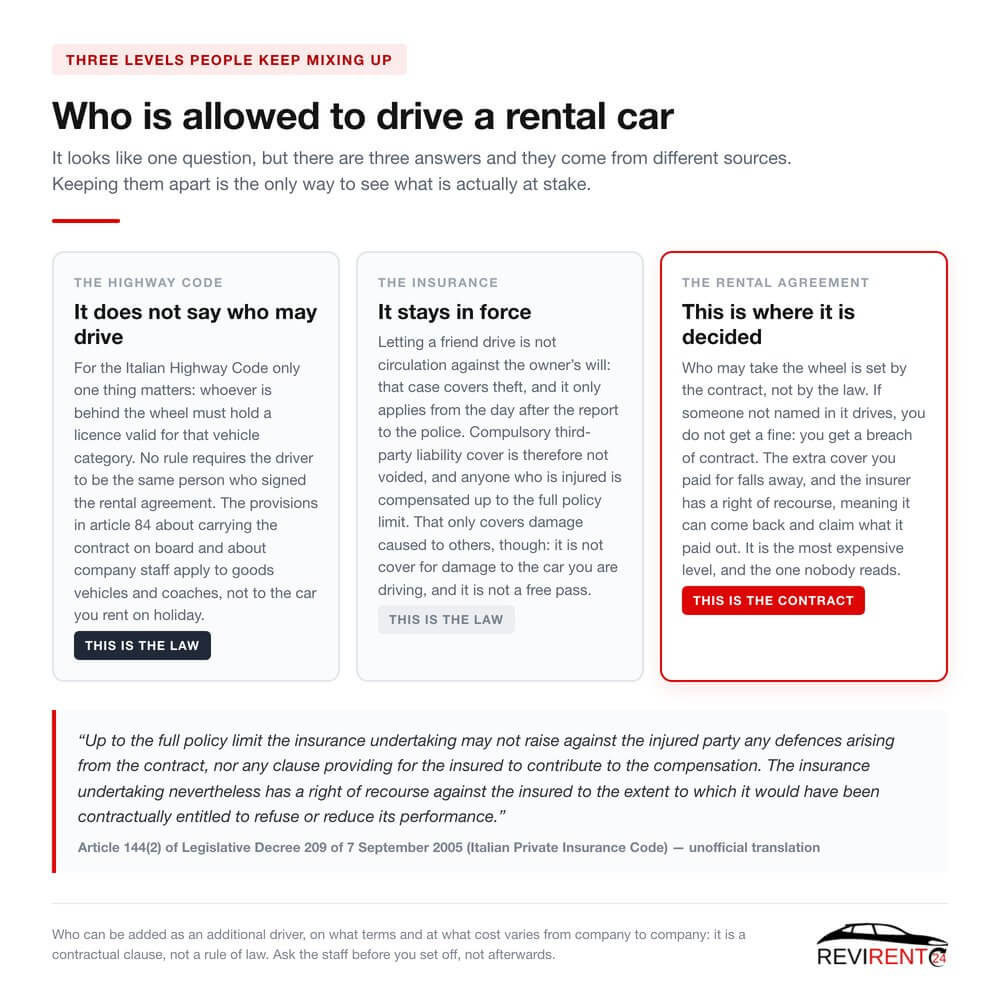
Less than you would expect. For the Highway Code only one thing matters, and it is written in article 116(1): you may not drive a motor vehicle without having obtained a driving licence valid for the corresponding category. That is it.
No rule requires the driver of a rental car to be the same person who signed the contract. There is no statutory obligation to be an "authorised" driver. If a patrol stops you and you hold a valid licence, the car is in order and the documents are on board, the check ends there: nobody asks who took out the rental, and there is no report to write.
This is the first thing to get straight, because it dismantles the most widespread fear, the fine. The penalty does not come. Something else does.
Why article 84 has nothing to do with your holiday
Anyone searching online almost always lands on article 84 of the Highway Code, the one actually headed "Hire without a driver". It contains two rules that look decisive: the hired vehicle must be driven by the staff of the undertaking using it, and the hire contract or a certified extract of it must be kept on board.
They look decisive, but they do not apply to your situation. Those two rules sit in paragraphs 4-ter and 4-quater, and paragraph 4-ter expressly states that they apply to the vehicles "referred to in paragraphs 2 and 3": that is, lorries, tractor units, trailers, road trains and articulated vehicles used in haulage for hire or reward, and the coaches of passenger transport companies. These are the rules of industrial hire between European companies, written to stop a lease being used to disguise a supply of labour.
The car you pick up for the weekend falls instead under paragraph 4(b-bis), covering vehicles with up to nine seats used to carry passengers. For that category article 84 says absolutely nothing about who may drive. The silence is deliberate: the law leaves the matter to the contract.
The contract is where the driver is decided
What the law does not say, the sheet you signed does. The rental agreement names the authorised driver or drivers, and that clause is the heart of the whole relationship: the rental company agrees to hand over an asset worth tens of thousands of euro on the basis of who that person is, what licence they hold and how long they have held it.
If somebody else takes the wheel, no public rule is broken, a private agreement is. The difference is not academic: it completely changes who presents the bill, and when.
The insurance is not voided, and this is the misunderstood part
"If an unauthorised person drives, the insurance is void" is the line you read everywhere, and it is wrong. Compulsory third-party liability cover is not voided.
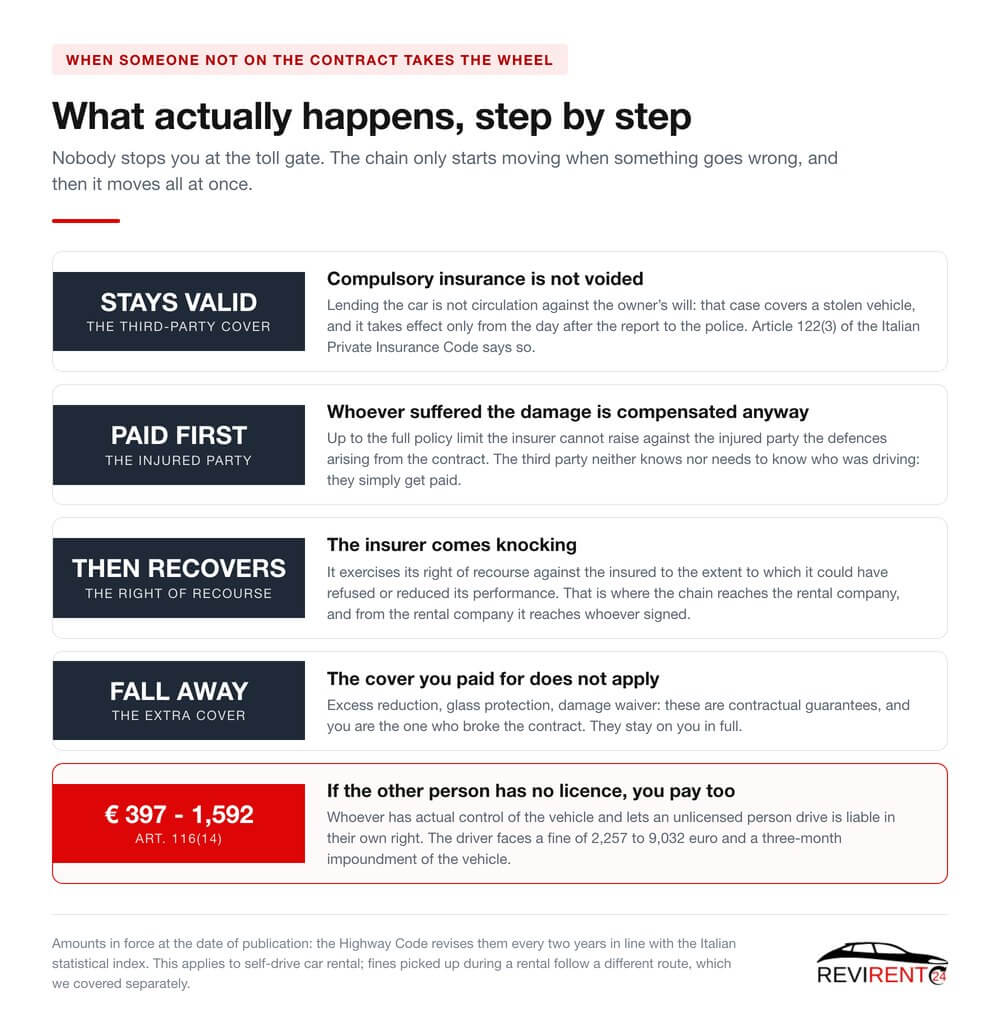
The Italian Private Insurance Code, in article 122(3), provides for one single case in which cover ceases to have effect: circulation occurring against the owner's will. That describes a stolen vehicle, not a lent one, and it only takes effect from the day after the report filed with the public security authority. Handing the keys to your wife is not circulation against anyone's will.
There is more. Article 144(2) of the same Code establishes that, up to the full policy limit, the insurance undertaking may not raise against the injured party any defence arising from the contract. That means that if you hit a cyclist, that cyclist is compensated. In full. They are not asked who was driving, they are not told the rental was in someone else's name, no clause is raised against them. The insurer simply pays.
On top of that, article 122(2) provides that the insurance covers liability for personal injury caused to those carried in the vehicle, whatever the basis on which they are carried. Even the passengers travelling with the unauthorised driver are covered for personal injury.
The right of recourse, the mechanism that sends the bill to you
But the same sentence in article 144(2) carries on, and the second half is the part nobody quotes: the insurance undertaking nevertheless has a right of recourse against the insured to the extent to which it would have been contractually entitled to refuse or reduce its performance.
In plain terms: the company pays the injured party because it is obliged to, and immediately afterwards it turns to its own insured, the company that owns the vehicle, and asks for that money back. The rental company in turn goes to whoever signed the contract, because that is the person it has an agreement with.
The reason the company stays in the middle of the chain is article 2054 of the Italian Civil Code: the owner of a vehicle is jointly liable with the driver unless the owner proves that the vehicle was driven against their will. Having handed you the keys of its own accord, the company cannot offer that proof, and it does not try: it simply turns to you, the person who passed those keys on.
The result is that the compensation was not paid by the insurance: it was paid by you, a few months later. This is why "the insurance will cover it" is a dangerous thing to say. The insurance is there, it works, and then it sends the bill to whoever broke the deal.
The extra cover is the first thing to go
Before the right of recourse there is a more immediate and far more frequent loss. When you rent, you are offered additional cover: excess reduction or waiver, glass and tyre protection, damage waiver on the vehicle, enhanced roadside assistance. Those are not compulsory insurance, they are contractual products, and they operate on the terms of the contract.
If the contract says the vehicle is entrusted to one person and somebody else is driving it, that cover does not operate. Damage to the car stays entirely with whoever signed, excess included, even though they paid precisely in order not to have one. It is the most common sting: you spend money to sleep soundly and then lose the cover over a twenty-minute swap at the wheel.
The same goes for damage that involves no third party at all. A wing mirror against a wall in a hill town, a rim ruined on a pothole, the underbody on a gravel track: there is no injured party to compensate, only a car to repair, and the cost falls directly on the person who rented it.
If the driver has no licence, the penalties become two
The picture changes completely when the other person has no licence, has lost it or never obtained one. Here the Highway Code does step in, and it hits both of you.
Article 116(14) penalises anyone who, having actual control of a vehicle, entrusts it to or allows it to be driven by a person who has not obtained the corresponding licence. You do not need to be the owner: having actual control of the vehicle is enough, and whoever rented it has exactly that. The administrative penalty runs from 397 to 1,592 euro.
The driver answers separately under paragraph 15, with a fine of 2,257 to 9,032 euro, rising to imprisonment of up to one year in the event of a repeat offence within two years. Paragraph 17 then attaches to paragraph 15 and provides for the vehicle to be impounded for three months: an impoundment on a car that is not yours and that you have to give back.
| Situation | Who answers | How much | Source |
|---|---|---|---|
| A person with a valid licence drives, but is not named in the contract | Whoever signed the rental | No Highway Code penalty. The extra cover falls away and the insurer exercises its right of recourse | Art. 144(2), Private Insurance Code |
| You entrust the car to someone who never obtained a licence | Whoever hands over the vehicle | From 397 to 1,592 euro | Art. 116(14), Highway Code |
| You drive without ever having obtained a licence | The driver | Fine of 2,257 to 9,032 euro, imprisonment up to one year on a repeat offence within two years | Art. 116(15), Highway Code |
| Additional consequence of driving without a licence | The vehicle | Impounded for three months | Art. 116(17), Highway Code |
| One of the compulsory documents is missing on board | The driver | From 42 to 173 euro | Art. 180(7), Highway Code |
Administrative penalty amounts are revised every two years in line with the change in the consumer price index: the figures given here are those in force at the date of publication.
The documents to carry, and the photocopy that counts
Article 180 lists what the driver must have with them: the vehicle registration document, a licence valid for the vehicle category and the compulsory insurance certificate. The rental agreement is not on that list, for cars with up to nine seats.
There is a detail that concerns rental vehicles specifically, though, and it is in paragraph 4: for vehicles used for hire without a driver, the registration document may be replaced by a photocopy certified by the owner and bearing the owner's signature. That is why the document wallet holds a copy rather than the original, and it is perfectly valid: the original stays with the company, which has to be able to produce it for dozens of vehicles at once.
If that copy is missing, or if the insurance certificate is missing, the penalty is the one in paragraph 7, from 42 to 173 euro. It is worth checking everything is there before setting off, just as it is worth checking the condition of the car.
Adding a second driver, and why it has to be done first
The fix for all of this is simple and takes two minutes: add the second driver to the contract. In practice it means showing the second person's licence and having them named on the agreement, usually with their signature.
The terms vary from company to company, because, as we have seen, they are not set by law. Minimum age and minimum licence seniority vary, any supplement varies, the maximum number of additional drivers varies. That is why it makes no sense to trust what you read in general: ask the company you are renting from, and ask before.
The important point is that the addition has to be made when you rent, or in any case before the keys change hands. Adding a driver after an accident is worthless: what counts is who was authorised at the moment the event happened.
Four real cases, and how they end
| The case | How it ends |
|---|---|
| Your wife is on the contract as second driver and scrapes the car in a car park | Everything is in order. The excess and any extra cover you took out apply, exactly as if you had been driving |
| A friend with a twenty-year-old licence drives for half an hour and nothing happens | Nothing happens, indeed. The risk does not surface until there is an event: that is precisely what makes the habit dangerous |
| The same friend, not on the contract, rear-ends another car | The injured party is compensated by the insurer. The insurer then exercises its right of recourse, the rental company turns to you, and the extra cover does not operate |
| You lend the car to your son, who does not have a licence yet | A penalty of 397 to 1,592 euro for you, a fine of 2,257 to 9,032 euro for him and the vehicle impounded for three months |
Who can drive a Revirent24 car
With us the answer starts from the same rule as everywhere else: the person named on the contract drives. What is different is how easy it is to get the right name on it.
We are a local operation, with offices in Città della Pieve, at Chiusi station, in Montepulciano, in Chianciano Terme and in San Casciano dei Bagni, and a phone that is answered every day from 8:30 to 19:00. If two of you are travelling and want to take turns, just say so when you book and bring both licences to the pick-up: we sort it out on the spot. If it only occurs to you afterwards, a call to the number on our contact page is enough to work out what to do.
What we do not do is leave the question unanswered. The exact terms, the age and licence seniority requirements and any cost for the additional driver are things we tell you beforehand, not afterwards, because that is exactly the clause that decides who pays if something happens. In the meantime you can see which vehicles are available in our fleet and read the frequently asked questions.
The question to ask before you set off
It is not "can I let someone else drive". It is "who is named on my contract as the authorised driver, and how do I add the second person". Put that way, the answer takes thirty seconds at the desk and removes the only serious risk in this whole story.
Because the point is not the fine, which does not come. The point is that on the day something happens, the name written on that sheet decides who signs the cheque. It is worth making sure it is the right name.
If you want to go deeper into the practical side of renting, we have covered separately who pays fines picked up with a rental car, what to do after an accident, which documents and requirements you need in order to rent, the rules for newly qualified drivers and how it works with a foreign licence.
Sources
Italian Highway Code, Legislative Decree 285 of 30 April 1992, articles 84, 116 and 180. Italian Private Insurance Code, Legislative Decree 209 of 7 September 2005, articles 122 and 144. Italian Civil Code, article 2054. Texts consulted on Normattiva at the date of publication. Quotations from Italian legislation are unofficial translations.