Children in a rental car in Italy: child seat, the 1.50 m rule and the anti-abandonment device
The child seat does not depend on the child's age but on their height, and the exemption you read everywhere covers taxis, not the car you drive yourself. What Article 172 actually says, why the R44 seat you own can still be used, and how to meet the anti-abandonment duty in a car that is not yours.
In summary
The things you need to know right away
- Height counts, not ageArticle 172 requires a restraint system for children under 1.50 m in height. The twelve-years rule does not exist in the Italian Highway Code.
- The exemption is not yoursParagraph 4 exempts children in taxis and chauffeur-driven hire. Self-drive rental is not on that list, so the ordinary rules apply.
- The device follows the plateUnder four years an alarm device is required because the car is registered in Italy. It may be independent of the seat, so you can bring your own.
In this guide (13)
- 1The law measures children, it does not ask their age
- 2What "approved" means now, and the date that confuses everyone
- 3The R44 seat you already own can still be used
- 4The exemption you read about exists, but not for the car you drive
- 5The anti-abandonment device follows the car, not the driver's passport
- 6The three permitted forms, and the one that solves rental
- 7Do not look for an approval number: there is none
- 8The front airbag, the detail to check on an unfamiliar car
- 9When the vehicle has no restraint systems
- 10What getting it wrong costs, and who actually pays
- 11Four concrete situations, and how they end
- 12How to organise it with Revirent24
- 13The question to ask before you travel
It almost always happens the same way. The booking is done, the bags are in the hall, and two days before leaving someone in the family asks the most obvious question there is: "the child seat, do we bring ours or will we find one there?". At that point you open Google, and within ten minutes you have collected three different answers, all of them confident, and none of them saying where the rule comes from.
The reason is that two pieces of wrong information are in circulation, plus one true one that gets told badly. The first is that the child seat depends on the child's age. The second is that there is an exemption if an adult is travelling alongside. The third, the true one, concerns the anti-abandonment device, and almost nobody mentions that on a rental car the problem has one precise solution.
Everything is set out below, with the article of law next to each statement, so you can check rather than trust.
The law measures children, it does not ask their age
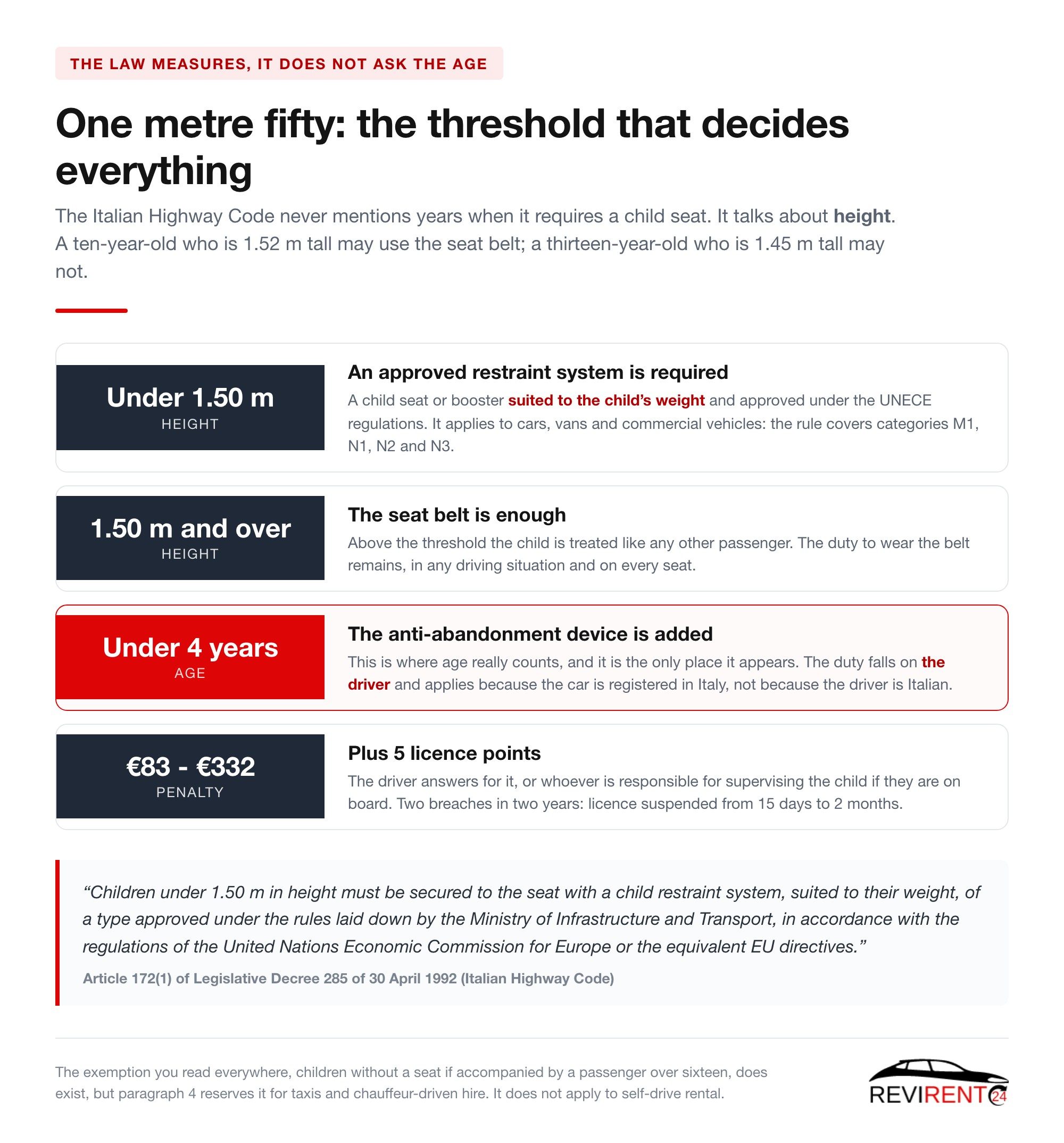
This is the point everything else depends on, and it is also the one most often got wrong. Article 172(1) of the Italian Highway Code states that children under 1.50 m in height must be secured to the seat with a restraint system suited to their weight and of an approved type.
Height. Not age. Nowhere in that paragraph does the word "years" appear in connection with the child seat. This has two very concrete and rather counter-intuitive consequences: a ten-year-old who has already passed one metre fifty may travel with the ordinary seat belt, while a thirteen-year-old who is one metre forty-five still needs a booster.
The widespread "twelve years" rule is not in the Italian Highway Code. It is a shorthand that circulates because by twelve most children have passed the threshold, but it is not the rule: the rule is a metre and a half, and that is what gets looked at if you are stopped.
What "approved" means now, and the date that confuses everyone
Paragraph 1 requires the restraint system to be approved "in accordance with the regulations of the United Nations Economic Commission for Europe or the equivalent EU directives". Behind that wording sit two regulations that coexist: the older R44, which classified seats by weight, and the more recent R129, the one everybody calls i-Size, which classifies them by height.
From 1 September 2023 Regulation R129 replaced R44, and from that date no new approvals are issued under the old standard. Commission Delegated Regulation (EU) 2022/1398 did however allow a run-off period: child seats already approved to R44 and placed on the market before that date could continue to be sold until 1 September 2024.
The R44 seat you already own can still be used
This is the part that causes the most anxiety, and the answer is reassuring. Those dates concern sale, not use. The European regulation speaks of "making available on the market" and "entry into service" of the product: it governs shops and manufacturers, not your family.
To know whether your seat is legal on the road you have to go back to paragraph 1, which asks for one thing only: that it be of a type approved under the UNECE regulations. R44 is a UNECE regulation. So an R44 seat in good condition, with a legible approval label and correctly installed, remains perfectly usable in Italy. There is no date after which carrying it in the car becomes unlawful.
Which, if you were wondering whether to buy a new one just for a week's holiday, changes the arithmetic considerably.
The exemption you read about exists, but not for the car you drive
Sooner or later you come across this sentence: children may travel without a child seat provided they are not in the front and are accompanied by a passenger of at least sixteen. It is not invented, it really is written in Article 172(4).
The problem is where that paragraph stops. The exemption applies to children carried "in motor vehicles for the public hire of passengers from a rank or in motor vehicles used for hire with a driver". In plain terms: taxis and chauffeur-driven hire, the cases where a professional is at the wheel and you are stepping into a vehicle you neither chose nor prepared.
Self-drive rental, where you drive the car you booked yourself, does not appear in that list. And in a list of exemptions, what is not written does not apply by analogy. So: if you take a taxi from Chiusi station with your child, you fall under paragraph 4; if you take the same road in the car you rented, you do not.
It is the same structure we have met before when writing about pets on board and who may drive a rental car: a rule designed for public transport quoted as though it applied to everyone.
The anti-abandonment device follows the car, not the driver's passport
Here comes the obligation that most surprises visitors from abroad, and quite a few Italians who do not often travel with small children.
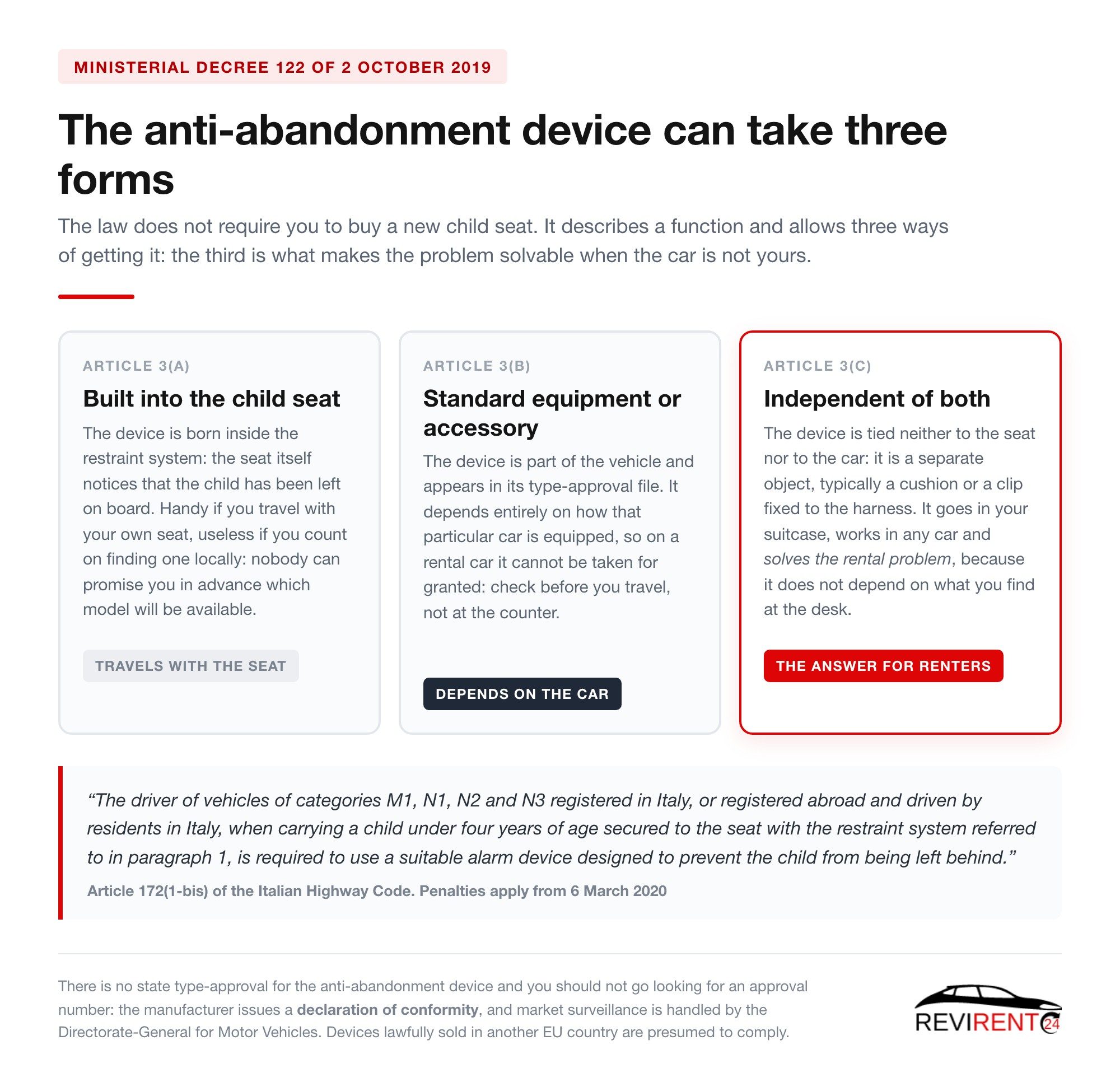
Article 172(1-bis) states that the driver of vehicles in categories M1, N1, N2 and N3 registered in Italy, or registered abroad but driven by residents in Italy, when carrying a child under four years of age secured with the restraint system, must use a suitable alarm device to prevent the child from being left behind.
Read it again, watching the criterion: what counts is where the car is registered. A rental car collected in Italy is registered in Italy, always. So the duty applies to a Dutch or American family on holiday in Val d'Orcia too, who may never have heard of such a device at home. It is not the driver's nationality that triggers it, it is the number plate.
And it is a duty of the driver, not of the rental company: the rule addresses whoever is at the wheel. Penalties have applied since 6 March 2020.
The three permitted forms, and the one that solves rental
The good news is that the law describes a function, not a compulsory product. Ministerial Decree 122 of 2 October 2019, in Article 3, allows three different forms of anti-abandonment device: built into the child seat at manufacture, standard equipment or an accessory of the vehicle included in its type-approval file, or independent of both the seat and the car.
The first two depend on things you do not control on a rental car. If the device is inside the seat, you need that seat. If it is a vehicle accessory, it depends on how that particular car is equipped.
The third is the one that solves the problem: a separate object, typically a cushion placed on the seat pan or a clip attached to the child seat harness, which works in any car and fits in your suitcase. It is the practical answer for anyone renting, because it does not depend on what you find at the desk.
Do not look for an approval number: there is none
Many parents waste time hunting on the device for a ministerial approval number, and do not find it because it does not exist.
Decree 122/2019 does not provide for state type-approval of these devices. It is the manufacturer who draws up a declaration of conformity, following the model in Annex B, taking responsibility for compliance with the required technical characteristics. Market surveillance falls to the Directorate-General for Motor Vehicles, which means it operates afterwards, on products already on sale.
Article 7 adds something useful for visitors: devices lawfully marketed in another European Union country, in Turkey or in an EEA State are presumed to comply. If you bought it properly in Germany or France, it is fine.
As for the characteristics, Annex A requires the device to activate by itself on every use without the driver having to do anything, to confirm that it has activated, and in the event of an alarm to give visual signals accompanied by audible signals or vibration, perceptible inside or outside the vehicle.
The front airbag, the detail to check on an unfamiliar car
Paragraph 5 is unambiguous: children may not be carried in a rearward-facing child seat fitted to a passenger seat protected by a front airbag, unless that airbag has been deactivated.
In a car you know, this is automatic. In a rental car it is not: the location of the control varies from model to model, sometimes it is a key slot in the side of the dashboard, sometimes it sits in the instrument cluster menu, and on some cars deactivation is simply not provided for.
Which is why there is only one practical rule, and it is also the safest: the child seat goes in the back. If for some reason it has to go in the front, that is something to check calmly at pick-up, along with the rest of the checks to make before setting off, not on the motorway.
When the vehicle has no restraint systems
There is one case that closely concerns anyone renting a van for a move or a nine-seater for a group, and paragraph 3 treats it far more strictly than you might expect.
In vehicles of categories M1, N1, N2 and N3 without restraint systems, children up to three years of age may not travel at all. Not "without a child seat": they may not travel. Children over three may occupy a front seat only if they are taller than one metre fifty.
It is worth noting that Article 172 does not speak only of cars: categories N1, N2 and N3 are goods vehicles. Vans and commercial vehicles therefore fall under the same duty, and there the presence of suitable anchorage points in the back is far less of a given than in a saloon.
What getting it wrong costs, and who actually pays
Paragraph 10 sets the penalty for failure to use restraint systems and also the alarm device: from 83 to 332 euro, amounts updated by the decree of 31 December 2020 and in force since 1 January 2021. The table annexed to the Highway Code adds the deduction of 5 licence points.
Then there is a detail almost nobody knows, and it is worth reading carefully, because it overturns the assumption that the driver always pays. Where the failure concerns a minor, the driver is liable or, if they are in the vehicle at the time, whoever is responsible for supervising the minor.
In a real situation: if you are driving and the grandparent accompanying the child is in the back, the notice may be issued to them. It is a liability that follows whoever has charge of the child, not only whoever holds the wheel.
Finally, repeat offences: if within two years the driver commits this breach twice, the second one carries suspension of the licence from fifteen days to two months.
| Situation | What the rule says | Reference |
|---|---|---|
| Child under 1.50 m | Approved restraint system, suited to the weight | Art. 172(1) |
| Child 1.50 m and over | Seat belt, like any other passenger | Art. 172(1) |
| Child under 4 years | The anti-abandonment device is added | Art. 172(1-bis) |
| Rearward-facing seat in front | Prohibited if the front airbag is active | Art. 172(5) |
| Vehicle without restraint systems | Children up to 3 may not travel | Art. 172(3)(a) |
| Taxi and chauffeur-driven hire | Exempt, if not in front and with a passenger of at least 16 | Art. 172(4) |
| Self-drive rental | No exemption: the ordinary rules apply | Art. 172(4), by implication |
Four concrete situations, and how they end
Family with a two-year-old, car rented in Chiusi for a week. An approved child seat is required, because she is under a metre and a half, and the anti-abandonment device is required too, because she is under four and the car is registered in Italy. The seat from home, even an R44, is perfectly fine.
Couple with an eleven-year-old who is 1.55 m tall. Nothing special is needed: he is past the threshold, he travels with the belt. Age does not come into it, in either direction.
Grandparents taking a three-year-old grandchild on a day trip. A child seat is required and so is the anti-abandonment device. And if a notice is issued, it may be made out to whoever has charge of the child, not necessarily to whoever was driving.
A group renting a nine-seater. Before counting the children you need to count the anchorage points and check which seats have restraint systems: in a vehicle without them, children up to three may not travel, and there is no way around it.
How to organise it with Revirent24
The legal part ends here, and the practical part is simple: the availability of child seats, the models, the size ranges covered and the conditions change from season to season and from branch to branch, so it is something to agree with the staff when you book, not to discover at pick-up.
The honest advice, if you are travelling with a child under four, is to pack an independent anti-abandonment device. It weighs almost nothing, works in any car in our fleet and removes the one variable you cannot control from a distance.
For everything else, telephone support answers every day from 8:30 to 19:00, and the branches are listed on the Our locations page. If you are setting off with small children and want to reach the desk without surprises, write or call us beforehand: a two-minute call when you book settles what otherwise becomes a problem with the bags already in the car.
The question to ask before you travel
It is not "do I need a child seat". You already have that answer: it depends on how tall your child is, and the threshold is one metre fifty.
The right question is a different one: under four years of age, what am I using to meet the anti-abandonment duty in a car that is not mine? Because that is the only part you cannot improvise at the desk, and it is also the only part that depends entirely on you.
If this was useful, on related topics we have also written about the documents and requirements needed to rent, who pays fines incurred with a rental car, what to do after an accident and how winter tyres and snow chains work.
Sources
Italian Highway Code, Legislative Decree 285 of 30 April 1992, Article 172 and the annexed penalty-points table, text consulted on Normattiva at the date of publication. Decree of the Ministry of Infrastructure and Transport 122 of 2 October 2019, published in the Gazzetta Ufficiale, General Series, no. 249 of 23 October 2019. Commission Delegated Regulation (EU) 2022/1398 of 8 June 2022, in the Official Journal of the European Union L 213 of 16 August 2022. Penalty amounts updated by the decree of 31 December 2020, in force since 1 January 2021.