

Renting a van for your move is almost always the simplest and cheapest way to shift furniture, boxes and appliances without making dozens of trips in your car. The real question is rarely where to find a van: it's which size you actually need, how much it costs and how to organise the day so you don't waste time (and money).
This practical guide covers everything you need to choose wisely: the van categories and how many cubic metres they carry, the factors that set the price, what your driving licence lets you drive, and a checklist for a stress-free move. With Revirent24 you can also rent without a credit card — a real advantage when you only need the van for a day or two.
Whether you're clearing a studio flat or moving a family home, it all comes down to one thing: how big does the van need to be, and what will it cost? Let's start there.
Why renting a van for your move makes sense
Anyone facing a move has three options: borrow a friend's van, hire a full-service removal company, or rent a van and handle the loading yourself. The first is rarely available exactly when you need it; the second costs far more because you're also paying for labour.
Renting is the smart middle ground. The main benefits:
Pay only for what you use: a day, a weekend or a few days, without the fixed costs of ownership (road tax, annual insurance, maintenance).
A recent, reliable vehicle: a van in good condition cuts the risk of a breakdown on the worst possible day.
Flexible sizing: choose the load volume based on what you're moving, rather than adapting to whatever vehicle you happen to have.
Insurance included: the vehicle travels covered, with options you can strengthen for extra peace of mind.
And no long-term commitment: once the move is done, you hand back the keys and you're finished.
What size of van do you need for your move?
This is the key question. Underestimate and you'll make more trips (more fuel, more hours, more fatigue); overestimate and you'll pay for a bigger vehicle than needed and one that's harder to manoeuvre in town. As a general guide, vans fall into four broad categories by load volume, measured in cubic metres (m³):
| Category | Approx. volume | Ideal for |
|---|---|---|
| Small van (e.g. Fiat Doblò, Citroën Berlingo) | 3–4 m³ | A few boxes, one appliance, a single room. |
| Medium van (e.g. Citroën Jumpy, Peugeot Expert, Fiat Scudo) | 5–8 m³ | A studio or one-bedroom flat with flat-packed furniture. |
| Large van (e.g. Fiat Ducato, Citroën Jumper) | 10–13 m³ | A furnished 2–3 room apartment with sofa, beds and wardrobes. |
| Maxi / long-wheelbase van | 15–20 m³ | A larger home or a full move, to cut it down to a single trip. |
Indicative volumes for guidance only: real capacity varies by model. For up-to-date availability, contact the Revirent24 team.
A rule of thumb: a studio usually fits in a medium van, a two- or three-room flat in a large one. If you have lots of bulky items (wardrobes, sofas, big appliances), size up: a single trip with a roomy vehicle almost always costs less than two trips with a small one.
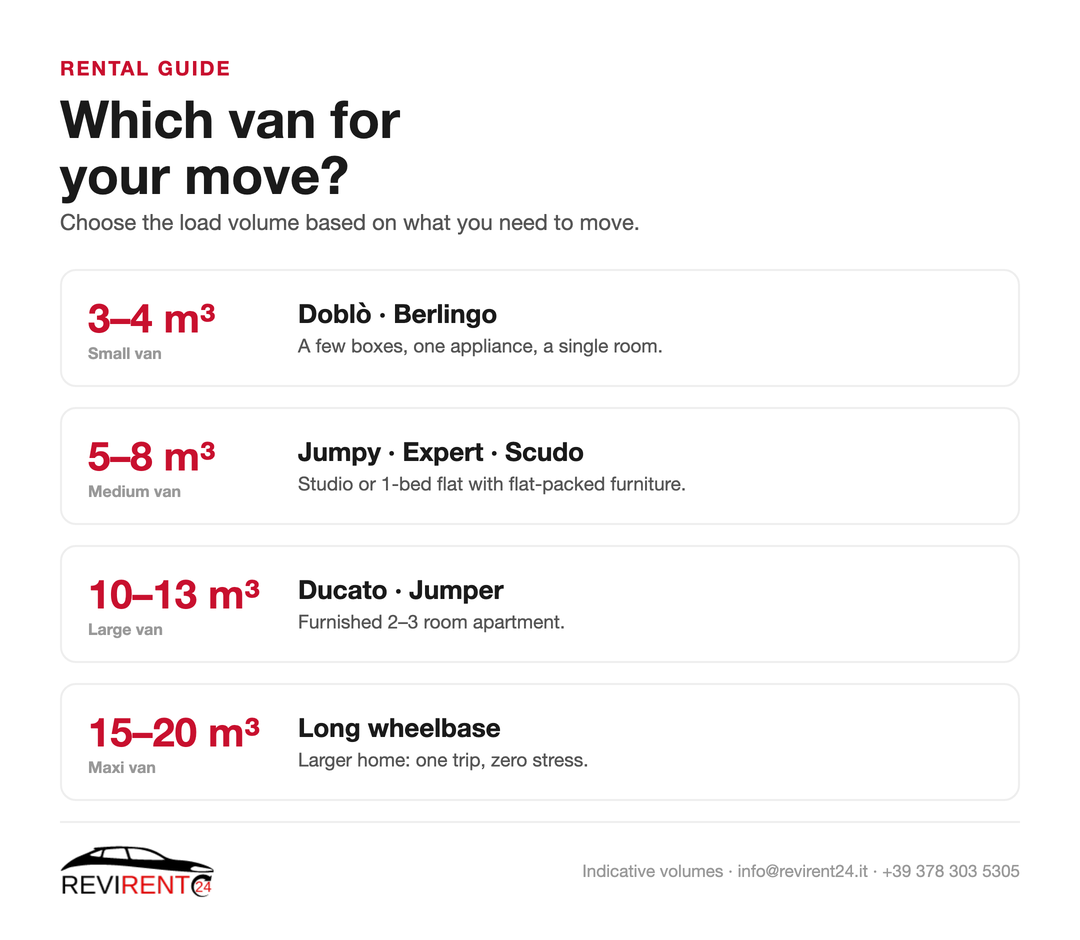
How to choose the right van size based on what you need to move.
How much does it cost to rent a van for a move?
There's no single price, because the cost depends on a few factors worth knowing before you ask for a quote:
Vehicle size: more cubic metres, higher daily rate.
Rental duration: half a day, a full day or a weekend. The daily cost often drops as the number of days increases.
Expected mileage: some packages include a set number of kilometres; going over adds a charge. It matters little for a move within town, more for one across provinces.
Insurance cover: the basic policy is always included; reducing the excess with extra cover raises the price a little but leaves you calmer.
Timing: weekends and month-ends (when many tenancies expire) see higher demand.
The advice is simple: ask for a quote stating the volume to move, the days and the mileage. In a few minutes you'll have a clear figure, with no surprises. If the move is part of a longer relocation (for work, say), also consider long-term rental, which over extended periods can work out cheaper than repeated daily hire.
Licence and requirements: which van can I drive?
Good news: almost all moving vans can be driven on a standard category B licence. As a general rule in Italy, a category B licence allows vehicles up to 3.5 tonnes gross weight (the figure is shown on the vehicle registration document). The vast majority of moving vans fall within this limit.
Only the largest vehicles, above 3.5 tonnes, require higher categories (C1 or C). As this is a regulated matter, always check the vehicle's category before you set off: the Revirent24 team will tell you exactly what you can drive on your licence and which vehicle suits you. For general rental requirements (documents and age) you can also read our blog section.
Renting a van without a credit card
It's one of the most annoying hurdles of traditional rental: many companies require a credit card in the driver's name, with a security hold that ties up money for days. Anyone with only a debit or prepaid card is left out just when they're in a hurry.
With Revirent24 you can rent a van even without a credit card. For a move, where you need the vehicle right away and for just a few days, that's a real advantage: fewer constraints, no deposit frozen for weeks, a smoother process. If you'd like to know how it works in your case, just call or message us — we'll explain in two minutes.
A stress-free move: 6 practical steps
The right van is half the job; the other half is organisation. Here's a tried-and-tested checklist so you don't reach the big day unprepared:
Estimate the volume: count boxes and large furniture, then pick the van category with a small margin.
Book in advance, especially for weekends and month-ends: roomy vans are the first to go.
Get the materials: sturdy boxes, tape, bubble wrap, blankets to protect edges and surfaces.
Load with method: heavy, flat furniture on the floor first, then boxes, fragile items last. Spread the weight and use straps.
Label boxes by room: it'll save you hours when unloading.
Check parking and access at both addresses (restricted zones, no-parking, lift, room for the van) to avoid fines and wasted trips.
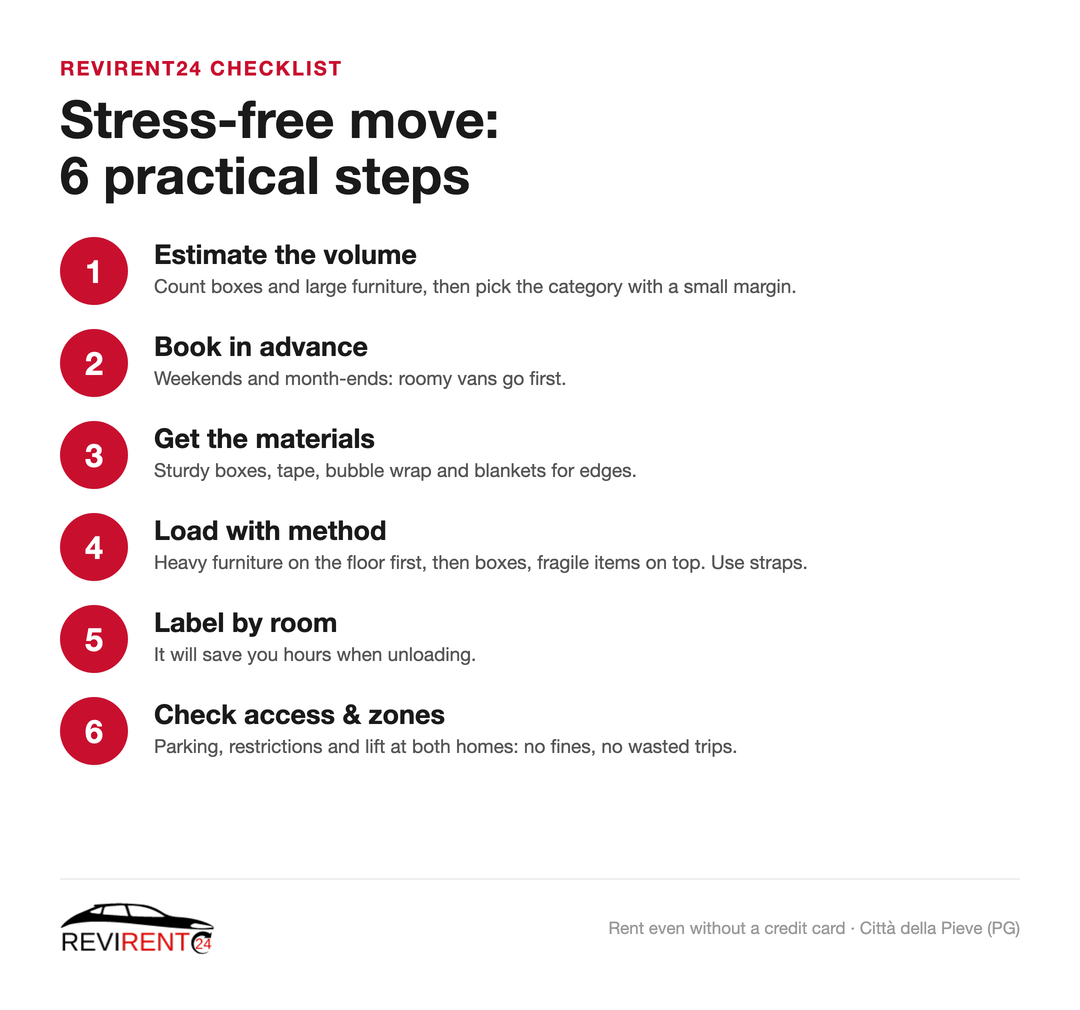
The Revirent24 checklist to organise your move and load the van safely.
Van rental or a removal company?
There's no one-size-fits-all answer: it depends on time, budget and how much you have to move. A full-service company makes sense when you're moving a large home, have no one to help load, or can't afford to lose a day: you pay more, but you lift nothing. Renting a van yourself is the right call when you have some time, a few friends willing to help and want to keep costs under control.
In practice, for a small or medium move — a room, a studio, a one-bedroom flat — renting is almost always the cheaper option: you spend a fraction of what a company would charge and stay in control of the timing. Many people also choose a hybrid route: rent the van and hire help for just a couple of hours for the heaviest items. In every case, the first step is working out how much space you need. Not sure of the right category? Tell us what you're moving and where, and take a look at our full vehicle fleet.
Pick-up, return and insurance: what to know
Before you sign, three things make the difference. At pick-up, check the vehicle's condition and fuel level together with the operator, so you avoid disputes at return. Verify the usable volume (not just the external length) and the load-bay height, handy for tall furniture. On return, clarify times, location and the fuel policy. On insurance, consider reducing the excess: for a move, with constant loading and unloading, a little extra peace of mind is worth the small surcharge.
Revirent24 operates in Città della Pieve (PG), conveniently placed between Umbria and Tuscany and handy for anyone arriving by train at Chiusi. If you're in the area, take a look at car rental in Città della Pieve too.
Frequently asked questions about van rental for moving
What licence do I need to drive a moving van?
In most cases a standard category B licence is enough, valid in Italy for vehicles up to 3.5 tonnes gross weight — the limit that covers the majority of moving vans. Only larger vehicles require higher categories. Always check the vehicle's category with the team.
How much does it cost to rent a van for one day?
It depends on the vehicle size, days, mileage and insurance cover. The fastest way to get an exact figure is to ask for a quote stating what you need to move and for how many days you need the van.
Can I rent a van without a credit card?
Yes. With Revirent24 you can rent even without a credit card — a convenient solution for a move, when you need the vehicle right away and for just a few days. Contact us for the details of your situation.
What size of van do I need for a studio flat?
Usually a medium van of 5–8 m³ is enough for a studio or a one-bedroom flat with flat-packed furniture. For a furnished two- or three-room apartment, choose a large van of 10–13 m³.
Is one trip better than several with a small van?
Almost always a single trip with a roomy vehicle is best: you save fuel, time and effort. Sizing up costs less than you'd think compared with two or three trips.
Do I need to book in advance?
It's recommended, especially on weekends and at month-ends, when demand for roomy vans is highest. Booking ahead secures the right size on the day you need it.
Ready to organise your move?
Choose the right van and set off with peace of mind. Our team helps you pinpoint the ideal size and prepares a clear quote — even without a credit card.
📞 Phone / WhatsApp: +39 378 303 5305
✉️ Email: info@revirent24.it
📍 Città della Pieve (PG) — Via Cardete 12/14