
A fine picked up with a rental car travels a different road from one you get in your own vehicle. You will not find it under the windscreen wiper: it starts from the authority that detected the offence, it goes through the number plate, and the plate leads to the company that owns the car. From there a chain of notifications and deadlines begins that can run for months, and that often reaches you long after you have handed the keys back.
Who pays, though, is not something left to the contract. The Italian Highway Code settles it, and it settles it precisely. Below you will find the whole path, article by article, with the deadlines worth watching and the practical steps to take when the envelope actually arrives.
Who pays a fine issued to a rental car
The answer sits in article 196 of the Italian Highway Code, the one that governs joint liability. The general rule is that the owner of the vehicle answers for payment together with whoever committed the offence. Straight after that, though, the Code adds an exception written specifically for rentals: in the cases covered by article 84, that is rental without driver, the renter, in place of the owner, is jointly liable with the author of the offence.
In plain terms: the company that rented you the car remains the registered owner, but it steps out of the picture. Its place is taken by whoever signed the rental agreement. So the person who was driving pays, and alongside them answers the person who took the car on hire, even if at that moment they were sitting on the other seat.
There are two practical consequences worth knowing before you set off.
The second driver must be named in the contract. If someone other than you was at the wheel, the offence is theirs, but you who signed are still jointly liable.
Whoever pays can claim it back. Article 196(4) gives anyone who has paid the amount a full right of recourse against the person who committed the offence.
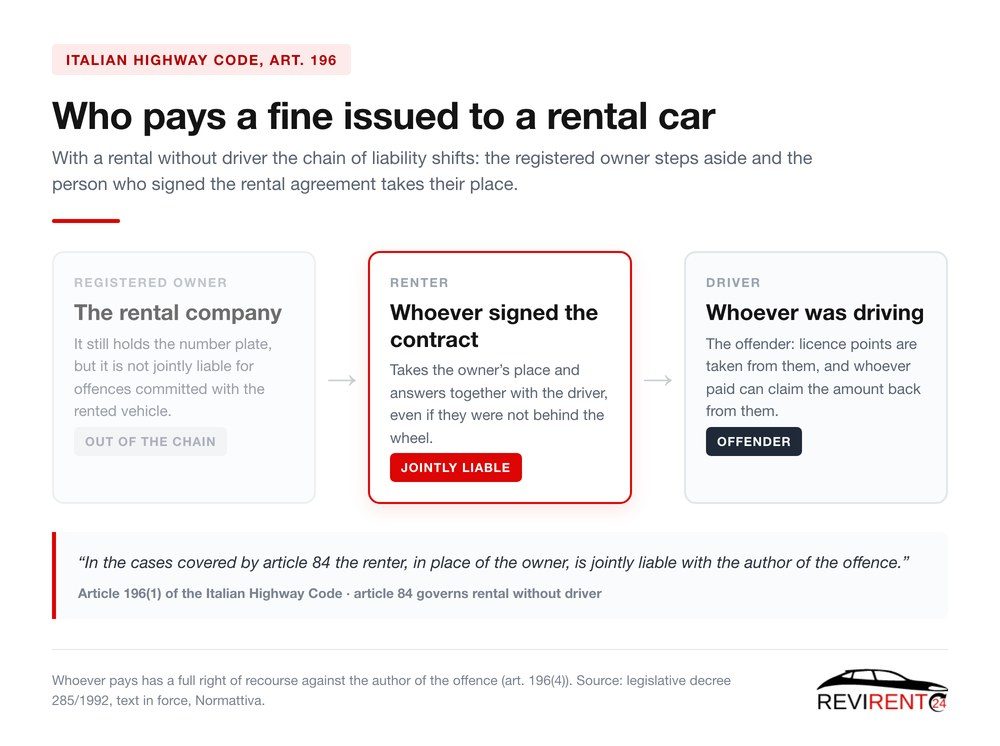
With a rental without driver the owner of the vehicle leaves the chain of liability and the person who signed the contract takes their place.
Why the ticket is not handed to you on the spot
Fines collected with a rental car are nearly always of one kind: detected by a device, with nobody stopping you. That is not a quirk of renting, it is written into the Code. Article 201(1-bis) lists the cases in which immediate challenge is not required, and it covers practically every automated situation:
the impossibility of reaching a vehicle travelling at excessive speed;
crossing a junction while the traffic light is red;
prohibited overtaking;
an offence detected in the absence of both the offender and the owner;
detection devices operated directly by the traffic police, when the vehicle is too far away or cannot be stopped in a regulation manner;
the speed control devices provided for by article 4 of decree law 121 of 2002;
the electronic gates that record unauthorised access to historic centres, limited traffic zones, pedestrian areas and reserved lanes, through type-approved devices.
In all of these cases the ticket is not handed over: it is notified later. And that is where the deadlines come in.
Notification deadlines: 90, 100 and 360 days
Article 201(1) sets the time limits within which the ticket must be notified. There are three of them, and they change according to how the offence was detected.
| Situation | Notification deadline |
|---|---|
| Offence not challenged on the spot, notified to the offender or to one of the parties under article 196 | 90 days from detection |
| Offence challenged immediately to the driver, notified to the jointly liable party | 100 days from detection |
| Recipient resident abroad | 360 days from detection |
| Liable party identified at a later stage | 90 days from when the authority is able to identify them |
That last line explains the envelopes that turn up months later. When the offender or another liable party is identified after the offence, the 90 days do not start on the day of the fine: they start when the authority was put in a position to know who they are. With a rental car this step is almost always there, because the name of the driver is written nowhere on the number plate.
The step that stretches the timeline: naming the driver
This is the hinge of the whole story, and it is worth understanding properly because it carries a penalty of its own.
When the offence carries a loss of licence points and the driver has not been identified, article 126-bis(2) requires the owner of the vehicle or another jointly liable party under article 196 to give the police the personal and licence details of whoever was driving at the time. The deadline is sixty days from the date the ticket was notified. If the owner is a legal entity, the obligation falls on its legal representative or a delegate, within the same deadline.
Anyone who fails to provide those details, without a justified and documented reason, faces an administrative penalty of 291 to 1,166 euro. It does not replace the original fine: it adds to it.
In practice, if you receive a request to say who was driving, that request has a deadline and should be taken seriously. It is also why a rental company, on receiving a ticket, moves immediately to trace the contract and the driver's name.
Licence points follow the driver, not the signatory
A licence starts with twenty points, assigned when it is issued, and deductions follow the table annexed to the Code (article 126-bis(1)). Paragraph 1-bis adds a useful limit: where several offences are detected at the same time, a maximum of fifteen points can be deducted, and this ceiling does not apply where suspension or revocation of the licence is provided for.
The deduction is personal and falls on whoever is responsible for the offence. It cannot land on someone who was not driving, and that is exactly why the system needs the driver's name: without it, the points cannot be taken from anyone. Hence the obligation described above.
How much you pay, and why those five days matter
Article 202 allows the offender to pay, within sixty days of the challenge or the notification, an amount equal to the minimum set by the rule that was broken. And it adds the reduction everyone knows: minus 30 per cent if payment is made within five days of the challenge or the notification.
The discount does not always apply. The Code rules it out for offences that carry confiscation of the vehicle under article 210(3), and for those that carry the accessory penalty of licence suspension.
Watch how those five days are counted, though, because in a rental that is where most money is lost. The period runs from the challenge or the notification of the ticket: if the envelope travels to the rental company first and only then reaches you, the discount window may already have closed. Keeping an up to date contact in your contract, and answering a request for details quickly, is not paperwork, it is the difference between paying the minimum and paying the minimum less a third.
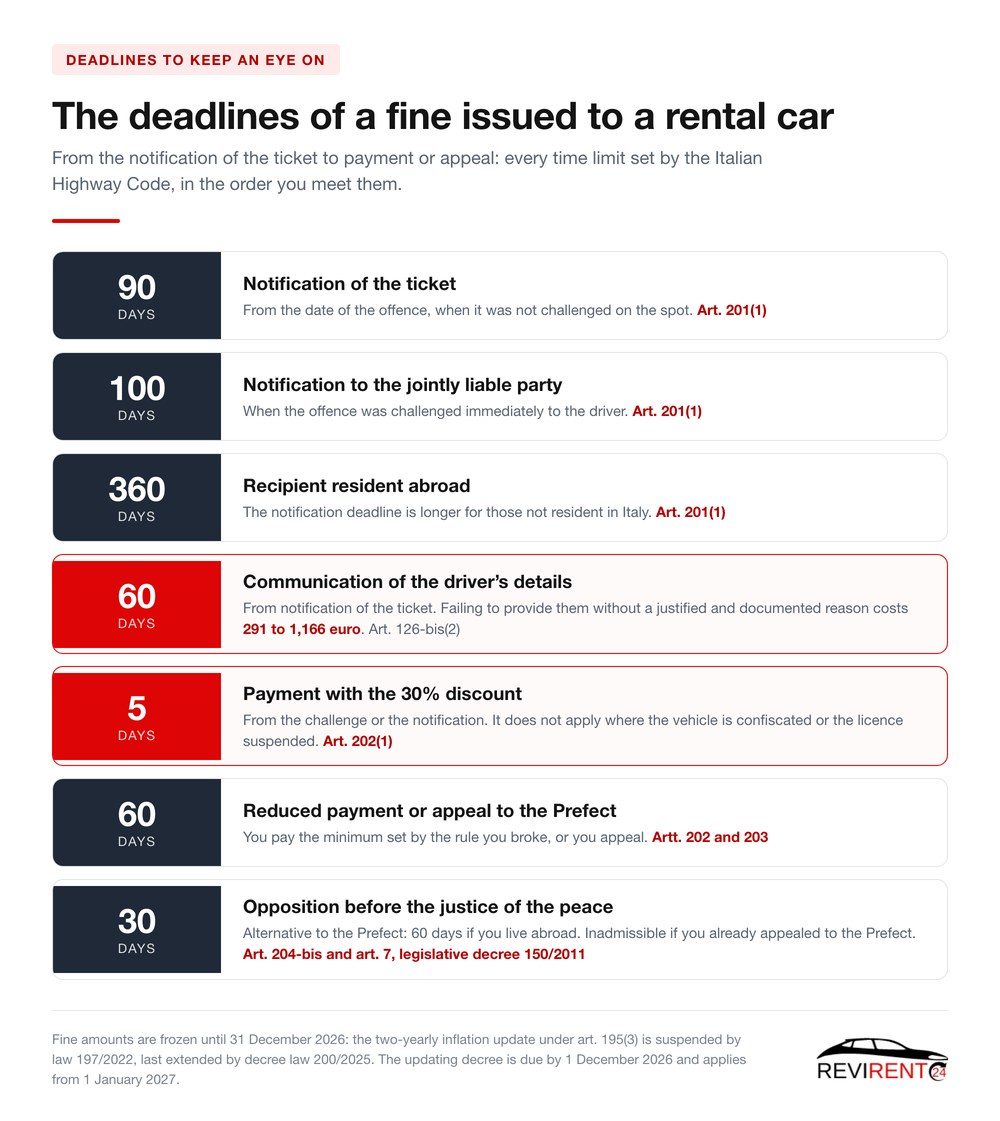
Every deadline at a glance, in the order you meet them: notification, driver details, payment, appeal.
Fine amounts are frozen for all of 2026, then they rise
This is the part nobody usually checks, and in 2026 it makes a difference.
Article 195(3) of the Code provides that the level of financial penalties be updated every two years in line with the full ISTAT variation in the consumer price index for blue and white collar households, through a decree adopted by 1 December of each two-year period and applicable from 1 January of the following year. Paragraph 3-bis adds that updated amounts are rounded to the nearest euro.
That update, however, is suspended. Law 197 of 2022, article 1(497), froze it for 2023 and 2024; later extensions carried it through 2025 and, most recently, through decree law 200 of 31 December 2025, also through 2026. The same paragraph states that the decree provided for by article 195(3) is to be adopted by 1 December 2026, to update the penalties applied from 1 January 2027 in line with inflation over the 2025-2026 period.
In practice: the amounts you read on a ticket today have been unchanged for four years and stay that way until 31 December 2026. From 1 January 2027 they are expected to move again, in the direction you would imagine.
If the fine is not yours: Prefect or justice of the peace, not both
If you believe the ticket is wrong, or that the offence cannot be attributed to you, there are two routes. They are alternatives, not cumulative, and they have different deadlines.
| Appeal to the Prefect | Opposition before the justice of the peace | |
|---|---|---|
| Basis | Article 203 of the Italian Highway Code | Article 204-bis of the Code and article 7 of legislative decree 150/2011 |
| Deadline | 60 days from the challenge or the notification | 30 days from the challenge or the notification, 60 if you live abroad |
| Where | The Prefect of the place of the offence, through the office or command of the detecting authority, or directly by registered letter with return receipt or certified email | The justice of the peace of the place where the offence was committed |
| Condition | You must not have already paid the reduced amount | You must not have already paid the reduced amount, nor already appealed to the Prefect |
The bottom right box is the one that catches people out: article 7(3) of legislative decree 150 of 2011 states expressly that an appeal to the justice of the peace is inadmissible if an appeal to the Prefect has already been lodged. You pick one road, and you pick it straight away.
The same goes for payment: pay the reduced amount and the route of appeal closes. Decide first, pay afterwards.
The item that is not a penalty: administration charges
Alongside the fine you may see a charge from the rental company for handling the case, that is for the work of tracing the contract, identifying the driver and answering the authority within the deadline.
On this it is worth being clear: it is not a penalty and it is not provided for by the Highway Code. It is a contractual item, so it depends on what the agreement you sign says. It is one of the things worth asking about at the desk before you set off, together with excess and cover, rather than after the envelope arrives. With us, you only have to ask the staff: we will walk you through it in two minutes, on the phone or in person.
Historic centres and limited traffic zones: the most common case in Valdichiana
Anyone travelling between Tuscany and Umbria passes through plenty of towns with controlled access. As you saw above, article 201(1-bis)(g) places unauthorised access to historic centres, limited traffic zones, pedestrian areas and reserved lanes among the cases where immediate challenge is not required: the electronic gate does not stop you and does not warn you, it simply records.
There is one practical rule, and it works everywhere: read the signs at the entrance before you drive in, not after. If a sign indicates a restriction and you have no permit, parking outside the walls always costs less than a ticket. If you are staying somewhere inside the restricted zone, ask the property whether and how it registers your plate: it is a routine procedure, but it has to be done beforehand.
What to do, in order, when a fine arrives
Look at the date of detection and the date of notification. They tell you whether the deadlines in article 201 were met and how much time you have left.
Check that it falls inside your rental period. The date, time and place of the offence must sit within the dates of the contract. Keep the contract: it is your evidence.
Work out who was driving. If it was the second driver named in the contract, the offence is theirs, but you remain jointly liable.
If you are asked for the driver's name, answer within 60 days. Failing to do so carries its own penalty, from 291 to 1,166 euro.
Decide: pay or appeal. If you pay, five days for the 30 per cent discount, sixty for the minimum. If you appeal, 60 days to the Prefect or 30 to the justice of the peace, and one route rules out the other.
Tell the rental company. If the fine was handed to you in person, saying so stops the whole procedure starting again from scratch months later.
The easiest way not to think about it
Most of the fines that reach people who rent come down to two things only: a speed limit read carelessly and an electronic gate crossed without noticing. Neither depends on who gives you the car, but the way the case is handled afterwards does.
We are a local car rental company: our phone support answers every day from 8:30 to 19:00 on +39 378 303 5305, and if you receive a letter you cannot make sense of you can simply call us or write to info@revirent24.it. Before you travel, if you want to be prepared, you may also find useful our guide to how motorway tolls are paid with a rental car, the one on documents and requirements for renting and the reminder on what to check before picking up the car.
If you are still choosing the vehicle, take a look at our fleet or write to us directly: we reply within 24 hours.
Legal sources: legislative decree 285/1992 (Italian Highway Code), articles 84, 126-bis, 195, 196, 201, 202, 203, 204-bis; legislative decree 150/2011, article 7; law 197/2022, article 1(497), as last amended by decree law 200/2025. Texts consulted on Normattiva, version in force as of October 2026. This article is for information only and is not a substitute for legal advice.