
You step off the train at Chiusi, the car is booked, the contract is in your inbox and in your pocket there is a driving licence issued by another country. Is it valid in Italy? It depends, and it does not depend on the rental: it depends on who issued that licence and on which international conventions that country has signed.
It is a question we get all the time, and the answer you find online is almost always vague: "you need an international driving permit", or "no, you do not need anything". Both statements are true, but for different countries. Here is the precise rule, article by article, with a table covering the countries most of our customers come from and a list of what to pack before you leave.
The rule in two lines
The Italian Highway Code draws a sharp line between two situations. If your licence was issued by a State of the European Union or of the European Economic Area, in Italy it counts as an Italian licence and you need nothing else. If it was issued outside that area, the baseline rule is that you need something more: an International Driving Permit, or an official Italian translation of your licence.
That baseline rule comes with an important preamble, written into the first line of article 135: "without prejudice to the provisions of international conventions". It is exactly those conventions that explain why a British tourist today drives in Italy on their licence alone and an American one does not.
European licences count as Italian ones
Article 136-bis of the Highway Code is blunt: driving licences issued by Member States of the European Union and of the European Economic Area are treated as the corresponding Italian driving licences. No permit, no translation, no paperwork.
The European Economic Area also includes Norway, Iceland and Liechtenstein, which are not in the Union. Anyone arriving from there is in exactly the same position as someone arriving from France or Germany.
The one thing that does apply to European licence holders is that every rule of conduct in the Italian Code applies to them, and so do all the penalties laid down for holders of Italian licences. Including the deduction of licence points, once the licence has been recognised by the Italian authority.
Non-European licences: what article 135 asks for
Here the rule is more layered. Article 135(1) says that holders of a licence issued by a State outside the European Union or the European Economic Area may drive in Italy the vehicles their licence covers, on two conditions:
that they have not been resident in Italy for more than one year;
that, together with the licence, they hold an international permit or an official Italian translation of it.
The same paragraph adds something that is easily forgotten: both the licence and the international permit must be in force. An expired permit is worth no more than a permit you never requested.
Mind the order of the words: the international permit does not replace your licence, it accompanies it. On its own it entitles you to drive nothing at all. The Code says so, and the Vienna Convention repeats it, recognising the international permit "on condition that it is presented with the corresponding domestic driving permit".
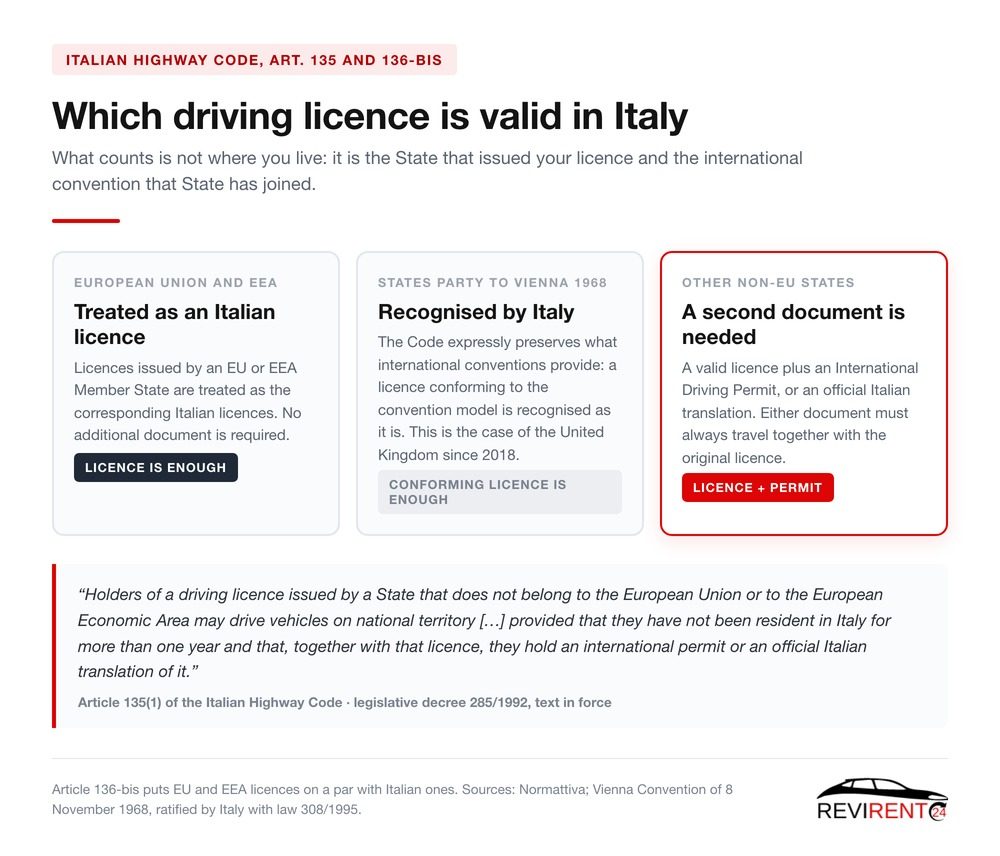
What counts is not where you live, but the State that issued your licence and the convention it has joined.
Two models of international permit, and why the validity differs
There is not one International Driving Permit. There are two, born of two different conventions, and in Italy both are valid, as the Automobile Club d'Italia confirms in its information sheet for foreign tourists who want to drive in Italy.
1949 Geneva Convention model: valid for 1 year from issue.
1968 Vienna Convention model: valid for 3 years from issue.
In both cases one ceiling overrides the stated duration: the permit can never outlive the domestic licence it refers to. The Vienna Convention puts it exactly like that, in article 41: validity is "no more than three years after the date of issue or until the date of expiry of the domestic driving permit, whichever is earlier".
So if your licence expires in eight months, the international permit issued to you today lasts eight months, not three years.
Your own country issues the permit, not Italy
This is where we see the most confusion, and where the most money gets wasted. The international permit is issued by the authority that issued your licence: article 135(2) says so, and article 41 of the Vienna Convention adds that the permit may only be issued by the State where the holder has their normal residence, and that it is not valid for driving in that same territory.
Three very practical consequences.
Request it before you travel. Once you are in Italy no office can issue it to you, because Italy is not the State that issued your licence.
"International licences" sold online are worth nothing. If they are not issued by your own country's authority, no convention covers them: at a roadside check they are printed paper.
It never works at home. The permit is for driving abroad, never in the country that issued it.
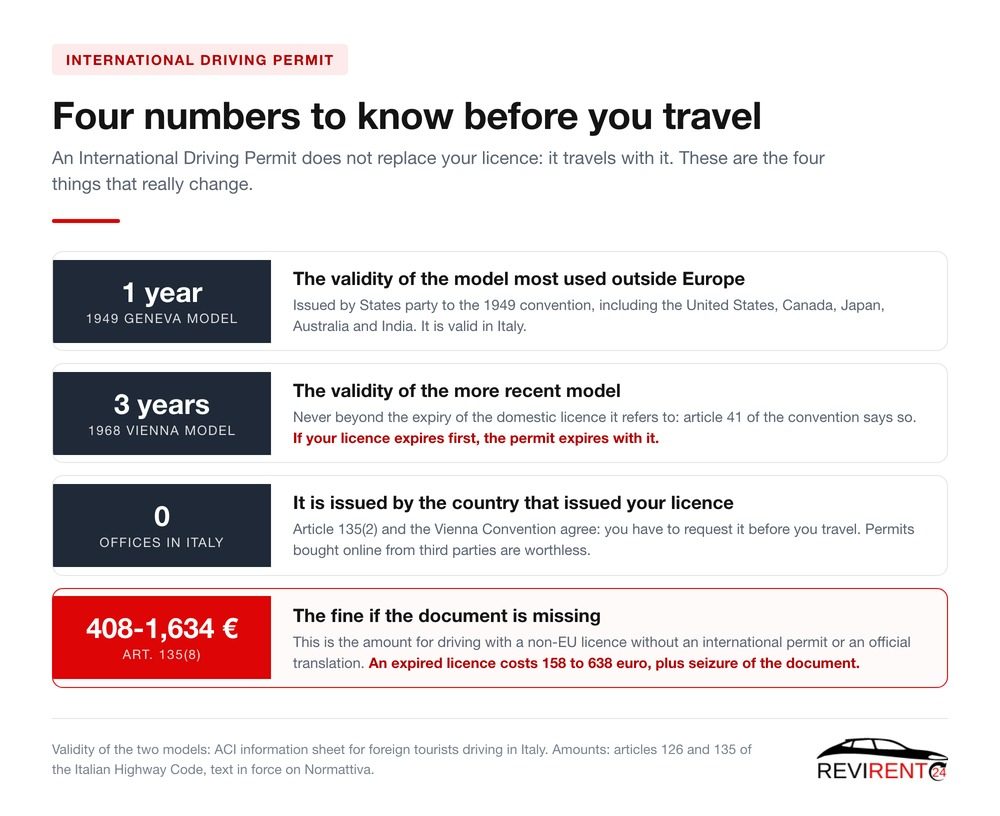
An International Driving Permit does not replace your licence: it travels with it, and it cannot outlive the licence itself.
Country by country: when the licence alone is enough
This is the part almost nobody writes out in full, because it means cross-checking the Italian Code against the list of States that joined the two conventions. That list is public and kept by the United Nations. Here is the current picture for the countries most of our customers come from.
| Where the licence comes from | Convention | What you need in Italy |
|---|---|---|
| EU and EEA countries (including Norway, Iceland, Liechtenstein) | Direct equivalence | The licence alone |
| United Kingdom (ratified Vienna 1968 on 28 March 2018) | Vienna 1968 | The licence alone, if it is the modern photocard |
| Switzerland (ratified on 11 December 1991) | Vienna 1968 | The licence alone |
| Brazil (ratified on 29 October 1980) | Vienna 1968 | The licence alone |
| United States (joined Geneva on 30 August 1950) | Geneva 1949 | Licence + international permit or official translation |
| Canada (23 December 1965) | Geneva 1949 | Licence + international permit or official translation |
| Japan (7 August 1964) | Geneva 1949 | Licence + international permit or official translation |
| Australia (7 December 1954) | Geneva 1949 | Licence + international permit or official translation |
| India (9 March 1962) | Geneva 1949 | Licence + international permit or official translation |
| China | Neither of the two | Licence + official Italian translation |
The United Kingdom row is the one that surprises people most, because many guides are still stuck in 2021. The UK ratified the Vienna Convention on 28 March 2018, so a British licence falls among those Italy recognises. The British government confirms it too, stating on its own website that you do not need an international permit to drive in Italy if you hold a photocard licence, while holders of the old paper licence need to get a photocard or an international permit.
China is the other half of the story: being party to neither the Geneva nor the Vienna Convention, there is no international permit that works in Italy. What remains is the second route article 135 allows, the official translation.
The official translation: the alternative the Code allows
The Code puts the international permit and the official translation on the same footing: "an international permit or an official translation into Italian". It is not a fallback, it is a full alternative.
To be official, the translation has to be certified: in practice you obtain it from the Italian diplomatic or consular mission in the country that issued the licence, or through a sworn translation before an Italian court. A translation done at home, or with an app, does not meet that definition.
If you come from a country that joined neither convention, this is your only route. If you come from a 1949 Geneva country, the international permit is almost always faster and cheaper than the translation.
What it costs to turn up without the right document
The figures are in the Code and they are not symbolic.
| Situation | Penalty |
|---|---|
| Non-EU licence with no international permit and no translation (art. 135(8)) | 408 to 1,634 euro |
| International permit not conforming to the conventions (art. 135(9)) | 80 to 317 euro |
| Expired licence (art. 126(11)) | 158 to 638 euro, plus seizure of the document |
| Driving without ever having obtained a licence (art. 116(15)) | criminal fine of 2,257 to 9,032 euro |
| Vehicle documents not carried on board (art. 180(7)) | 42 to 173 euro |
The fourth row deserves an extra line. Article 116(15) is not an administrative penalty: it is a criminal fine handed down by a court, and if you reoffend within two years it also carries up to one year of detention. Paragraph 17 adds three months of administrative seizure of the vehicle, which on a rental car is a serious problem for whoever rented it to you as well.
If you live in Italy, a foreign licence has an expiry date
This part is not about tourists. Article 135 allows you to drive on a non-European licence as long as you have not been resident in Italy for more than one year. Past that year, the foreign licence can no longer be used to drive in Italy, even if the document itself says it expires in 2032.
At that point the only route is conversion, governed by article 136: you can obtain an Italian licence without sitting the exam only where a bilateral agreement exists between Italy and the issuing State, on a reciprocal basis. Where there is no agreement, you take the exam again.
Anyone who keeps driving on a foreign licence after that year falls under article 116, paragraphs 15 and 17: criminal fine and seizure of the vehicle.
For European licences the mechanism is different and far gentler: the licence stays valid, you may ask for recognition or conversion, and only licences with no administrative expiry date must be converted within two years of taking up normal residence.
Age and categories: what a State may refuse to recognise
The Vienna Convention leaves every country two options worth knowing about before you book. First: a State may refuse to recognise a licence whose holder is under eighteen. Second: for vehicles in categories C, D, CE and DE it may refuse one whose holder is under twenty-one.
Translated for anyone renting: if your country lets you drive at sixteen or seventeen, that licence will get you nowhere in Italy. For an ordinary car, category B, eighteen is the threshold that counts.
Commercial conditions, on the other hand, are set by whoever rents you the car. With us the minimum age starts at eighteen and we do not ask for a credit card, two things you rarely find in the international chains. Some vehicle categories may carry different conditions: the quickest thing is to ask us before you book, as we explain in our guide to documents, minimum age and requirements and in the one on renting without a credit card.
What you need in the car besides your licence
Article 180 lists the documents a driver must carry: the vehicle registration document, a licence valid for the category of vehicle, and the compulsory insurance certificate.
Rental cars come with a quirk written into the same article, at paragraph 4: for vehicles used for rental without driver the registration document may be replaced by a photocopy certified by the owner and signed by them. That is why the document wallet of a rental car holds a copy rather than the original: it is not an oversight, it is the rule.
It is still worth walking around the car and checking that the wallet is actually there, along with everything else. We covered it in detail in our guide on what to check before picking up a rental car.
The checklist to tick before you leave
Look at who issued your licence, not at where you live now. The issuing State is what counts.
Check the expiry date: if the licence expires during your trip, no international permit keeps it alive.
If you come from outside the EU and EEA, get the international permit or the official translation before you travel.
Always carry the original licence: the international permit alone is never enough.
Bring a valid identity document, because the contract is made out from it.
Put the second driver on the contract if two of you will be driving: their documents must be in order exactly like yours.
Renting from Revirent24 with a foreign licence
We are a local car rental company between Tuscany and Umbria, with branches in Montepulciano, Chiusi railway station and Citta della Pieve, and Chiusi station is the natural landing point for anyone stepping off the high-speed train to explore the Val d'Orcia or Lake Trasimeno. Which means foreign licences come through our desk every single day, and the question about the international permit is one we hear often.
Three things worth knowing.
You can drop the car off at any of our branches, not necessarily the one you picked it up from.
Phone support answers every day from 8:30 to 19:00, and out-of-hours pick-up can be arranged by appointment.
You speak to a person, not to a call centre: if your case is unusual, we sort it out before you book rather than at the counter.
To see what is available, start from the vehicle fleet, check our locations or write to us from the contact page. If you are flying in, our guide on how to reach Chiusi and Citta della Pieve from the airports will save you a couple of connections.
Three mistakes we see often
Treating the international permit as a licence. It is not one. It is a document that renders your licence in a standard format, and it is only valid when it travels with the original.
Buying it online from a site with no connection to your country. The Code and the Convention say the same thing: it is issued by the authority that issued your licence. Everything else is a worthless document bought at full price.
Assuming the road rules take care of themselves. Driving on a foreign licence means complying with every rule of the Italian Code, and facing the same penalties as an Italian motorist. That goes for speed limits, for restricted traffic zones, for motorway tolls and for fines issued to a rental car, which reach you even once you are back home. In winter there are also the rules on winter tyres and snow chains, which many visitors discover only at the first road sign.
The sources behind this guide are the text in force of the Italian Highway Code on Normattiva (articles 116, 126, 135, 136, 136-bis and 180), the text of the Vienna Convention on Road Traffic of 8 November 1968, ratified by Italy with law 308 of 5 July 1995, the lists of States party to the 1949 Geneva and 1968 Vienna conventions published by the United Nations, and the Automobile Club d'Italia information sheet on international permits for foreign tourists. If your case is unusual, for instance a licence issued by a State that does not appear in the table, it is worth checking with the Italian diplomatic mission in your country, or simply asking us before you book: answering questions like this is part of the job.
Book with the licence you have, no surprises at the desk
Write or call: in two minutes we will tell you whether your licence is enough as it is or whether you need to bring something more, and we will have the contract ready before you arrive. We are in Montepulciano, Chiusi railway station and Citta della Pieve, we answer every day from 8:30 to 19:00 on +39 378 303 5305 and at info@revirent24.it.