A clumsy manoeuvre in a Montepulciano car park, a nose-to-tail at the Chiusi motorway exit, a wing mirror greeting a stone wall on a gravel road up to the wineries. It happens, and when it happens in a car that is not yours the first question is not "how much will this cost me": it is "who do I call now".
The answer is simpler than it looks, because the rules do not change just because the car is rented. One thing changes, and it matters: there is one extra owner in the chain, and some of the paperwork is theirs to do. Here are the steps in order, with the statutory deadlines and the concrete things to do in the first ten minutes, when adrenaline is high and your phone is the only tool you have.
What stays the same, and the one thing that changes
Under Italian law an accident in a rental car is an accident like any other. The same duties of conduct apply, the same accident statement form, the same compensation procedure, the same deadlines for the insurer.
The only difference is whose name is on the policy. The insurance belongs to the rental company, not to you. Everything else follows from that: damage to the car is the owner's loss and the owner handles it, while the damage you suffered stays yours and you claim it yourself. Keeping the two apart is what prevents almost every mess.
The first ten minutes: what the Italian Highway Code requires
Article 189 of the Italian Highway Code is the one rule you really need in your head. It says four things, in this order.
Stop, always, if the accident is in any way connected to your conduct.
Give assistance to anyone who has suffered personal injury.
Make the scene safe and, as far as safety allows, do not alter the state of the place and do not destroy traces useful to establish liability.
Give your personal details and any other useful information, including for compensation purposes, to the injured parties. If they are not present, communicate those details by any possible means.
Where only property is damaged, paragraph 3 adds a practical duty that is often ignored: avoid obstructing traffic. In practice, photograph the scene as it is, then move the vehicle.
The penalties show how seriously the rule is taken. Failing to stop where only property is damaged costs from 302 to 1,208 euros, and if the damage to the vehicles is severe enough to trigger the roadworthiness re-test under article 80, a licence suspension of fifteen days to two months is added. Failing to stop where people are injured is no longer an administrative offence but a crime: imprisonment from six months to three years. Failing to assist an injured person carries one to three years. Breaching the duties in paragraphs 2, 3 and 4, that is safety, clearing the road and exchanging details, costs from 87 to 344 euros.
There is also a paragraph almost nobody knows, and it is very relevant in our area, where you drive between fields and woodland: paragraph 9-bis requires you to stop and arrange rescue when the accident has harmed pets, farm animals or protected animals. Failing to do so risks 421 to 1,691 euros.
The amicable accident statement, and why it beats ten phone calls
The form everyone calls CID, and whose proper name is CAI, the amicable accident statement, is not a favour you do the insurer. It is an obligation and, at the same time, your best weapon.
The obligation comes from article 143 of the Italian Private Insurance Code: in an accident between insured vehicles, the drivers or their respective owners must report the claim to their own insurer using the form supplied by the company, on the model approved by IVASS, the Italian insurance supervisor. If no report is filed, article 1915 of the Civil Code on failure to notify a claim applies, with all the consequences that brings.
The weapon is in paragraph 2 of the same article. When the form is signed by both drivers, it is presumed, unless the insurer proves otherwise, that the accident happened in the circumstances, in the manner and with the consequences written on the form. In plain terms: that joint signature moves the burden of proof from your side to theirs.
Since 8 April 2026 you can sign the statement on your phone
This is the change almost nobody has on their radar, and it is already in force. IVASS Regulation no. 56 of 25 March 2025, published in the Official Gazette no. 81 of 7 April 2025, replaced the old ISVAP Regulation no. 13 of 2008 and rewrote both the insurance certificate and the claim report form.
Two articles matter to drivers. Article 11 states that the form may be completed on paper or as an electronic document, at the choice of the driver or the owner. Article 14 requires insurers to provide applications usable on mobile devices and accessible via the web to complete the form and transmit it electronically, with a signature whose security requirements are no lower than those of an advanced electronic signature.
The Regulation entered into force the day after publication and gave companies twelve months to comply with article 14. That deadline expired on 8 April 2026: today your insurer must offer you the digital tool. If you cannot find it, ask for it, and remember you are entitled at any time to receive the form on paper or on another durable medium.
A detail that helps travellers: article 12 also accepts forms issued by foreign insurers, provided they match the Italian model, and the instructions annexed to the Regulation accept a form drawn up in another language if it conforms to this one.
The two signatures that halve the deadlines
This is the most tangible financial benefit of the amicable statement, and it is written in black and white in article 148 of the Insurance Code and article 8 of Presidential Decree 254/2006.
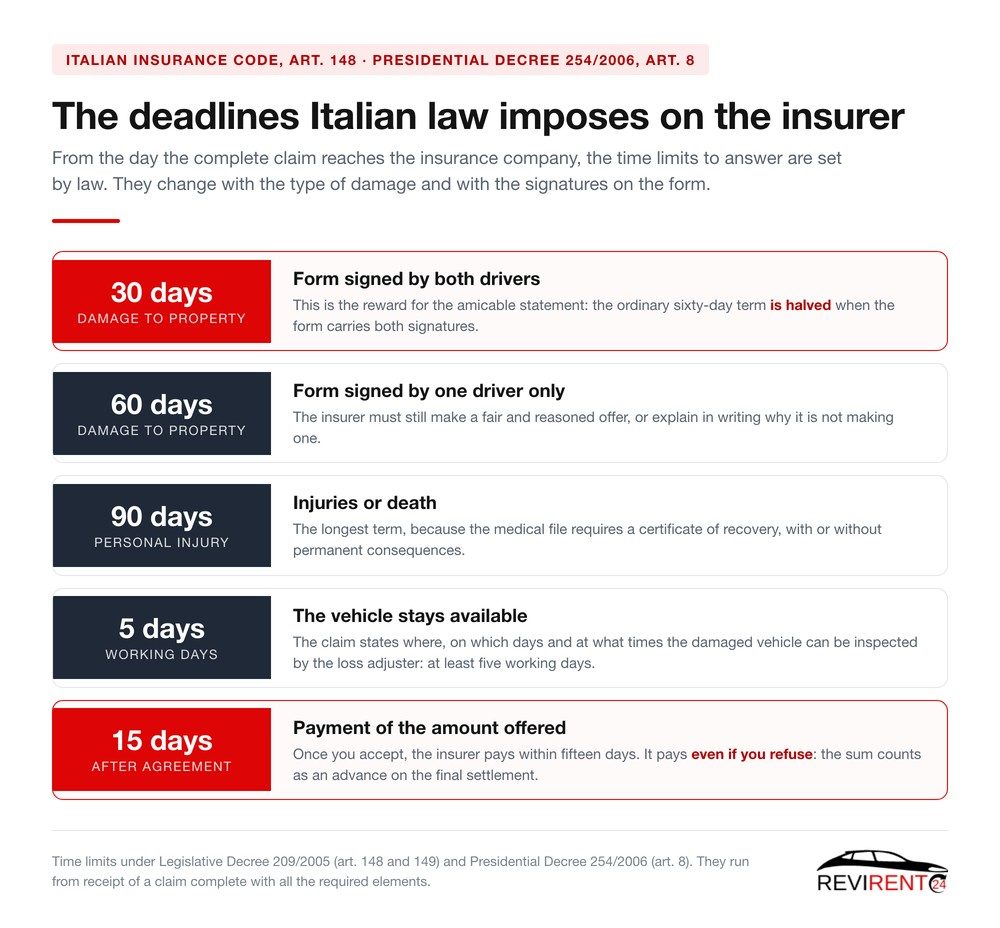
The clock starts when the complete claim is received, not on the day of the accident.
| Situation | Deadline for the insurer | Legal basis |
|---|---|---|
| Property damage, form signed by both drivers | 30 days | art. 148(1) and art. 8(2)(c) |
| Property damage, form signed by one driver only | 60 days | art. 148(1) and art. 8(2)(b) |
| Personal injury or death | 90 days | art. 148(2) and art. 8(2)(a) |
| Payment of the amount offered and accepted | 15 days | art. 149(4) |
Within that period the insurer must make a fair and reasoned offer or state in writing the specific reasons why it is not making one. There is no legitimate third option, and silence is not one of them.
Two practical warnings worth money. First: the claim must state where, on which days and at what times the damaged property remains available for inspection by the loss adjuster, for no fewer than five working days. Second, which on a rental car concerns the owner but affects your drop-off timing: the injured party may carry out repairs only after that period has expired or after the adjuster has completed the assessment. Repairing earlier does not forfeit the right to compensation, but everything will have to be documented with repair invoices.
If the other driver will not sign
It happens, and it is not a disaster. The instructions annexed to the form explain exactly what to do: fill in completely the part concerning your own vehicle, vehicle A, and for the other party, vehicle B, it is enough to answer question 7, the details of the driver and the owner, and to state at question 8 the name of their insurance company. Where possible, answer the other questions too.
In that case you lose the presumption and the deadline goes back to sixty days, but the report is valid and has been filed. The rest is done by the police report, the witnesses and the photos. That is why it always pays to take the registration number, the insurer's name and, if there are any, the contact details of those who saw what happened: the details of possible witnesses are one of the elements that Presidential Decree 254/2006 expressly requires in the claim.
Who files the claim when the car is a rental
This is where people most often get it wrong. Article 149 of the Insurance Code provides that, in an accident between two identified and insured vehicles, the injured parties must address their claim to the company that issued the contract for the vehicle they were using. In a rental car, that contract belongs to the rental company.
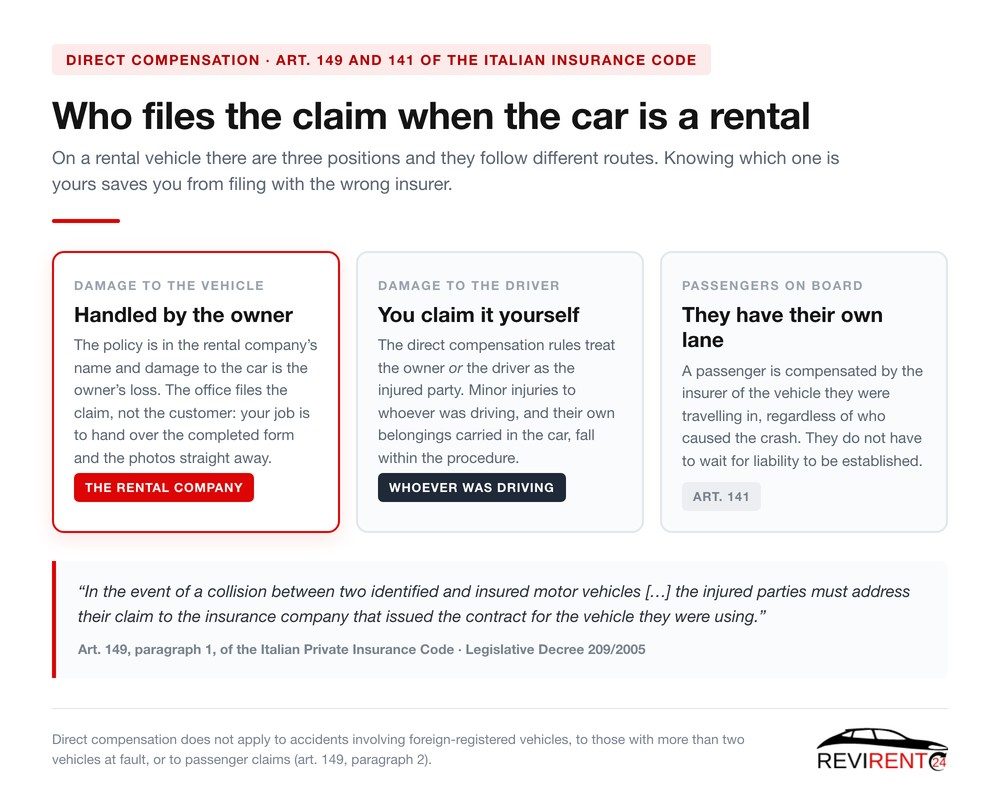
Three positions, three different routes. Mixing them up is the fastest way to lose weeks.
That does not cut you out. The direct compensation rules define the injured party as the owner or the driver of the vehicle that suffered damage, and article 149(2) specifies that the procedure covers damage to the vehicle, property carried in it belonging to the policyholder or the driver, and personal injury to the non-liable driver, as long as it stays within the limits for minor injuries.
In practice: the damage to the car is handled by the rental office, while your sprained wrist and the laptop that broke in the boot are yours to claim. Your job towards the rental company is to hand over the completed form, the photos and the police report if a patrol attended. The sooner they arrive, the sooner the countdown starts.
Passengers have a lane of their own
If other people were on board, the rule is clearly in their favour. Article 141 provides that a passenger is compensated by the insurer of the vehicle they were travelling in, within the statutory minimum cover and regardless of who is found liable, with the sole exception of a fortuitous event.
That means your passengers do not have to wait for liability to be sorted out: they turn to the insurer of the car they were in, that is the rental company's insurer, and the procedure starts immediately. That insurer will then recover from the insurer of the party actually at fault.
When direct compensation does not apply
The fast-track procedure has precise boundaries, set by article 149(2) and by the implementing decree. It does not apply when:
a foreign-registered vehicle is involved, which is far from rare in a tourist area;
there are more than two vehicles at fault, because the decree speaks of a collision between two identified and insured vehicles with no other vehicle at fault involved;
the collision happened outside Italian territory;
the claim is a passenger's claim, which follows the article 141 route described above.
In these cases the claim goes to the insurer of the party at fault and the deadlines remain those of article 148. The addressee of the registered letter changes, the rest of the path does not.
What the claim must contain for the clock to start
This is the number one reason a file gets stuck: the deadlines do not run from the accident, they run from receipt of a complete claim. Article 6 of Presidential Decree 254/2006 lists what is needed.
| Element | Why it is needed |
|---|---|
| Names of the policyholders and both registration numbers | They identify the claim in the clearing system between insurers |
| Names of the respective insurers | It lets your insurer notify the other one immediately |
| Description of the circumstances and of how it happened | It is the basis on which the liability criteria are applied |
| Details of any witnesses | Decisive when the second signature is missing |
| Whether the police attended | The police report replaces much of the reconstruction |
| Place, days and times for the inspection | Without it the loss adjustment cannot be arranged |
If the drivers were injured, add the age, occupation and income of the injured party, the extent of the injuries, the declaration about benefits from social insurance bodies and the medical certificate of recovery, with or without permanent consequences. A registered letter with acknowledgement of receipt remains the safest form, but the decree also allows hand delivery, telegram, fax and electronic transmission, unless the contract expressly rules the last one out.
Excess, deposit and cover: what to read before you set off
So far we have been talking about third-party liability insurance, which is compulsory and covers the damage you cause to others. Damage to the car you are driving is a different story and depends on the rental contract, not on the law.
The items to read are always the same: the amount of the excess, that is the share of the damage left to you; any security deposit blocked on your card; the optional cover that reduces or removes the excess; and the exclusions, which usually concern wheels, tyres, underbody, glass, interiors, lost keys and driving under the influence of alcohol or drugs.
There is no market standard for these figures: they change from company to company, from vehicle to vehicle and often from rate to rate. That is why the only honest answer is the one we give you at the desk or on the phone, with the contract in front of us, before you sign. It is a three-minute conversation worth far more than any article, this one included.
Damage with no other party: car parks, hail, wild boar
Not all damage comes from a collision. A scratch found on the way back from the supermarket, a hailstorm, a wild animal crossing at dusk on the roads between the hills are frequent situations and have one thing in common: with no other identified vehicle, direct compensation has nothing to do with it.
So what do you do. Photograph the damage straight away with date and time, note where and when you noticed it, and tell the rental company the same day, not at drop-off. If the police attended, for instance for an animal that was hit, ask for the report number. If the party at fault is unknown but exists, for example someone who hit you while parked and drove off, a report to the authorities is how you put on record that the damage is not yours.
If the offer never comes, or is not enough
This is exactly what the deadlines are for. Once sixty days from the claim have passed, ninety in the case of personal injury, court proceedings become possible: article 145 says so, requiring a registered letter with acknowledgement of receipt to the insurer of the party at fault under the ordinary procedure, and to your own insurer, copied to the other one, under direct compensation.
Within direct compensation, article 149(6) adds an important rule: if the insurer states the reasons preventing compensation, or says nothing within the deadline, or no agreement is reached, the action is brought against your own insurer only. You do not have to chase the other party's company.
And if an offer does arrive but you consider it low, article 149(5) protects you: the insurer pays the amount offered within fifteen days even to someone who has said they do not accept it or has not replied at all, and that sum counts as an advance on the final settlement. Refusing does not mean being left with nothing while you wait.
One last money-saving point: if you accept the amount offered, no fees are due on the sums paid for professional advice or assistance other than the medico-legal one for personal injury. This is set by article 9 of Presidential Decree 254/2006, which also requires the insurer to give you technical help in completing the claim and to explain the liability criteria it has applied.
The checklist to keep with your documents
Print it, or save it on your phone. These are the ten minutes that decide the next two months.
Stop and check that nobody is injured. If anyone is, call 112 before anything else.
Make the scene safe: warning triangle, reflective jacket, hazard lights.
Photograph before moving anything: position of the vehicles, points of impact, registration plates, road signs, road condition. Then clear the carriageway.
Fill in the form, on paper or through your insurer's app, and try to get the second signature. It is worth thirty days instead of sixty.
Collect the registration number, the insurer, the name of the driver and of the owner of the other vehicle, and the witnesses' contacts.
Call the rental company the same day, even if the damage looks minor.
Keep a copy of everything: form, photos, report number, officer's name.
One phone call solves half the problem
You have just read the paperwork part, and it is the same for everyone. What really changes the experience is the other half: knowing that at the other end of the line there is someone who knows your file and your name.
Our phone support is open every day from 8:30 to 19:00 on +39 378 303 5305, and our offices in Montepulciano, Chiusi and Città della Pieve are minutes away from the main roads of the Valdichiana. If something has gone wrong, call us before you move: we will tell you what you need and what you do not.
If you are still choosing a car, take a look at our fleet and write to us with any question about the contract. On the same track you will also find our guides on who pays fines issued to a rental car, on how motorway tolls work, on when you need an International Driving Permit and on car insurance in car rental.
The rules cited are Legislative Decree 285/1992 (Italian Highway Code, art. 189), Legislative Decree 209/2005 (Private Insurance Code, art. 141, 143, 145, 148, 149), Presidential Decree 254/2006 and IVASS Regulation no. 56 of 25 March 2025, in the versions in force at the date of publication of this article. They do not replace your rental contract or legal advice on your specific case.