
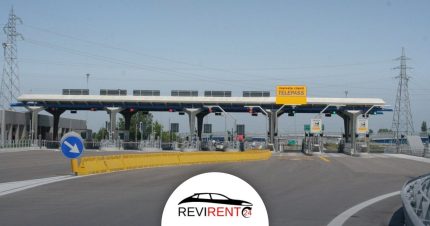
You do not pay the toll to the rental company, you pay it to the road
When you pick up a car from us, the rental bill and the motorway bill stay two separate things. We hand over the vehicle, the documents and the keys; the toll is collected by whoever operates that stretch of motorway, and it is calculated on the kilometres you actually drive. That is why there is no special rental toll rate: the number plate changes, the price does not.
That said, driving a car that is not yours adds two very concrete complications that almost no guide deals with: the toll device you keep at home cannot simply be moved across, and if something goes wrong at the toll gate the paperwork reaches the registered keeper of the vehicle, which means us. Here is the whole picture, with the official numbers.
Closed and open systems: why you sometimes take a ticket and sometimes do not
On most of the Italian network, the A1 included, the closed system applies: you take a ticket on entry, hand it over on exit and pay according to the distance actually covered. On some stretches the open system applies instead, where the entry point is not recorded and you pay a flat rate at the barrier: no ticket, fixed amount.
The difference matters for a very practical reason: if you lose the ticket in a closed system, the exit gate has no way of knowing where you entered. Keep it in one fixed place, not in the jacket pocket that ends up in the boot.
What it really costs: the official formula
Autostrade per l'Italia states it plainly: to work out the amount due you multiply the unit rate by the kilometres travelled. VAT at 22% is then added, and the result is rounded to the nearest 10 cents, with decimals below 5 cents rounding down and 5 cents or more rounding up.
The unit rate is not a single figure. It depends on three things: the vehicle class, the type of route (a mountain section full of viaducts and tunnels costs more than a flat one) and the operator running that part of the network. Under the rates in force from 1 January 2026, they range from 0.07869 euro per kilometre for class A on flat terrain up to 0.22437 euro per kilometre for class 5 in the mountains, VAT included.
Translated into orders of magnitude, using the minimum class A flat rate as a floor:
| Kilometres travelled | Indicative minimum amount |
|---|---|
| 50 km | around 3.90 euro |
| 100 km | around 7.90 euro |
| 200 km | around 15.70 euro |
Read that table for what it is: a theoretical minimum, not a quote. On your real route the unit rate will almost always be higher, because hill sections and different operators come into play. For the exact gate-to-gate amount, use the toll calculation page on the official site, which is the only source we can point you to without inventing figures.
The toll class depends on height, not on engine size
This is the part that surprises renters most. On the motorway you are not classified by how powerful or how big the vehicle is, but by a physical parameter measured at the gate: the height at the front axle, with the threshold set at 1.30 metres, and the number of axles.
| Class | How it is defined |
|---|---|
| A | 2 axles, height at the front axle equal to or below 1.30 m |
| B | 2 axles, height at the front axle above 1.30 m |
| 3 | vehicles and combinations with 3 axles |
| 4 | vehicles and combinations with 4 axles |
| 5 | vehicles and combinations with 5 or more axles |
The direct consequence for anyone renting from us: a saloon, a compact SUV and a city car all sit in class A and pay the same per kilometre. A van for a house move or a tall passenger van, on the other hand, clears the threshold at the front axle and lands in class B: same road, same kilometres, higher toll. If you are comparing two quotes for a long transfer, that difference belongs in the calculation alongside fuel.
One detail that saves a lot of irritation: the profile is measured at the gate, so a fitted roof rack or roof box can change the reading. If you need to load something on the roof, mention it to us at pick-up.
The Telepass you keep at home is not the answer you think it is
We get the question almost every week: can I bring my own Telepass and just put it in the rental car? The honest answer is no, and the reason is contractual before it is technical.
The device is tied to your contract and to the number plates you have declared. A device can be linked to a maximum of two plates, and with the Pay per use and Go by Telepass formats only one plate can be linked. Moving it to another vehicle does not mean unsticking it from the windscreen and sticking it back on: it means carrying out a plate change, done through the app, the website members area or a physical service point, and it requires valid photo identification, the new plate and the DUC, the Italian single registration and ownership document for the vehicle.
That is where the matter settles itself: on a rental car the DUC is registered to the company that owns the vehicle, not to whoever is driving it for a few days. It is not a document you carry in your pocket, and it is not a procedure you can start on your own initiative. So before you build your trip around your personal toll device, write to us or call us: we will tell you how the vehicle you booked is equipped, so you are not making the decision in the lane thirty metres from the barrier.
So how do you actually pay
The network operator lists five toll payment channels: electronic tolling, credit and debit cards, prepaid Viacard, rechargeable Telepass and cash. For anyone driving a rental car, the combination that produces no surprises is also the simplest one: a card in your pocket and some coins in the glovebox.
Two obvious but decisive habits. First: the signs above each lane state which payment methods are accepted, and they need to be read before you commit to a lane, because once you are in it there is no reversing. Second: lanes reserved for electronic tolling carry their own dedicated yellow signage, and those are exactly the ones to avoid if you do not have a valid device linked to that plate.
If something goes wrong at the gate
It happens: the barrier does not lift, the card is declined, the ticket is lost, you picked the wrong lane. In those cases do not force anything and do not manoeuvre: use the intercom in the lane and follow what the operator tells you. If the transit closes without payment, an unpaid toll report is issued.
The report can be settled within 15 days of the issue date at no extra cost. After that deadline the amount is increased by the assessment charges provided for under article 176, paragraph 11-bis of the Italian Highway Code, and the case moves on to debt recovery. If the amount looks wrong because the entry gate was not recorded correctly, there is a procedure to self-certify the entry toll booth: the up-to-date instructions are on the unpaid toll page and in the related frequently asked questions.
The golden rule when the car is a rental: tell us straight away, the same day if you can. The report does not reach you, it reaches us as the registered keeper, and the later we find out the longer the whole thing drags on for both sides. One phone call as soon as it happens closes in minutes what, left alone, turns into a registered letter three months later.
The local good news: from Chiusi towards Perugia there is no toll
Anyone picking up from us and heading into Umbria has an advantage that most people discover by accident. The link between the A1 and Perugia is the Bettolle-Perugia motorway spur (RA 6), operated by ANAS: roughly 58 kilometres of motorway-grade carriageway classified as a toll-free motorway. It starts at Bettolle, in the municipality of Sinalunga, and runs to the outskirts of Perugia.
Along the way sit the junctions serving almost every destination around Lake Trasimeno and the Valdichiana: Foiano della Chiana, Cortona, Castiglione del Lago, Tuoro sul Trasimeno, Passignano, Magione, Corciano and the Perugia exits. In practice a day at the lake or a visit to Perugia starting from our offices runs on fast-flowing road without reaching for your wallet at any gate.
And for the Val d'Orcia the motorway is often beside the point
It is worth saying, even though it argues against the idea that motorway always means speed. The destinations our customers ask about most, namely Montepulciano, Pienza, Montalcino, Chianciano Terme and San Casciano dei Bagni, are reached from Chiusi and Città della Pieve on provincial and regional roads, without a single metre of motorway and without a cent of toll. The motorway earns its place when the journey genuinely stretches out: Florence, Rome, Bologna, or when you need to reach or leave an airport by a fixed time.
A calculation worth making before you set off: on a short leg the time saved on the motorway is often a handful of minutes, while the scenery and the freedom to stop stay entirely on the ordinary road. That is not romanticism, it is why a lot of our customers come back with the tank almost untouched and a few more photographs.
Three habits that keep tolls under control
Decide the route the night before, not at the roundabout. Comparing the motorway leg with the trunk road tells you in thirty seconds whether those paid kilometres are buying you real time or just habit.
Choose the lane by the signs, not by the shortest queue. The fastest-moving lane is nearly always the electronic tolling one, and if you do not have a valid device linked to that plate it is also the lane that earns you an unpaid toll report.
Keep the ticket and the receipt until you return the car. They take up no space and they are the only quick evidence if the amount or the entry gate is ever disputed. It is the same principle as the check you run when you pick the vehicle up: two minutes spent now, no arguments later.
What you can ask us before you set off
We are a local rental company between Umbria and Tuscany, with pick-up in Montepulciano, at Chiusi railway station and in Città della Pieve, and with the option of returning the vehicle to any one of our offices. Telephone support answers every day from 8:30 to 19:00 and, if your train or flight lands outside office hours, pick-up can be arranged by appointment.
Before you turn the key you can ask us how the vehicle you booked is equipped, which toll class it falls into and which route makes sense for your itinerary. If you are still choosing the vehicle, have a look at the fleet or see where we are; if your question is about paying for the rental itself, we have written a separate guide on renting without a credit card.
In the end the toll is the most predictable part of any journey: a rate per kilometre and a class that depends on the height of the vehicle. The only genuinely unpredictable variable is arriving at the gate without knowing how to pay. That one, before we hand you the keys, is on us.
Cover photo: Pepozzo, Casello Campegine Terre di Canossa, Wikimedia Commons, CC BY 3.0 licence. Data sources: Autostrade per l'Italia (toll calculation, toll classes, payment methods, unpaid tolls), Telepass, ANAS. Rates in force from 1 January 2026.