



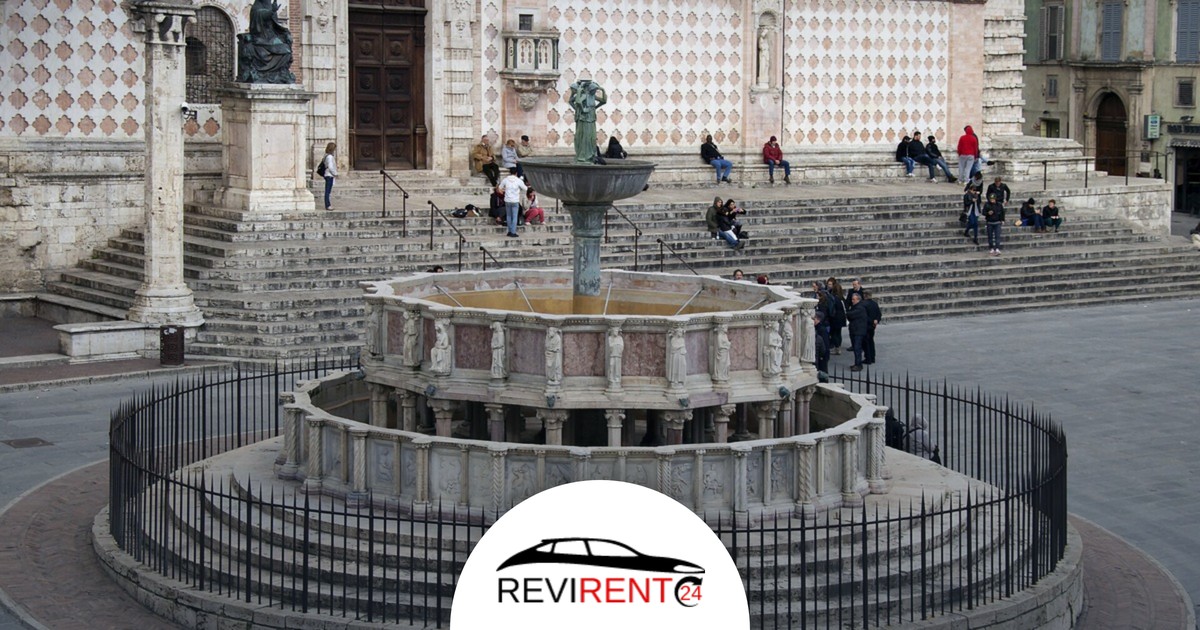
Perugia is a city you look at from above. The capital of Umbria sits on a hill, with an old town gathered around a square that has barely changed in seven hundred years. You can get there by train, but the city is where the line stops: with a rental car, Perugia becomes your base for Assisi, Lake Trasimeno, Orvieto and the whole of central Umbria, on your own schedule.
This guide covers what to see in a day, how to deal with the limited traffic zone, and a practical itinerary starting from our offices in Chiusi, Città della Pieve and Montepulciano.
Why a car makes sense in Perugia
Perugia is not a city that ends at its own walls. Within an hour's drive you have Assisi, Lake Trasimeno, Deruta, Todi, Spello and the hill villages in between: all doable in a day, but only with your own vehicle. Public transport covers the main routes well enough, yet as soon as you leave them journey times stretch and departures thin out.
There is a geographical reason too. The historic centre is up on the hill while the rest of the city and its services are down in the valley: with a car you decide when to go up and when to come down, and above all where to sleep. Many comfortable, well-priced places to stay are outside the walls, and without a car they become awkward.
Distances from our offices are short: about 44 km from Città della Pieve, about 50 km from Chiusi and about 67 km from Montepulciano. That is between forty minutes and a little over an hour of easy driving.
Getting to Perugia from our offices
The easiest route from Città della Pieve runs towards Tavernelle and then along the Pievaiola road, entering the city from the west, which is also the side where the big park-and-ride car parks are. From Chiusi you join the same route after the first stretch towards Città della Pieve.
If you arrive by train, Chiusi-Chianciano Terme station sits on the Rome-Florence line and is the most practical base: pick up the car there and you are in Perugia in under an hour. Plenty of our customers travel exactly this way, and we covered it in our guide on getting around Chiusi and its surroundings. All offices and opening hours are on the Our offices page.
Where to leave the car: restricted traffic, car parks and escalators
This is where most visitors get it wrong. Perugia's historic centre is a limited traffic zone: not somewhere to improvise, because the access gates are monitored and the rules vary by time of day and by area.
The right approach is different: leave the car below and go up on foot or by mechanical link. Perugia has two systems designed for precisely this. The minimetro connects the large car parks on the western side to the centre, while the escalators climb from the car parks beneath the Rocca Paolina and leave you a short walk from Corso Vannucci.
Three practical rules that will save you trouble:
- Set your navigation to the car park, not the square, so you are not routed through a restricted gate.
- If your hotel is inside the zone, ask about the procedure before you travel: properties can usually register your number plate, but it has to be done in good time.
- Always check the road signs on site and the city council's information: times, fares and gates are updated from time to time.
Piazza IV Novembre and the Fontana Maggiore
This is the heart of the city and worth the trip on its own. At its centre stands the Fontana Maggiore, built in the 13th century by Nicola and Giovanni Pisano: two stacked polygonal basins covered in reliefs and statues depicting the months of the year, the liberal arts, biblical scenes and episodes from the city's history. It is one of the masterpieces of Italian Gothic sculpture, and it rewards a slow walk all the way round.
On the north side stands St Lawrence Cathedral, its white and pink marble flank facing the square, with the steps where locals have sat and watched the world go by for centuries. Opposite is the Palazzo dei Priori: together they form a remarkably intact medieval stage set.
Palazzo dei Priori, the National Gallery and the Collegio del Cambio
The Palazzo dei Priori is Perugia's medieval town hall, with its doorway on the main street and a broad fan-shaped staircase onto the square. Two things inside should not be missed.
The first is the National Gallery of Umbria, the museum that gathers Umbrian painting from the Middle Ages onwards: the right place to understand where the region's artistic tradition comes from. The second is the Nobile Collegio del Cambio, the hall of the old money changers' guild, decorated with frescoes by Perugino. It is a small, intense space and usually far less crowded than the big museums.
Between the two you walk along Corso Vannucci, the main street: pedestrian, gently sloping, lined with historic cafes and shop windows. In the evening it becomes the city's living room.
The Rocca Paolina: the city beneath the city
The Rocca Paolina is the strangest and best thing in Perugia. In the 16th century the fortress commissioned by Pope Paul III was built on top of an entire medieval quarter, the one belonging to the Baglioni family, swallowing its houses, lanes and arches rather than demolishing them.
The result is that you can walk through it today: a network of covered streets, doorways and brick chambers, lit and freely accessible. The escalators linking the car parks to the centre run right through it, so you may well cross the fortress simply on your way up into town. It is probably the only place in Italy where the most convenient route to the main square is itself a monument.
Etruscan Perugia: the Etruscan Arch and the Etruscan Well
Before it was medieval, Perugia was Etruscan, and the evidence is above ground. The Etruscan Arch, also known as the Arch of Augustus, is one of the gates of the Etruscan city wall, later reworked in Roman times: a monumental block at the end of Via Ulisse Rocchi, a few minutes from Piazza IV Novembre.
Not far away is the Etruscan Well, a remarkably large piece of hydraulic engineering cut into the rock and still open to visitors: you descend on a walkway to see the travertine block roofing structure up close. If the subject interests you, the National Archaeological Museum of Umbria, housed in the San Domenico complex, fills in the picture; outside the city, towards Ponte San Giovanni, you will find the Hypogeum of the Volumni, an Etruscan family tomb.
A one-day itinerary in Perugia
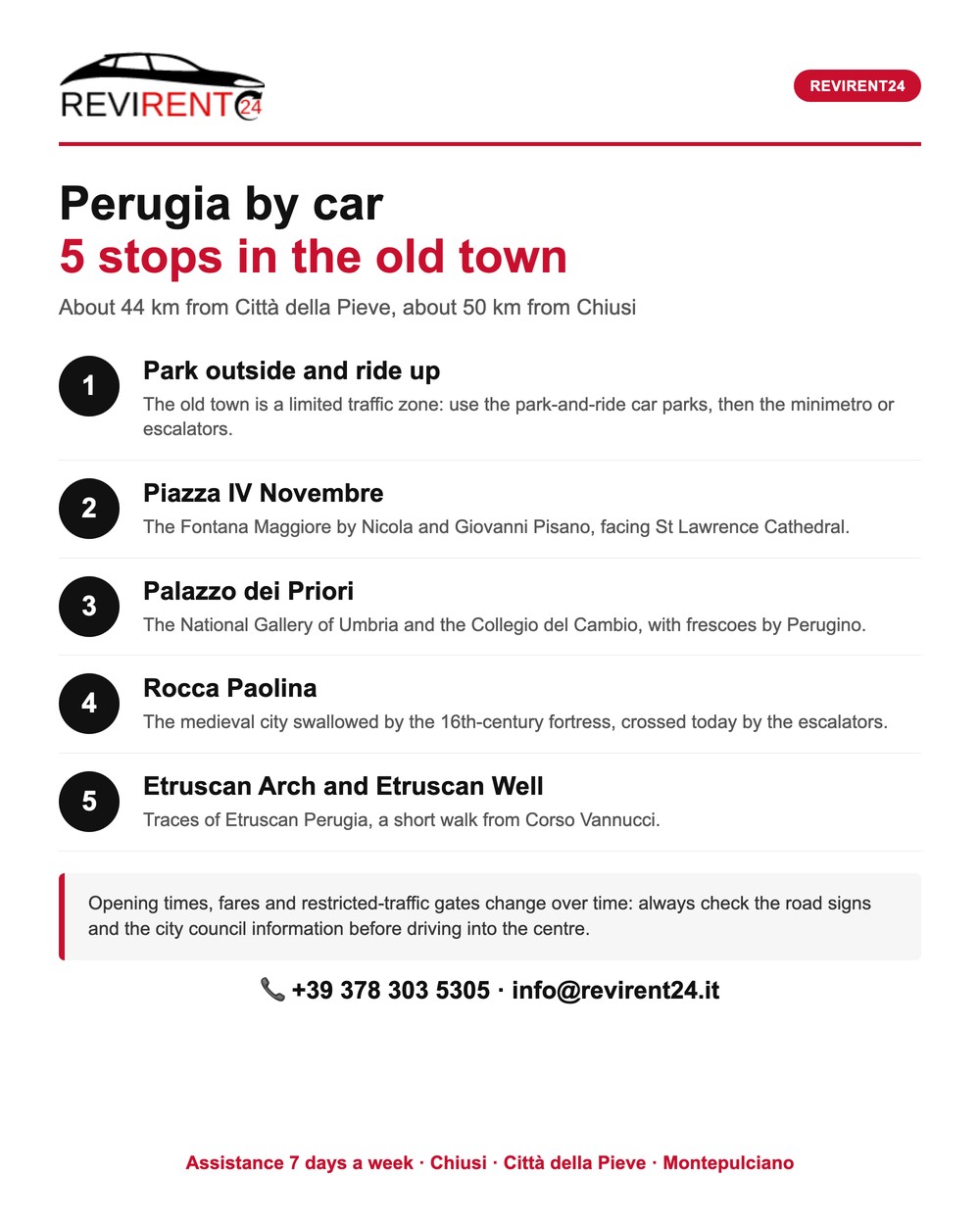
A realistic outline for anyone arriving by car from the Valdichiana or the Val d'Orcia. Timings are indicative and include the walking.
| Stop | What you do | Time |
|---|---|---|
| 1. Park and ride up | Leave the car below and take the minimetro or the escalators | 30 min |
| 2. Piazza IV Novembre | Fontana Maggiore and St Lawrence Cathedral | 45 min |
| 3. Palazzo dei Priori | National Gallery of Umbria and Collegio del Cambio | 2 hours |
| 4. Corso Vannucci and Rocca Paolina | A walk along the main street, then down into the fortress | 1 hour 30 |
| 5. Etruscan Perugia | Etruscan Arch, Etruscan Well and the northern lanes | 1 hour |
If you stay two days, the second plans itself: Assisi is a little over twenty kilometres away and deserves a full half day, as we describe in our guide on what to see in Assisi by car. Alternatively head south to Orvieto and its tuff cliff, or west towards Cortona and Lake Trasimeno.
Which car to choose for Perugia and around
The practical advice is counter-intuitive: for the city, smaller is better. The park-and-ride facilities are multi-storey structures with narrow lanes, and the roads climbing towards the centre are tight. A compact car is easier to handle and cheaper to run.
If Perugia is only your first stop and you then head for Monte Subasio, the Valnerina or the Trasimeno hills, an SUV or crossover gives you more comfort on country roads and more luggage space. Travelling with family or a group, a seven-seater solves the problem of splitting across two cars.
The full fleet, with trim levels and availability, is on the car park page. If you travel for work and do it regularly, it is worth looking at our long-term rental options too.
Renting with Revirent24: how it actually works
We are a local car rental company operating between Chiusi, Città della Pieve and Montepulciano, and our conditions are set out on our FAQ page. In short, for anyone heading to Perugia:
- You do not need a credit card. It can be used as a payment method, but it is not compulsory: without one, a security deposit of 500 euros applies. We explained it all in our guide on car rental without a credit card.
- Documents: a valid ID document and a valid driving licence of the right category for the vehicle. The minimum age is 18.
- Cover: third-party liability, fire and theft, and collision damage waiver. In the event of damage, the CDW excess is 500 euros.
- Additional driver: available, up to two drivers.
- Payment: cash, bank transfer or card (VISA and Mastercard; we do not accept American Express or Diners).
If you arrive by train and it runs late, just let us know and we will move the pick-up time. The number is always the same, +39 378 303 5305, on WhatsApp too.
When to go and what to expect
Perugia works all year round, but the seasons are not equal. Spring and early autumn are the best windows: manageable temperatures for walking uphill and good light on the square. In summer the city is lively and hosts music events with an international following, so book car and accommodation well ahead. In winter the centre is quieter and the museums are far more enjoyable; bear in mind that on Umbria's hill roads winter equipment becomes a real consideration, as we explain in our guide on winter tyres and snow chains with a rental car.
Two final notes. First: Perugia is a city on a slope, so comfortable shoes, always. Second: dates, times and venues for events change from year to year, so check the official channels before building a trip around one.

Frequently asked questions
Can you drive into Perugia's historic centre?
The historic centre is a limited traffic zone and the access gates are monitored. The correct approach is to leave the car in the park-and-ride facilities below and go up by minimetro or escalator. Always check the road signs and the city council's information, as times and gates are updated.
How far is Perugia from Chiusi and Città della Pieve?
It is about 44 km from Città della Pieve, about 50 km from Chiusi and about 67 km from Montepulciano. By car that is between forty minutes and a little over an hour, traffic permitting.
Is one day enough to visit Perugia?
A full day lets you see Piazza IV Novembre, the Palazzo dei Priori with the National Gallery of Umbria, Corso Vannucci, the Rocca Paolina and the Etruscan Arch area. If you want to add Assisi or Lake Trasimeno, allow two days.
Do I need a credit card to rent a car?
No. With Revirent24 a credit card can be used as a payment method but is not compulsory. Renting without one involves a security deposit of 500 euros, which is not required if you pay by card.
Which car is best for visiting Perugia?
For the city itself, a compact car: it is easier to manoeuvre in multi-storey car parks and on narrow uphill streets. If you continue to Assisi, the Valnerina or Lake Trasimeno after Perugia, a crossover offers more comfort and luggage space.
Can I pick the car up at Chiusi-Chianciano Terme station?
Yes. The station is the most convenient base for anyone arriving from Rome or Florence. If your train is delayed, just call us on +39 378 303 5305 and we will move the pick-up time.
Can I travel with a pet?
Yes, provided you tell us in advance and the animal travels in a proper carrier. Otherwise a charge of 40 euros applies for cleaning and restoring the interior.
Start here
Perugia rewards visitors who arrive on their own terms: go up when you like, stay as long as you like and, when you are done, the whole of Umbria is half an hour away. We give you the right car and take the constraints away.
Email us at
