Child car seats in a rental car in Italy: the rules that actually apply
How tall a child must be before the seat comes out, which approval is still valid and why Italy's anti-abandonment device applies to foreign visitors too. The figures that matter, with their sources, and the five minutes of checks to run at pick-up.
In summary
The things you need to know right away
- Height matters, not ageBelow 1.50 metres an approved restraint system is required, whatever the child's age.
- The taxi exemption is not yoursIt covers taxis and hire with driver. If you drive the rental car yourself, the seat is required.
- Anti-abandonment covers visitorsThe duty follows the car's Italian plate, not the residence of the person at the wheel.
In this guide (15)
- 1The tape measure counts more than the calendar
- 2The taxi exemption does not apply to a self-drive rental
- 3R44 and R129: off the shelves does not mean outside the law
- 4How to read the label in thirty seconds
- 5Under fifteen months, rearward facing only
- 6Backless boosters do not exist below 125 centimetres
- 7Child seat in the front: the problem is the airbag
- 8The anti-abandonment device applies to foreign visitors too
- 9What the decree says the device may look like
- 10How many children can get in
- 11Who pays the fine, and what the licence risks
- 12Bring your own seat or find one on arrival
- 13ISOFIX and belts: what to check at pick-up
- 14How we handle it
- 15The summary in five lines
There is one question that almost always arrives the night before departure, with the suitcase already in the hallway: "do we bring the car seat, or will we find one in the car?". Behind it sit three far more important questions that hardly anyone asks: how long is a seat actually required, which approval is still valid, and who pays if something is wrong.
The rules do exist, they are written in only two places, and they do not change because the car is a rental. One thing does change: in a vehicle that is not yours, you cannot rely on your household habits, because you do not know what is on board until you open the door. This guide lines up the measurements that matter, explains which approval is still valid and clears up a point that surprises many foreign visitors, namely Italy's compulsory anti-abandonment device.
The tape measure counts more than the calendar
The first misunderstanding is about age. Article 172 of the Italian Highway Code does not speak of years: it says that children whose stature is below 1.50 metres must be secured to the seat with a child restraint system, suited to their weight and of a type approved under the regulations of the United Nations Economic Commission for Europe or the equivalent European directives.
So the measure is height. A nine-year-old who is 1.40 metres tall still needs a device; a ten-year-old past 1.50 metres does not. A tape measure in the suitcase, before a holiday with children at the borderline, settles more doubts than any family debate.
The same article adds two lesser-known duties. Paragraph 2 puts on the driver the duty to make sure the devices remain in working order: in a rental car that means checking belts, retractors and anchorages at pick-up, not three hundred kilometres later. Paragraph 3 states that in vehicles without restraint systems children up to three years of age cannot travel at all, and older ones may sit in the front only if they are taller than 1.50 metres.
The taxi exemption does not apply to a self-drive rental
This is the single biggest source of mistakes, and it comes from an ambiguous word.
Paragraph 4 of article 172 sets out an exemption: children no taller than 1.50 metres may travel without a child restraint system when they are on board a public hire vehicle, that is a taxi, or a vehicle used for hire with driver, provided that they do not occupy a front seat and are accompanied by at least one passenger aged sixteen or over.
The word "hire" appears, which is why so many people believe the exemption covers the car they drive themselves. It does not. The provision refers to hire with driver, a non-scheduled public transport service with a licensed professional at the wheel. Self-drive rental, where you are handed the keys and off you go, falls outside the exemption: the ordinary rules apply on board, approved device included.
In plain terms: the taxi ride from the station to the hotel can be made without a child seat, if the child sits in the back and is accompanied. A week in the Valdichiana with a rental car cannot.
R44 and R129: off the shelves does not mean outside the law
The second misunderstanding is about approval, and here half-truths abound.
Until a few years ago child seats were approved under UN Regulation No 44, which classified them by weight groups. Today the reference standard is UN Regulation No 129, the one everybody calls i-Size, which works by stature in centimetres. The switch was not abrupt and the dates are written into Commission Delegated Regulation (EU) 2022/1398, published in the Official Journal of the European Union L 213 of 16 August 2022.
Recital 6 puts it plainly: from 1 September 2023 Regulation No 129 replaces No 44, ending the possibility of approving under the latter child restraint systems that are not built into vehicles. To let stocks and distribution channels run down, making available on the market devices already approved under R44 was authorised until 1 September 2024.
From which follows the point that matters to travellers: an R44 seat bought before that date has not become illegal. It can no longer be sold as new, but the Highway Code asks for a device of a type approved under the UN regulations, and an R44 approval granted at the time remains exactly that. If the seat is intact, if the label is legible and if it fits the child, it can be used.
The practical advice is another matter. A device compliant with Regulation No 129 has also been tested in a side impact, which R44 did not require, and it is adjusted by stature, a more honest figure than weight. If the family seat is ten years old and has survived three house moves, replacing it is not a legal duty but it is a good idea.
| UN Regulation No 44 | UN Regulation No 129 (i-Size) | |
|---|---|---|
| Classification criterion | Weight groups | Stature range in centimetres |
| New approvals | No longer granted since 1 September 2023 | The standard in force |
| Sale of already approved devices | Allowed until 1 September 2024 | No cut-off date |
| Use of a device already bought | Allowed: the approval stays valid | Allowed |
| Side impact test | Not required | Required |
The dates in the second and third rows come from Delegated Regulation (EU) 2022/1398; the fourth row follows from article 172 of the Highway Code, which asks for a type-approved device without setting an expiry date for use.
How to read the label in thirty seconds
Every device carries a label with the approval mark. On a seat compliant with Regulation No 129 the mark shows the size range in centimetres for which the device was approved, for instance from 100 to 125 centimetres or from 125 to 150, and the letter E inside a circle followed by the number of the country that granted the approval.
Three things to check before leaving, ideally at home rather than in the rental car park:
the stature range printed on the label covers the child's current height;
for integral devices the label also states the maximum occupant mass, which must be respected;
the instructions for use are still available, because that is where the manufacturer explains how long to keep the seat rearward facing.
Under fifteen months, rearward facing only
Regulation No 129 contains one rule worth learning by heart. Point 6.1.2.7 states that for children under fifteen months of age only lateral facing or rearward facing devices shall be used.
Two technical constraints follow, designed to stop a child who is too small from ending up facing forward:
a rearward facing device intended for the first fifteen months must accommodate a child up to 83 centimetres tall;
a forward facing device is not designed to accommodate a child whose stature is below 76 centimetres.
It is also why a convertible seat, in its rearward facing configuration, must cover at least 83 centimetres. When the manufacturer recommends keeping the child rearward facing beyond that threshold, its instruction outweighs the legal minimum.
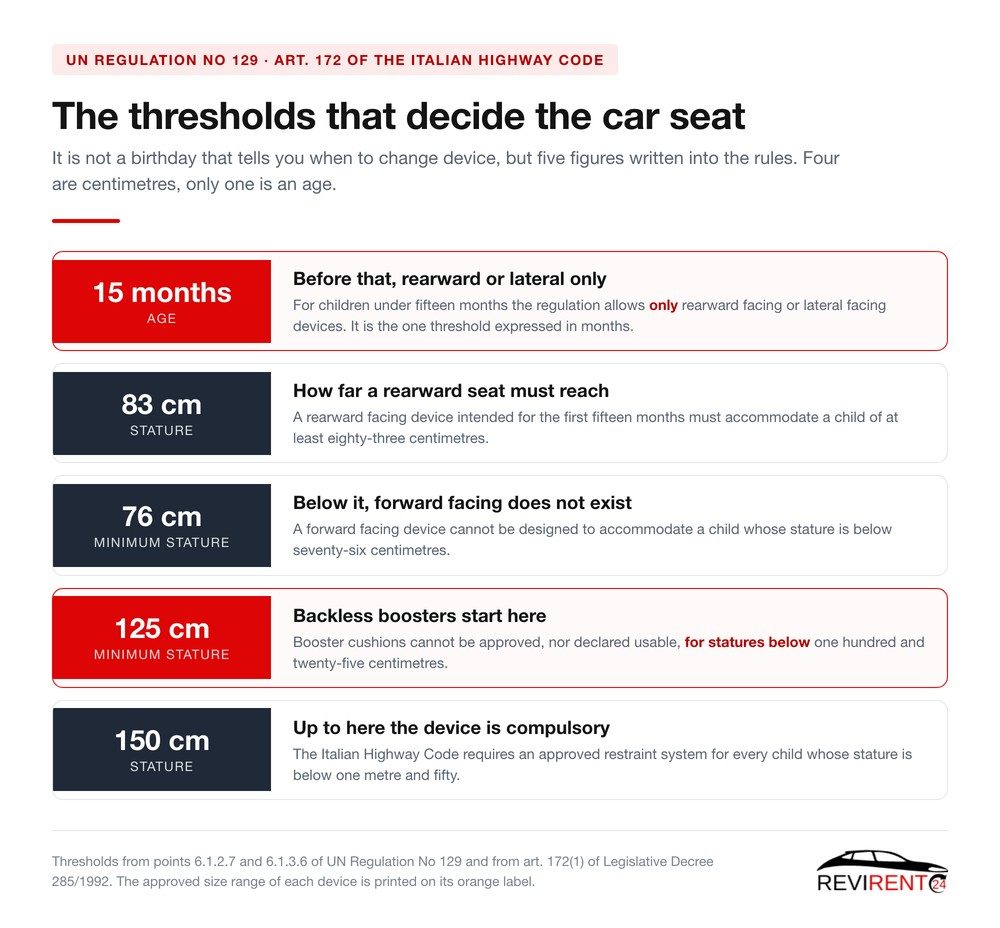
Four of the five thresholds are centimetres. The only one expressed in months concerns the facing direction.
Backless boosters do not exist below 125 centimetres
The low cushion, the backless one you slide under the child to raise them so the belt runs in the right place, is the device most often borrowed, found at the bottom of a boot or kept at the grandparents' house. It is also the one most often used too early.
Point 6.1.3.6 of Regulation No 129 is unambiguous: for booster cushions, approval shall not be granted for a stature below 125 centimetres, and those cushions shall not be declared usable below that figure. This is not a paediatrician's recommendation, it is the boundary of the approval itself.
It means there is an intermediate stage between the high-backed seat and the bare cushion that cannot be skipped: up to 125 centimetres you need a device that also supports the back and the head, because it is the backrest that places the belt correctly on the shoulder and protects in a side impact.
| Child's stature | What is needed | Reference |
|---|---|---|
| Up to 76 cm | Rearward or lateral facing device. Below this figure forward facing is not provided for | UN Reg. 129, point 6.1.2.7 |
| Up to 83 cm, under 15 months | Rearward or lateral facing device only, whatever the stature | UN Reg. 129, point 6.1.2.7 |
| From 76 to 125 cm | Device with a backrest, facing forward or rearward according to the manufacturer's instructions | UN Reg. 129, points 6.1.2.7 and 6.1.3.6 |
| From 125 to 150 cm | A backless booster cushion is allowed too, if approved for that range | UN Reg. 129, point 6.1.3.6 |
| Above 150 cm | The vehicle's seat belt, as for an adult | Art. 172(1), Highway Code |
The table is a map, not the last word: that belongs to the label on the individual device and to its instruction booklet, because the approved range changes from model to model.
Child seat in the front: the problem is the airbag
Carrying a child in the front is not banned outright, but paragraph 5 of article 172 sets a categorical limit: a child may not be carried in a rearward facing seat on a passenger seat protected by a front airbag, unless the airbag has been deactivated, including by an adequate automatic system.
In a rental car this is exactly the kind of detail you do not improvise. The deactivation switch exists on many models, often in the glovebox or on the side of the dashboard on the passenger side, but not on all of them and not always in the same place. Some cars handle it automatically through an occupant sensor.
The practical rule is simple and settles ninety per cent of cases: the car seat goes in the back. If for some reason it has to go in the front, ask the staff where the airbag is switched off and check that the deactivation light is on before setting off, not afterwards.
The anti-abandonment device applies to foreign visitors too
Here is the surprise for many travellers, and the text deserves a careful read.
Paragraph 1-bis of article 172 says that the driver of vehicles in categories M1, N1, N2 and N3 registered in Italy, or registered abroad and driven by residents in Italy, when carrying a child under four years of age secured to the seat with a restraint system, must use a dedicated alarm device designed to prevent the child from being left behind.
The decisive condition is the registration plate, not the driver's residence. A car rented in Italy is registered in Italy: the duty applies even if the driver lives in Munich, Rotterdam or Boston. There is no tourist exemption, and this is probably the least known fact in the whole subject.
Penalties did not start immediately, because lawmakers allowed time for manufacturers and for public information: they have applied since 6 March 2020.
It is the same mechanism that governs other duties attached to the plate rather than to the driver's origin, like those we covered when writing about renting with a foreign driving licence and the international driving permit: the car is Italian, and Italian rules travel with it.
What the decree says the device may look like
The specifications are set by decree no. 122 of the Ministry of Infrastructure and Transport of 2 October 2019, published in Gazzetta Ufficiale no. 249 of 23 October 2019. Article 1 defines it as an alarm device, made of one or more interconnected elements, that prevents children under four from being left behind and activates when the driver moves away from the vehicle.
Article 3 allows three configurations: built into the child restraint system at the factory, provided as standard equipment or as an accessory of the vehicle in its type-approval file, or independent of both the seat and the car.
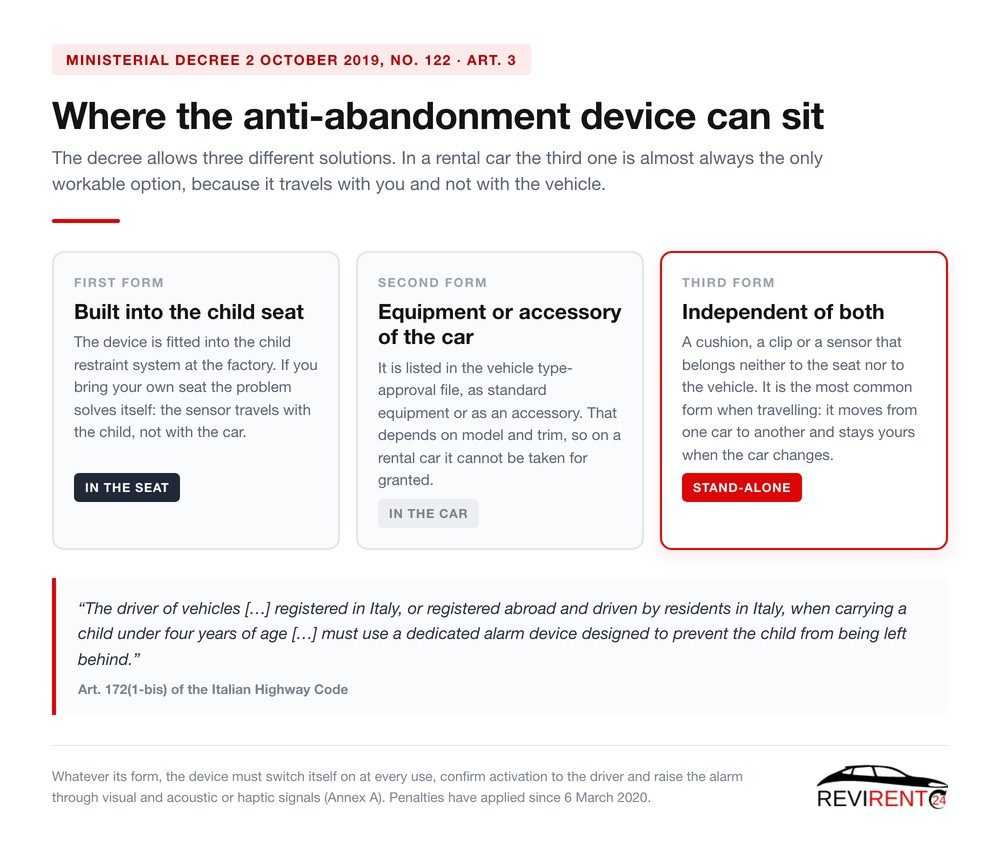
In a rental car the third form is almost always the only workable one: it travels with you, not with the vehicle.
Annex A lists what the device must be able to do, and those are the criteria for judging a purchase:
signal that the driver has left the child behind;
switch itself on automatically at every use, with no further action by the driver;
give the driver a confirmation signal when it activates;
draw attention promptly through visual and acoustic signals, or visual and haptic ones, perceivable inside or outside the vehicle;
warn of a low battery level, if battery powered.
The decree adds that the device may include an automatic communication system to send messages or calls over mobile networks: that is an option, not a requirement. And it specifies, in point 2 of the annex, that when interacting with the vehicle or the child seat the device must not alter their approval characteristics in any way.
One last note for visitors: article 7 of the decree presumes compliant any device lawfully marketed in another European Union country, in Turkey or in an EFTA state party to the EEA agreement. A cushion bought in Germany or Spain, in other words, is fine.
How many children can get in
You still hear that "three small children fit in the back, they are tiny". That used to be true. It is not any more.
Article 169 of the Highway Code sets the general rule: the number of people on board cannot exceed the figure stated in the vehicle registration document. The exemption that allowed two extra children under ten in the rear seats, accompanied by a passenger aged at least sixteen, was expressly limited to 8 May 2009. It expired more than fifteen years ago, and the same applies to the matching exemption in paragraph 9 of article 172.
A child counts as a person, and every person needs an approved seating position. For a large family the variable to settle at booking time is the number of seats, not improvisation at the kerb. Paragraph 4 of article 169 is worth remembering too: passengers must sit so as not to restrict the driver's freedom of movement or block the view.
Who pays the fine, and what the licence risks
Paragraph 10 of article 172 punishes with an administrative fine from 83 to 332 euro anyone who fails to use restraint devices, belts and child systems included, or the alarm device required by paragraph 1-bis. The same provision answers the question of who is liable: when the failure concerns a minor, liability falls on the driver or, if present in the vehicle at the time, on whoever is responsible for supervising the child.
In a rental car that detail matters, because it confirms that the owning company is out of the picture: the person driving pays, or the person sitting next to the child. It is the same logic that governs penalties in general, as we saw when discussing who pays fines issued to a rental car.
Then comes a consequence that weighs more than money. If within two years the driver commits at least two breaches of that same paragraph, the last offence also brings suspension of the driving licence from fifteen days to two months. And paragraph 11 fines from 41 to 167 euro anyone who, while using the devices, alters or hinders their normal operation: think of the clip that holds the belt in a comfortable but wrong position.
The chapter changes entirely if a crash is involved: there the company's policy and the compensation procedure come into play, which we reconstructed step by step in our guide on what to do after an accident in a rental car.
Bring your own seat or find one on arrival
By now the practical choice makes itself, but it is worth spelling out.
Bringing your own is the safest option in compliance terms: you know the approval, you know the stature range, you know how the harness adjusts and the child is used to it. If your seat has a built-in anti-abandonment device, one piece of luggage solves two problems. The drawback is bulk, especially when a flight is involved.
Finding one on arrival saves space and effort, but it has to be organised in advance: how many devices, for which statures and ages, and whether the anti-abandonment device is needed too. That is a request to make when booking, along with everything else, not something to discover at the counter.
In between there is a third route, often the most convenient for those coming from far away: bring only the stand-alone anti-abandonment device, which weighs a few hundred grams and fits in a backpack, and settle the child seat question with the staff beforehand.
ISOFIX and belts: what to check at pick-up
An i-Size seat needs ISOFIX anchorages, and almost every recently registered car has them on the outer rear seats. Almost, not all, and not on every position: the centre rear seat often has none, and in some models it has a three-point belt while in others only a lap belt.
At pick-up, before loading the luggage, five minutes of checks are worth it:
look for the ISOFIX anchorages between backrest and cushion, usually marked by two labels;
check that the Top Tether upper anchorage is there, if your seat requires one: it may be behind the backrest, on the boot floor or on the roof lining;
make sure the rear belts run out and retract properly, as paragraph 2 of article 172 requires;
if you use a device secured by the car's belt, check that the belt is long enough to complete the path shown by the manufacturer;
if anything looks wrong, say so at the desk straight away: with the car still parked it takes five minutes, on the road it does not.
The same attentive look is worth giving to seasonal equipment, as we explain in our guide to winter tyres and snow chains on board.
How we handle it
Revirent24 rents cars in the Valdichiana with offices in Montepulciano, at Chiusi railway station and in Città della Pieve, and you can return the car to any of the three. It is a region you explore as a family: hill towns, wineries, white gravel roads and short hops, exactly the setting in which a child seat gets fitted and removed several times a day.
That is why the request belongs in the booking, together with dates and pick-up point. Our phone support answers every day from 8:30 to 19:00 on +39 378 303 5305, and you can write to info@revirent24.it: tell us how many children are travelling, with what stature and age, and we will work out the best configuration for the car you have chosen. Pick-up outside office hours is arranged by appointment, which helps anyone arriving at Chiusi by train with luggage and pushchairs.
One detail families appreciate: with us renting is possible without a credit card too, a requirement that for many households is the real obstacle to setting off. And if the holiday turns into a longer stay, we bring the same care to long-term rental, where the car is chosen around the people who get in every day.
The summary in five lines
Below 1.50 metres an approved device is required, with no age-based exceptions. Under fifteen months you travel rearward facing. A backless booster does not start before 125 centimetres. An R44 seat bought by 1 September 2024 can still be used, but is no longer sold. And if there is a child under four on board, in a car with Italian plates the anti-abandonment device is compulsory for foreign visitors too.
The rest is five minutes at pick-up and one phone call at booking time. For any doubt about the car you have chosen, write to us or call: it is quicker than looking for the answer in a forum.