Travelling with pets in a rental car in Italy: the law and the contract
On carrying animals by car, Italian law and the rental contract ask for two different things, and almost nobody says so. What article 169 of the Highway Code actually requires, what getting it wrong costs, and why leaving a dog in the car now puts your licence at risk.
In summary
The things you need to know right away
- One pet may travel looseItalian road law does not require a carrier for the first animal, only that it does not obstruct driving.
- From two upwards, a cageBeyond the first animal only carriers or a netted rear compartment are allowed, and nets cannot be fitted to a rental car.
- With us the carrier is always requiredDeclare the pet when booking: it is a contract rule, not a legal one, and without it a 40.00 euro cleaning charge applies.
In this guide (13)
- 1One animal: the law does not require a carrier
- 2From two animals upwards, everything changes
- 3The divider net is a solution that does not exist in a rental car
- 4The detail nobody manages to explain: a reference to a repealed provision
- 5What it costs to get it wrong, and who pays
- 6Leaving the animal in the car: here the risk is your licence
- 7The European animal transport regulation does not apply to you
- 8Where the animal can actually travel
- 9The Revirent24 rule: always a carrier, and declared in advance
- 10If you are arriving from abroad with your animal
- 11Preparing the trip: five things that make the difference
- 12At collection and at return
- 13Booking with an animal on board
Anyone setting off with a dog asks the same thing: "can I keep him on the seat?". It is the wrong question, or rather, it is one question where there should be two. Because in a rental car two separate texts decide how your animal travels, and they say different things: the Italian Highway Code and the contract you sign at the desk.
Mixing them up is the most common mistake. People who read only the law turn up convinced the carrier is optional, and are told otherwise. People who read only the contract believe the carrier is imposed by the Highway Code, and repeat something that is simply untrue. Here we separate the two, with the actual provisions in hand, and then set out the practical steps for leaving without surprises.
One animal: the law does not require a carrier
The reference is article 169(6) of the Italian Highway Code, that is Legislative Decree 30 April 1992, no. 285. The wording is blunt: carrying more than one domestic animal is prohibited, and in any case carrying animals in conditions that obstruct or endanger driving is prohibited.
Read the other way round, that sentence says something that surprises almost everyone: a single domestic animal may travel loose in the cabin. There is no general obligation to use a carrier in Italian road law for the first animal. There is, however, a condition, and it is far stricter than it looks, because it is not measured in centimetres but in behaviour: the animal must never obstruct the driver or endanger driving.
That condition connects to paragraph 1 of the same article, which requires the driver to enjoy the fullest freedom of movement to perform the manoeuvres needed for driving, and to paragraph 4, which requires that passengers neither restrict the driver's movements nor block the driver's view. A thirty kilo dog shifting across the rear seat while you take a hairpin bend in the Val di Chiana is, in practice, an obstruction. A cat deciding to reach the dashboard is an even more obvious one.
So the law does not demand a cage, it demands a result. And in a car, with a live and alert animal, that result is reliably achieved in one way only: by containing it.
From two animals upwards, everything changes
The second part of paragraph 6 opens the only possible route when there is more than one animal: carrying domestic animals only, even more than one, is allowed provided they are kept in a proper cage or container, or in the compartment behind the driving position suitably separated by a net or another equivalent device.
Here the room for interpretation closes. Two loose dogs in the cabin are a breach regardless of how they behave, even if they sleep through the entire journey. It is not a matter of the driver's good sense, it is a matter of number.
Which is why a pair of animals always costs more organisational effort than a single one: you need two carriers, or a double carrier, or a load compartment stably separated from the rest of the cabin.
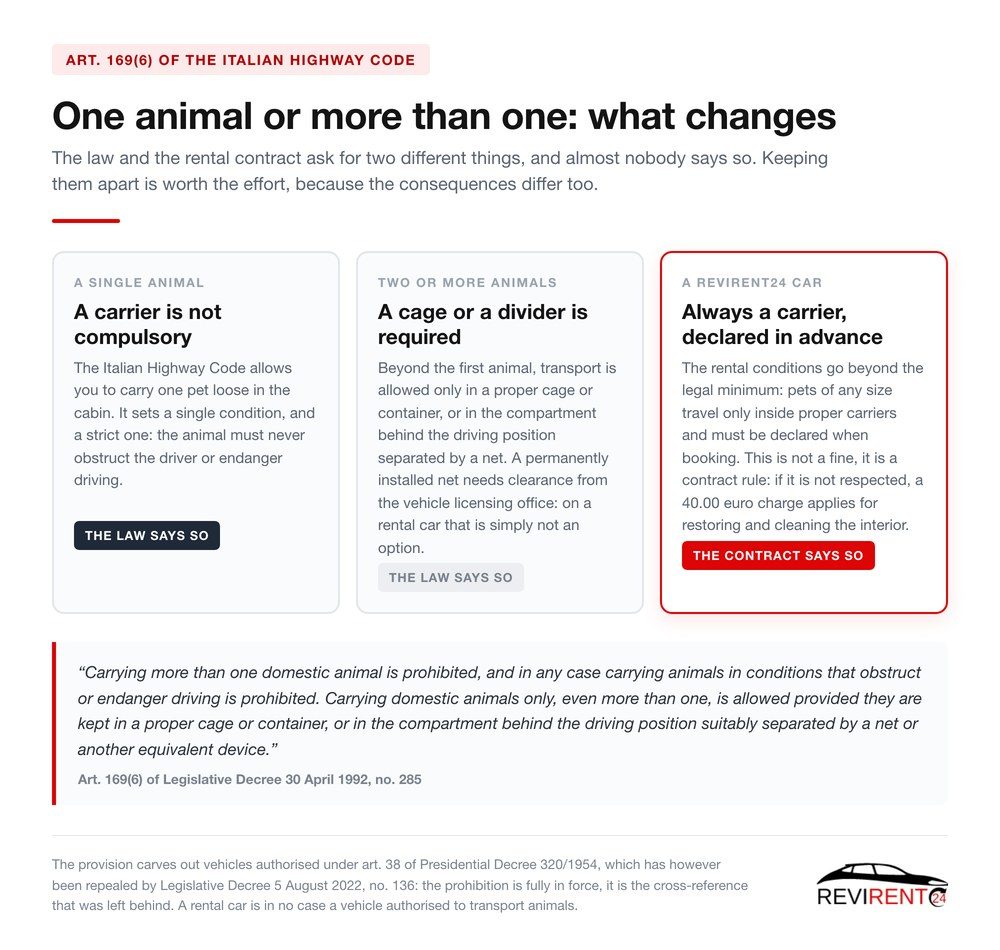
What the Highway Code asks for and what the rental contract asks for are two different things.
The divider net is a solution that does not exist in a rental car
People who often travel with two dogs immediately think of the net behind the seats. In your own car that is a sensible choice. In a rental car it is not, and the reason is written into the same provision.
Paragraph 6 specifies that the net or equivalent device, if permanently installed, must be authorised by the competent office of the Department for Land Transport. That means the stable installation of a divider in the load compartment is not an accessory like any other: it goes through the vehicle licensing authority.
In a car that is not yours, and that you hand back in a week, that route is closed twice over. First because you cannot authorise a modification to a vehicle registered to someone else. Second because you cannot alter the fit-out of a rental car anyway, just as you cannot alter any other component. What remains are removable pressure-fit nets, which are not permanent installations but, precisely for that reason, do not offer the same holding guarantee: if they do not restrain the animal, the obstruction to driving is back in play.
The practical conclusion is simple and holds for nearly every traveller: in a rental car the answer is the carrier, not the compartment divider.
The detail nobody manages to explain: a reference to a repealed provision
There is a passage in paragraph 6 that derails anyone trying to piece it together alone. The provision opens by saying the prohibition concerns vehicles other than those authorised under article 38 of Presidential Decree 8 February 1954, no. 320, that is the veterinary police regulation.
If you go looking for that article 38 to work out which vehicles are authorised, you will not find it: the 1954 veterinary police regulation was repealed by Legislative Decree 5 August 2022, no. 136, in force since 27 September 2022, through which Italy aligned its animal disease rules with Regulation (EU) 2016/429.
It is worth being clear about what this does and does not mean. It means nothing for the driver: the prohibition in paragraph 6 is fully in force and applies exactly as before. It is the cross-reference that was left behind, a coordination oversight that is not the only one in the Highway Code. And in any case the exception concerned vehicles authorised to carry animals under veterinary rules, a category a rental hatchback has never belonged to.
We flag it for a precise reason: if your online search turned up confused explanations about "which vehicles are authorised", now you know why nobody can tell you.
What it costs to get it wrong, and who pays
Breaches of the rules on carrying animals fall under paragraph 10 of article 169, which penalises anyone breaching the other provisions of that article: an administrative fine of 87 to 344 euro.
In a rental car the next question is always the same: who pays it? The answer is the driver. The rental company is the registered keeper and receives the notice, but the breach belongs to whoever was driving, and the path is the one we described in our guide on who pays fines issued to a rental car: the rental company passes on the driver's details and the penalty is re-notified to the person at the wheel.
There is, however, a far heavier consequence than a fine, and it comes from a different branch of the law.
Leaving the animal in the car: here the risk is your licence
Article 727 of the Italian Criminal Code punishes two kinds of conduct, and the second one concerns travellers closely. The first paragraph targets anyone who abandons domestic animals or animals that have acquired habits of captivity. The second paragraph provides that the same penalty applies to anyone who keeps animals in conditions incompatible with their nature and causing severe suffering.
A car locked in the August sun with the animal inside is the textbook case of the second limb. No intent to get rid of the dog is needed: the condition in which it is left is enough.
The penalties have been revised twice in eighteen months, so anyone relying on old memories will get the numbers wrong. Law 25 November 2024, no. 177, the Highway Code reform, in force since 14 December 2024, added two provisions: if the act takes place on a road or its appurtenances the penalty is increased by one third, and above all, establishing the offence entails in every case, where the act is committed by means of a vehicle, suspension of the driving licence for six months to one year. Law 6 June 2025, no. 82, in force since 1 July 2025, then raised the minimum fine under the first paragraph from 1,000 to 5,000 euro: the range today runs from 5,000 to 10,000 euro, as an alternative to detention of up to one year.
Put that way, the twenty minute stop on a "I'll only be a moment" basis changes character. It is no longer a risk for the animal alone: it is conduct that can cost the driver half a year of licence, in a country you may well have flown into, where the car is your only way of getting around.
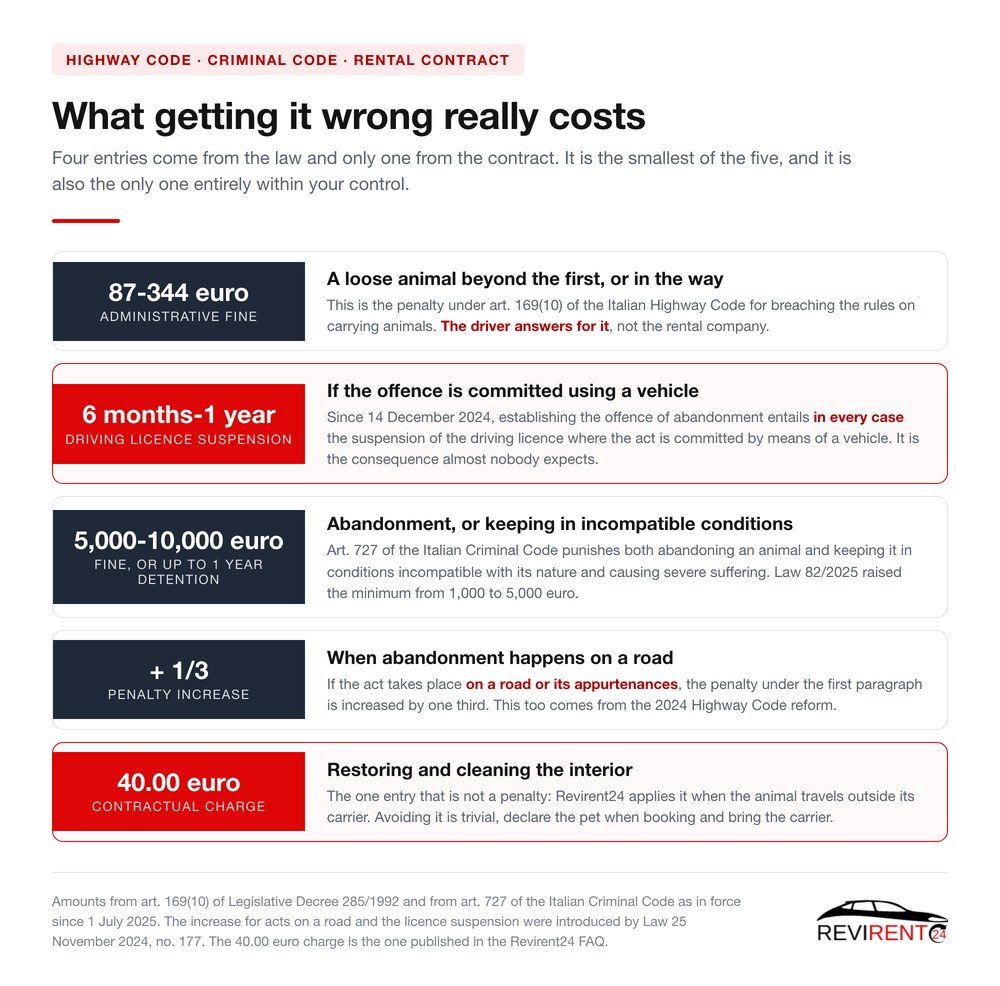
Four consequences out of five come from the law. The smallest, and the only one entirely up to you, comes from the contract.
The European animal transport regulation does not apply to you
You will sometimes read that carrying animals by car is governed by Regulation (EC) No 1/2005, the one on the protection of animals during transport. It is a confusion worth closing straight away, because it creates needless worry about maximum durations, compulsory rest stops and travel paperwork.
Article 1(5) of that regulation is explicit: the regulation does not apply to the transport of animals which is not in connection with an economic activity, nor to transport directly to or from veterinary practices or clinics on the advice of a veterinarian.
Your dog on holiday is not transport connected with an economic activity. The rules that concern you are the Highway Code provisions set out above, plus veterinary common sense, which is not a rule but works better than many rules.
Where the animal can actually travel
Translated into real choices, inside a B or C segment car of the kind most often rented, there are four possible positions and they are not equivalent.
| Where | Does the law allow it? | What it actually takes |
|---|---|---|
| Loose on the rear seat | Yes, if there is only one animal and it does not obstruct driving | A calm animal used to cars. It remains the most fragile case, because the condition must hold for the whole journey |
| Carrier on the rear seat | Yes, always | A rigid or semi-rigid carrier secured with the seat belt so it cannot slide under braking |
| Carrier in the boot | Yes, always | A boot with adequate ventilation and the carrier wedged against the seat backs, not resting on the luggage |
| Rear compartment behind a net | Yes, but a permanent net must be authorised by the licensing office | Not workable in a rental car: no stable installation is allowed on the vehicle |
| Loose on the front seat | No, where it restricts the driver's movement or view | To be ruled out regardless, even with small animals |
The middle columns follow from article 169(1), (4) and (6) of the Highway Code. The right-hand column is handover experience, not law: it is what we see work, and what we see come back with an interior to clean.
The Revirent24 rule: always a carrier, and declared in advance
This is where we move from the law to the contract, and the contract asks for something more.
Our conditions, published in the frequently asked questions, say three precise things. First: carrying animals of any size must be notified in advance. Second: animals may be carried in our vehicles only inside proper carriers. Third: if this rule is not respected, a charge of 40.00 euro is applied for restoring and cleaning the vehicle interior.
It is worth explaining why, rather than simply stating it. A rental car does not go home after the trip: it returns to the fleet and the next day someone else collects it, possibly someone with an allergy. Hair works its way into the vents and the seat stitching and does not come out with one pass of a vacuum cleaner. The carrier does not protect the car from your dog: it protects the next rental, and by extension it protects you, because it is what keeps the 40 euro off your final bill.
Two clarifications that avoid misunderstandings. The charge is not a penalty: it is the cost of restoring the interior, and it is avoided entirely by following the rule. And notifying us in advance is not a way of charging you more: it lets us prepare the vehicle and tell you, if relevant, which model in the fleet takes a carrier of that size best.
If you are arriving from abroad with your animal
Anyone landing in Italy and collecting a car in Chiusi or Montepulciano with a dog in tow has already cleared, upstream, a check that concerns the journey rather than the rental: the one under Regulation (EU) No 576/2013 on the non-commercial movement of pet animals.
| Requirement | What the regulation asks for |
|---|---|
| Identification | An implanted transponder (microchip), or a clearly readable tattoo applied before 3 July 2011 |
| Rabies vaccination | Administered by an authorised vet, with the animal at least twelve weeks old and never before the microchip date |
| Waiting period after the first vaccination | Validity starts no less than twenty-one days after completion of the primary vaccination protocol |
| Document | A duly completed identification document, that is the European pet passport |
| Maximum number | Five animals per single non-commercial movement, subject to exemptions for competitions and events |
The figures come from articles 5, 6 and 17 and from Annex III of the regulation. One point deserves attention because it ruins more trips than you would think: the twenty-one day wait applies to the first vaccination. If the dog has never been vaccinated against rabies, booking the vet the week before departure is not enough.
On the driving side, if your licence was issued outside the European Union it is worth also reading our guide on foreign licences and the international driving permit, because that is the second document people discover is missing at the desk.
Preparing the trip: five things that make the difference
The rules tell you what you cannot do. The rest is craft, and it comes from the cars that come back.
A carrier is secured, not just placed. A loose carrier on the seat becomes a projectile under braking. The seat belt passed around the frame, or wedging it against the seat backs in the boot, solves the problem in ten seconds.
The animal eats before, not during. A light meal three or four hours before departure cuts travel sickness far more than any remedy improvised at a service station.
A stop every two or three hours. Water, a few minutes on the lead, and off again. It applies to you too, and on the Florence to Rome stretch service areas are plentiful.
Window half open, not the muzzle out. A direct draught into the eyes and ears at ninety kilometres an hour is a genuine veterinary problem, not a fussy owner's quirk.
A sheet under the carrier. It costs two euro and does more than any end-of-trip cleaning, because hair that never reaches the fabric never has to be removed.
If you are travelling in winter across the Apennines, add one step: with an animal on board a forced stop becomes more awkward, so it pays to arrive prepared. We cover it in our guide on winter tyres and snow chains in a rental car.
At collection and at return
Two moments deserve more attention than usual when travelling with an animal.
At collection, besides the usual walk around the bodywork, open the boot and judge the real space by eye: the capacity quoted by the manufacturer includes the underfloor, whereas the carrier sits on the deck. Check too that the rear air vents are present and working, because on the most compact cars they are not always fitted.
At return, ten minutes with a vacuum at a service station are worth more than any discussion at the desk. If something happened during the trip, say so: a seat needing treatment, declared straight away, is a manageable problem, while the same seat discovered after you have left becomes a file reopened days later. It is the same principle that applies after an accident in a rental car: what is declared immediately always costs less than what is discovered afterwards.
Booking with an animal on board
The path is shorter than it looks: pick the model from those available in our fleet, tell us when booking that you are travelling with an animal and state its size, get the carrier ready. That is all.
Collection and return at our offices in Montepulciano, Chiusi railway station and Città della Pieve: you will find them all, with addresses and opening hours, on the our locations page. If you are unsure about carrier size or which model suits you best, phone support answers every day from 8:30 to 19:00 on +39 378 303 5305, or write to info@revirent24.it or through the contact page.
One question asked at booking time is worth more than any guide, including this one.