



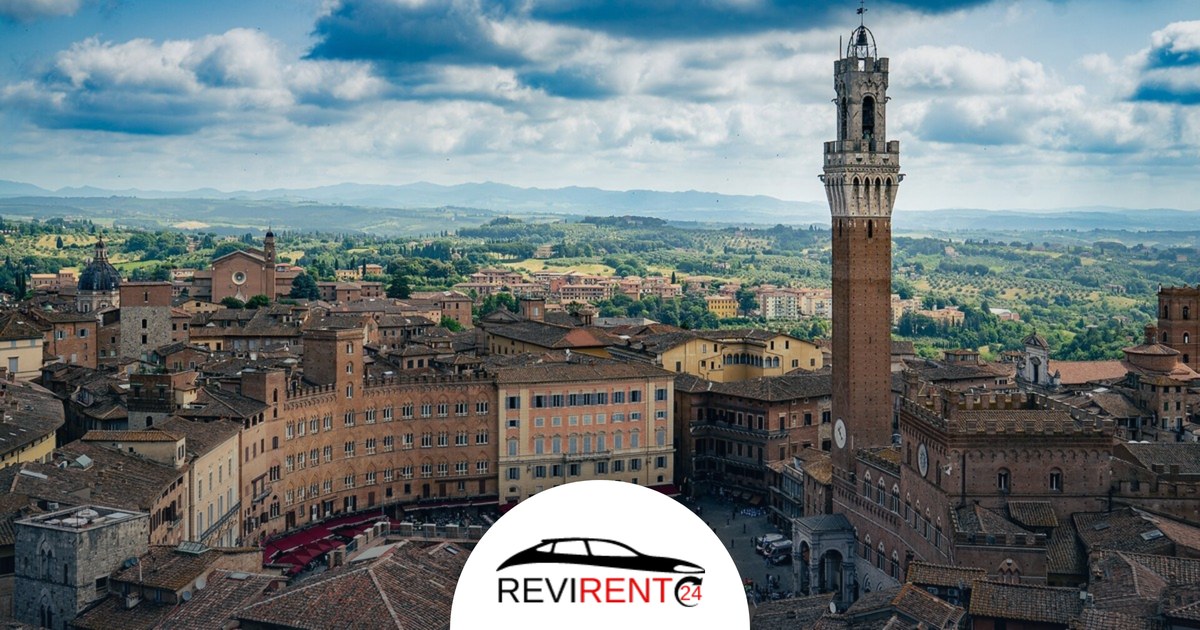
Siena is explored on foot, but you get there by car. The old town is an uphill maze, closed to traffic and a UNESCO World Heritage Site since 1995: inside the walls a car is useless. Outside, everything changes. With your own vehicle Siena becomes the gateway to the Crete Senesi, Chianti, Val d'Orcia and San Gimignano, all day-trip destinations you can only reach if you are not tied to someone else's timetable.
This guide covers what to see in a day, where to leave the car without falling foul of the restricted-traffic zone, and a practical itinerary starting from our offices in Chiusi, Città della Pieve and Montepulciano. Chiusi, as it happens, is in the province of Siena: this is our own county town.
Why visiting Siena by car makes sense
Siena is not a city you pass through: it sits alone among the hills, away from the main railway lines. Arriving by train almost always means changing, and travellers without a car end up seeing the old town and very little else.
The real value lies within an hour's drive. Around Siena you have the Crete Senesi with their bare clay hills, Chianti with its roads running between the vines, San Gimignano and Monteriggioni, and the whole of the Val d'Orcia to the south. Public transport serves these places badly or not at all: without a car they stay on the wish list.
There is also a practical point that affects your budget. Sleeping inside the walls is expensive, and the comfortable places out in the surrounding countryside only work if you have a way to move around in the evening.
How to reach Siena from our offices
The natural route runs through the Valdichiana. From Montepulciano it is about 66 km, from Chiusi about 85 km and from Città della Pieve about 95 km: a good hour of driving on roads that flow well.
The quickest way from Chiusi follows the Valdichiana up to Bettolle and then the toll-free Siena-Bettolle link road, which enters the city from the east. From Montepulciano you can choose: the same link road, or the scenic route through Pienza and San Quirico, which takes considerably longer but is worth the trip. In that case, turn the day into a proper itinerary, as we explain in our guide to the car itinerary among the thermal baths of the Val d'Orcia.
If you arrive by train, Chiusi-Chianciano Terme station sits on the Rome-Florence line and is the handiest base: you pick up the car there and you are in Siena in just over an hour, free to stop wherever you like along the way. We covered this in our guide on how to get around Chiusi and its surroundings. Offices and opening hours are on the Our offices page.
Where to leave the car: restricted traffic zone, car parks and lifts
This is where the day is won or lost. Siena's old town is a limited traffic zone (ZTL) and it is not an area worth chancing: the gates are camera-controlled and the rules change by area and by time of day.
The right approach is simple: leave the car in the structures around the walls and walk in. Siena is built on three hills, so the centre sits higher than the car parks; some structures are connected to the upper town by escalators and mechanised lifts, others involve a few minutes of uphill walking. Choose according to how far you are willing to climb, not according to the distance on the map.
Three rules that will keep you out of trouble:
- Set the sat nav to the car park, never to Piazza del Campo: that is exactly how people end up driving through a restricted gate without noticing.
- If your accommodation is inside the ZTL, ask them for the procedure before you set off: properties can usually register your number plate, but it has to be done in good time.
- Always check the road signs on site and the official city council information: times, fares and gates are updated over time.
Piazza del Campo and the Torre del Mangia
It is one of the most recognisable squares in Europe and it looks like nowhere else. It is shaped like a shell, sloping down towards the Palazzo Pubblico, its brick paving divided by travertine bands into nine sectors: a reference to the Government of the Nine, the council that ruled Siena during its golden age.
At the top stands the Fonte Gaia. What you see is a nineteenth-century copy: the original reliefs by Jacopo della Quercia, worn away by time, are kept in the museum at Santa Maria della Scala. On the opposite side rises the Torre del Mangia, the bell tower of the Palazzo Pubblico and one of the tallest medieval civic towers in Italy. You can climb it: the staircase is narrow and runs to several hundred steps, but the view over the rooftops and the hills repays the effort.
One detail almost nobody notices: there is no monument in the middle of the square. It is deliberately empty, because that is where the Palio is run twice every summer.
Palazzo Pubblico and the Civic Museum: Good and Bad Government
The Palazzo Pubblico is Siena's medieval town hall and houses the Civic Museum. Inside there are two works that justify the ticket on their own.
The first is the cycle by Ambrogio Lorenzetti in the Sala della Pace, the Allegory and Effects of Good and Bad Government: a fourteenth-century fresco showing, side by side, what happens to a city that is well governed and to one that is not. It is considered one of the first great landscapes in Western painting, and it remains startlingly relevant.
The second is the Maestà by Simone Martini in the Sala del Mappamondo: the enthroned Virgin surrounded by the heavenly court, painted in the early fourteenth century to remind the rulers who they answered to. If you only have time for one museum in Siena, make it this one.
The Cathedral, the floor and the Piccolomini Library
The Cathedral of Santa Maria Assunta is a few minutes' walk from the Campo and shifts the register completely. The lower part of the facade is the work of Giovanni Pisano; the interior is marked by the black and white bands of the pillars, the colours of the city's coat of arms, with an effect that takes you aback the first time.
Inside you will find the pulpit by Nicola Pisano, carved in the thirteenth century, and above all the inlaid marble floor: a cycle of figured panels created over centuries, which is uncovered only during certain periods of the year. If seeing it in full matters to you, check the dates on the cathedral's official channels before planning the trip: it is not visible all year round.
From the nave you step into the Piccolomini Library, a room entirely frescoed by Pinturicchio, its colours intact and the illuminated choir books still on display. Next to the cathedral, the Baptistery of San Giovanni holds the baptismal font worked on by some of the greatest sculptors of the early fifteenth century.
The Facciatone: the cathedral Siena never finished
This is the most Sienese story there is. In the fourteenth century the city decided to extend the cathedral until it became the largest church in Christendom, rotating the whole layout: the existing cathedral would have become the transept of the new one. Work began, then came the structural problems and the plague of 1348, and the site stopped for good.
What remains is the Facciatone, a towering wall opening onto thin air, today reached from the Museo dell'Opera. You climb to the top and look out over Siena while standing inside a church that never existed. It is the best viewpoint in the city and, unlike the Torre del Mangia, hardly anyone plans for it.
Santa Maria della Scala, San Domenico and pilgrims' Siena
Facing the cathedral stands the Santa Maria della Scala complex, for centuries one of the largest hospitals in Europe: it took in pilgrims walking the Via Francigena towards Rome. Today it is a museum spread over several underground levels, with the frescoed Pellegrinaio hall telling the story of daily life in the fifteenth-century hospital.
On the other side of the city, the Basilica of San Domenico is the place linked to St Catherine of Siena, patron saint of Italy, who was born and lived here. Just below, in the Fontebranda district, you can visit her house, now a sanctuary. It is also the area with one of the finest views of the cathedral's profile.
The Palio and the contrade: what to know before you go
Siena is divided into seventeen contrade, and this is not folklore laid on for tourists: they are real communities, with boundaries, headquarters, museums and rivalries going back centuries. Walking through the centre you see the emblems change on the walls and the flags at the windows: you are crossing from one district into another.
The Palio is run in Piazza del Campo twice during the summer and is a horse race between the contrade drawn by lot. On race days the city changes completely: the square is prepared, traffic around the centre is regulated even more tightly and accommodation sells out far in advance.
The practical advice cuts both ways. If you want to see the Palio, check the dates on the official channels and book car and accommodation months ahead. If instead you want to visit Siena at your own pace, avoid those days: you will find the same city with a tenth of the people.
A one-day itinerary in Siena
A realistic outline for anyone arriving by car from the Valdichiana or the Val d'Orcia. Times are indicative and include the walking, which in Siena is always uphill or downhill.
| Stop | What you do | Time |
|---|---|---|
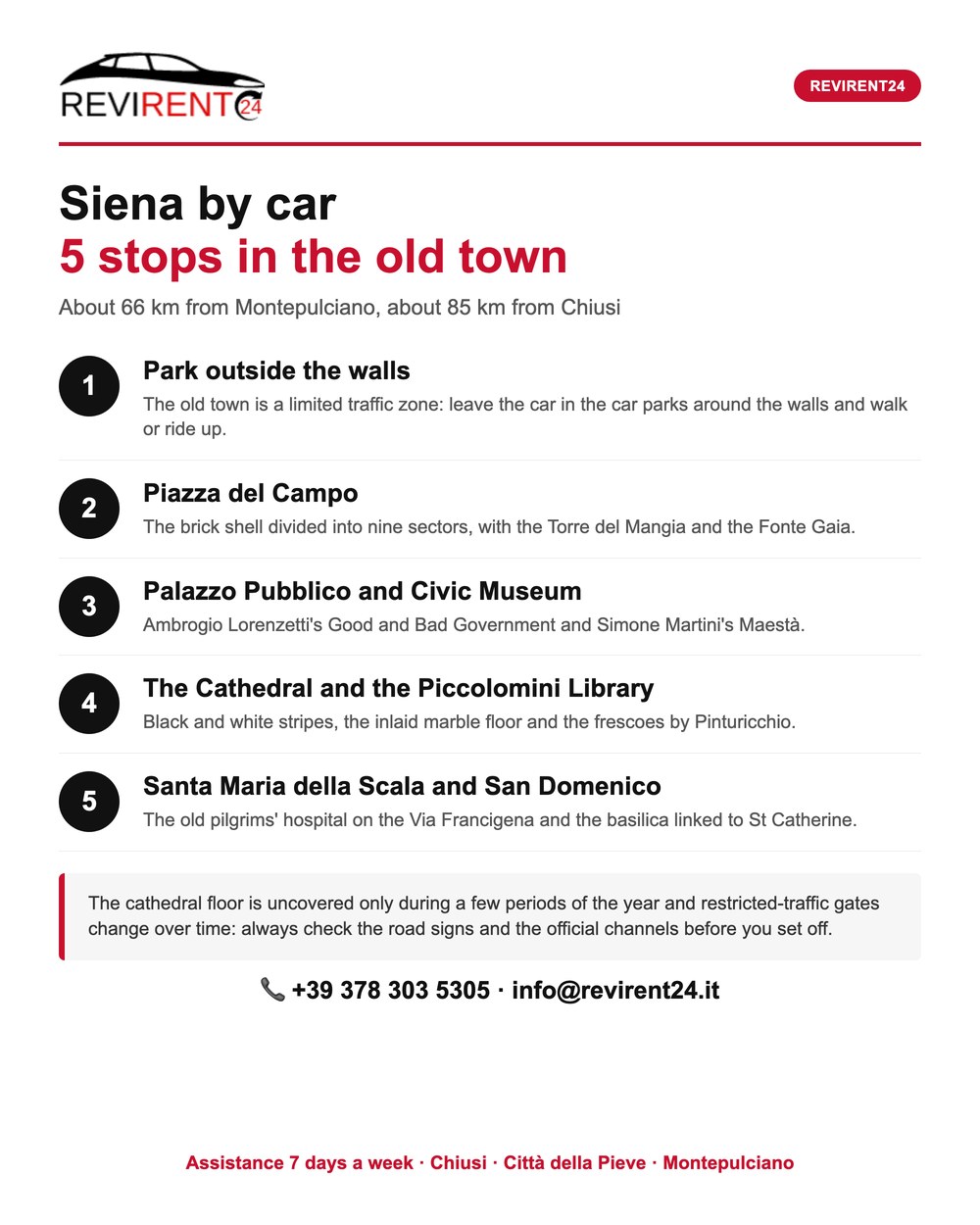
| 1. Park and walk in | Leave the car outside the walls and head up on foot or by escalator | 30 min |
| 2. Piazza del Campo | The shell-shaped square, the Fonte Gaia and the climb up the Torre del Mangia | 1 hr 30 |
| 3. Civic Museum | Lorenzetti's Good and Bad Government and Simone Martini's Maestà | 1 hr 30 |
| 4. Cathedral and Facciatone | The cathedral, the Piccolomini Library and the view from the Museo dell'Opera | 2 hrs |
| 5. Santa Maria della Scala or San Domenico | The Via Francigena hospital, or the Siena of St Catherine | 1 hr |
If you have a second day it builds itself: head south towards the Val d'Orcia and Montepulciano, or east towards Cortona and Lake Trasimeno. If you would rather stay close to base, our guide to Chiusi and the Val d'Orcia by car has plenty of ideas.
Which car to choose for Siena and the surrounding area
For the city the advice is clear: smaller is better. The car parks around the walls are multi-level structures with narrow lanes and steep ramps, and the roads leading to the gates are medieval in every sense. A city car is easier to handle and cheaper to fill up.
If Siena is only your base and you then move between the Crete Senesi, Chianti and the Val d'Orcia, the roads turn into narrow country lanes, sometimes unsurfaced: an SUV or crossover gives you more comfort and more luggage space. With a family or a group, seven-seaters save you from travelling in two cars.
The full fleet is on the Car park page. If the trip repeats itself or is work-related, it is worth looking at our long-term rental options too.
Renting with Revirent24: how it actually works
We are a local car rental company based between Chiusi, Città della Pieve and Montepulciano, and our terms are the ones published on our FAQ page. In short, for anyone heading to Siena:
- You do not need a credit card. It can be used as a payment method, but it is not compulsory: without a card you leave a security deposit of 500 euros. We explained it all in our guide on renting a car without a credit card.
- Documents: a valid ID document and a valid driving licence with the right category for the vehicle. The minimum age is 18. The details are in our guide to documents and requirements for renting.
- Cover: third-party liability, fire and theft, and collision damage waiver. In the event of damage the CDW excess is 500 euros.
- Additional driver: available, up to two drivers.
- Payment: cash, bank transfer or card (VISA and Mastercard; we do not accept American Express or Diners).
If you are arriving by train and it is running late, just let us know: we will move the pick-up time. The number is always the same, +39 378 303 5305, on WhatsApp too.
When to go and what to expect
Siena works all year round, but the seasons are not equal. Spring and early autumn are the best: good walking weather, postcard light on the hills and a city that can breathe. July and August are the months of the Palio and peak tourism: heat, crowds and expensive rooms, so book well ahead. In winter the centre is quiet and the museums can actually be enjoyed; bear in mind, though, that the roads around Siena climb and drop constantly and winter equipment becomes a real issue, as we explain in our guide to winter tyres and snow chains with a rental car.
Two final notes. First: comfortable shoes, always, because flat ground does not exist in Siena. Second: museum opening hours, the uncovering of the cathedral floor and event dates change from year to year, so check them on the official channels before building your day around them.

Frequently asked questions
Can you drive into Siena's old town?
No, the old town is a limited traffic zone and the gates are camera-controlled. The right approach is to leave the car in the structures around the walls and continue on foot or by escalator. Always check the road signs and the city council information, because times and gates are updated over time.
How far is Siena from Chiusi and Montepulciano?
It is about 66 km from Montepulciano, about 85 km from Chiusi and about 95 km from Città della Pieve. By car that means from just over an hour to about an hour and twenty, traffic permitting, usually via the Siena-Bettolle link road.
Is one day enough to visit Siena?
A full day lets you see Piazza del Campo, the Civic Museum in the Palazzo Pubblico, the cathedral with the Piccolomini Library and one of either Santa Maria della Scala or San Domenico. If you want to add the Crete Senesi, Chianti or the Val d'Orcia, count on two days.
Is the cathedral floor in Siena always on view?
No. The inlaid marble panels are uncovered only during certain periods of the year and are protected the rest of the time. If it matters to you, check the dates on the cathedral's official channels before fixing your trip.
Do I need a credit card to rent a car?
No. With Revirent24 a credit card can be used as a payment method but it is not compulsory. Renting without a card requires a security deposit of 500 euros, which is not needed if you rent with a card.
Which car is best for visiting Siena?
For the city a small car is best: it is easier to manoeuvre in multi-level car parks and on the narrow streets around the walls. If you carry on towards the Crete Senesi, Chianti or the Val d'Orcia, a crossover offers more comfort on country roads and more luggage space.
Can I pick up the car at Chiusi-Chianciano Terme station?
Yes. The station is on the Rome-Florence line and is the handiest base for anyone coming from further afield. If your train is delayed, just call us on +39 378 303 5305 and we will move the pick-up time.
Let's start here
Siena rewards those who arrive on their own terms: you go in when you want, you leave when you are done and, the moment you step outside the walls, half of Tuscany is within driving distance. We give you the right car and take the constraints away.
Write to
