


Using your phone while driving a rental car in Italy: the fine, the points and two suspensions that add up
In summary
The things you need to know right away
- The ban is about your handsArticle 173(2) forbids devices that involve taking your hands off the wheel, even momentarily. Holding the phone as a sat nav counts exactly like holding it to read a message.
- Two suspensions, not oneThe officer takes your licence on the spot for 7 or 15 days. The prefect suspension, 15 days to 2 months, starts when that ends and is added to it: up to three months.
- In a rental carThe temporary permit only covers taking the vehicle to the place of custody. Only someone already named as an authorised driver may take the wheel.
In this guide (15)
- 1What the law bans is not calling, it is taking your hands off the wheel
- 2Headphones banned, an earpiece allowed: the difference is written in the Code
- 3What it costs: from 250 to 1,000 euro, and up to 1,400 within two years
- 4Five points, ten if the licence is under three years old
- 5The fifteen-point cap does not protect you
- 6The short suspension: the officer takes your licence, not the prefect
- 7Seven or fifteen days, doubled if you caused a crash
- 8Foreign licence: the rule is turned upside down
- 9The piece nobody reads: for the phone, the two suspensions add up
- 10In a rented car the immediate problem is not the fine, it is who drives now
- 11Why the fine reaches you weeks later anyway
- 12You may use the sat nav, you may not hold it
- 13Legal hands-free means leaving your data in a car that is not yours
- 14What to know before you set off, in order
- 15The simple way not to get it wrong
The ban in article 173 is not about the call, it is about your hands: it forbids devices that involve taking your hands off the steering wheel, even momentarily. Since 14 December 2024 it costs 250 to 1,000 euro, five points and a licence suspension even on a first offence. And the phone is the only offence for which the law states that the roadside suspension and the prefect suspension add up. In a rental car the problem becomes immediate: who drives now?
Of all the offences you can commit in a rented car in Italy, using your phone is the most underestimated. Not because it is cheap: since 14 December 2024 the fine starts at 250 euro and goes up to 1,000. The point is something else. The phone is now the only offence in the Italian Highway Code for which the legislator wrote, in black and white, that two licence suspensions add up. One is applied by the officer at the roadside, the other arrives later from the prefect and only starts running when the first one has expired.
In your own car that would be a nuisance. In a rented car, with a contract that says who is allowed behind the wheel and a return date already fixed, it becomes an immediate logistical problem: your licence is taken there and then, and the car stays where it is. This article sets out the exact rules, with the figures that go with them, and then the part that only concerns people driving a vehicle that is not theirs.
What the law bans is not calling, it is taking your hands off the wheel
The rule is article 173 of the Italian Highway Code, which has a misleading heading, "Use of lenses or certain devices while driving", and whose paragraph 2 contains the ban that affects everyone.
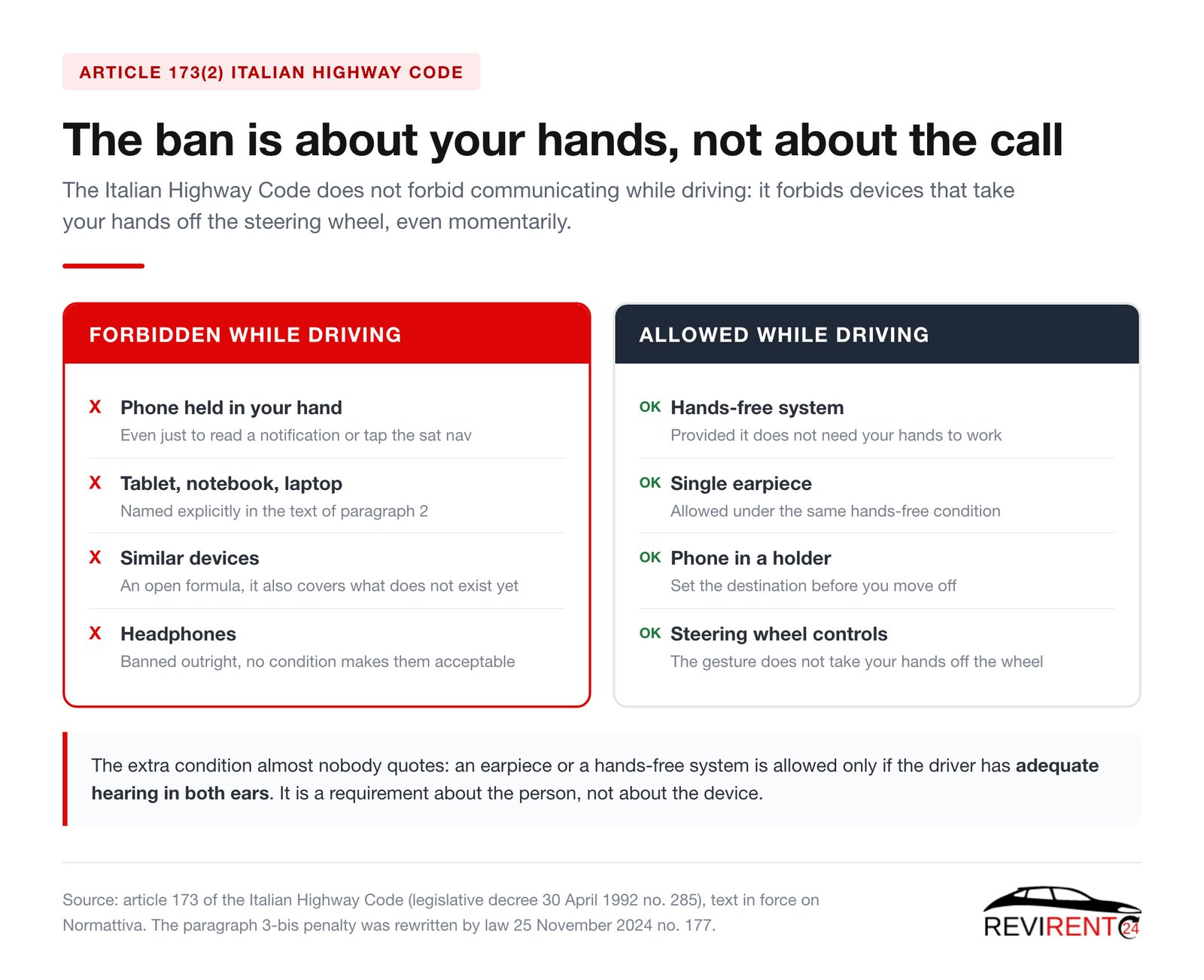
The text in force says the driver is forbidden to use, while the vehicle is moving, "radio-telephone equipment, smartphones, laptops, notebooks, tablets and similar devices that involve, even only momentarily, taking the hands off the steering wheel", as well as headphones. The only exception covers drivers of armed forces and police vehicles.
The wording to read carefully is "even only momentarily, taking the hands off the steering wheel". It does not say "making a call", it does not say "texting", it does not say "using social media". It says the device must not take your hands away from the wheel. Two consequences follow, and most people do not expect them.
First: holding the phone in your hand while using it as a sat nav falls squarely within the ban, exactly like holding it to answer a message. The purpose does not change the nature of the gesture. Second: the ban is not only about phones. Tablets and laptops are named expressly, and the phrase "similar devices" is there on purpose, to cover whatever comes next.
Headphones banned, an earpiece allowed: the difference is written in the Code
The second sentence of paragraph 2 is the one that lets you work legally. It says that hands-free equipment or equipment fitted with an earpiece is allowed, on two conditions: that it does not need your hands to operate, and that the driver has "adequate hearing in both ears".
Put together, the two sentences draw a very precise line that is almost always summarised badly online.
Headphones, meaning the kind that cover both ears, are banned in every case. There is no condition that makes them acceptable.
A single earpiece is allowed, but the condition is not that one ear stays free: it is that the driver hears well with both. That is a requirement about the person, not about the device.
Hands-free is allowed on the same terms, as long as it does not force you to pick anything up.
In practice, a phone lying on the passenger seat that rings and that you answer by reaching out is not hands-free. A phone in a holder, connected to the car system or to an earpiece, and operated by voice or by a steering wheel button, is.
What it costs: from 250 to 1,000 euro, and up to 1,400 within two years
The penalty is in paragraph 3-bis of article 173 and was rewritten by law 25 November 2024 no. 177, the Highway Code reform in force since 14 December 2024. Before that date the fine ran from 165 to 660 euro and the licence was suspended only for repeat offences.
This is the picture today.
| Article 173 paragraph 3-bis | First offence | Second offence within two years |
|---|---|---|
| Fine | from 250 to 1,000 euro | from 350 to 1,400 euro |
| Licence suspension | from 15 days to 2 months | from 1 to 3 months |
| Points deducted | 5 | 10 |
| Points if the licence is under 3 years old | 10 | 20 |
The suspension row deserves a pause, because it is the real novelty of 2024 and it changes the nature of the offence. Until 13 December 2024 using your phone at the wheel was an expensive fine. Since 14 December 2024 it is an offence that always carries a licence suspension, even the first time, even if your licence is full of points, even if you have never been fined in your life.
Five points, ten if the licence is under three years old
The deduction is in the table annexed to article 126-bis, which the same law 177/2024 amended precisely in the article 173 entry. A first breach of paragraph 2 costs 5 points, a second one within two years costs 10.
The closing note of that table adds a rule that doubles everything. For licences issued after 1 October 2003 to people who did not already hold another category B or higher licence, the points for each single offence are doubled if the offence is committed within the first three years from issue. A new driver who answers the phone therefore loses 10 points out of 20, half the licence, in one go. If that driver has also rented a car, it is worth remembering that power limits on the vehicles new drivers may drive apply as well.
The fifteen-point cap does not protect you
There is a detail of article 126-bis that almost nobody connects to the phone, and it is paragraph 1-bis.
That paragraph says that when several offences are established at the same time, the total points deducted cannot exceed fifteen. It is a safeguard: it stops a single roadside check from wiping out a licence. But the second sentence adds that "the provisions of this paragraph do not apply in cases where suspension or revocation of the licence is provided for".
Since 14 December 2024 the phone always carries a suspension. So when article 173 appears on the same ticket, the fifteen-point cap falls away, and the points add up without a ceiling. It is an indirect consequence of the reform, not spelled out anywhere, but it follows from simply reading the two rules together.
And there is a second knock-on effect, this time in paragraph 6 of the same article. Anyone who, after being served with a first offence costing at least five points, commits two more separate offences within twelve months, each costing at least five points, is sent for a licence review, meaning a retest of technical fitness. The phone costs exactly five points: it is one of the offences that starts that count.
The short suspension: the officer takes your licence, not the prefect
The same law 177/2024 introduced a brand new article into the Code, 218-ter, headed "Licence suspension in relation to the points score". It is the mechanism the press calls the short suspension, and it is unlike anything that existed before.
It works like this. For a closed list of fifteen entries, if at the moment of the check the national register of licence holders shows that the driver has fewer than twenty points because of deductions already suffered, an immediate suspension is added to the fine. Letter m) of that list is article 173 paragraph 3-bis, the phone.
The substantive difference is in paragraph 5. Normally a licence suspension is ordered by the prefect, and the order arrives in the following weeks. Not here: paragraph 5 says expressly that the short suspension is not subject to a suspension order being adopted by the prefect. The licence is taken by the officer who establishes the offence, stays at that officer's command and is handed back at the end of the period. The period runs from the day of withdrawal.
Paragraph 6 adds an important limit: the short suspension applies only to drivers identified at the moment the offence was committed. A deferred notice arriving in the post weeks later does not produce a roadside withdrawal; in that case the period runs from the date the ticket is served or notified.
Seven or fifteen days, doubled if you caused a crash
The length of the short suspension depends only on the remaining score, under paragraph 2 of article 218-ter.
| Situation at the time of the check | Length of the short suspension |
|---|---|
| Italian licence with 20 points or more | no short suspension |
| Italian licence with a score from 10 to 19 | 7 days |
| Italian licence with fewer than 10 points | 15 days |
| Either of the above, but with a crash caused | doubled, 14 or 30 days |
| Foreign licence with 1 to 10 penalty points recorded | 7 days |
| Foreign licence with more than 10 penalty points recorded | 15 days |
The doubling in paragraph 3 deserves a careful read, because the definition of a crash is wider than the one that comes to mind. The rule says the length is doubled where the driver has caused a road accident, "including where that event consists in running off the carriageway without any involvement of persons or things other than the driver and the driver's own vehicle". Running off the road on your own, without touching anyone, is an accident for the purposes of the doubling.
Foreign licence: the rule is turned upside down
Paragraph 4 of article 218-ter is the part that matters to anyone arriving in Italy from abroad and renting a car, and it is written the other way round compared with the Italian version. For a logical reason: a foreign licence has no Italian score to burn through, so the database provided for by article 6-ter of decree-law 151/2003 does not record the points you have left, it records the penalty points you have accumulated.
The precondition for applying the short suspension is that at least one penalty point is recorded. Above that threshold, the rule sets 7 days if the penalty points run from one to ten, and 15 days if there are more than ten. Where in the Italian version fewer points mean a longer suspension, in the foreign version it is more points that mean a longer suspension. If you drive on a non-Italian licence, the full picture of the documents you need is in the article on foreign driving licences and the international driving permit.
The piece nobody reads: for the phone, the two suspensions add up
At this point the question is obvious. If article 173 already provides for a suspension of 15 days to 2 months, and article 218-ter provides for another one of 7 or 15 days, which of the two applies?
Both of them, one after the other. And this is not an inference: it is written out in full in article 218, which, again by hand of law 177/2024, was amended with a sentence that names a single letter of the 218-ter list, and that letter is m), the phone.
The text says that in those cases the licence taken by the officer is sent to the prefecture within five days of the expiry of the short suspension, and that "from that same expiry date of the short suspension there runs the period of suspension set by the prefect, which is added to the one provided for by article 218-ter".
The phone is the only item on the list to be named there, because it is the only one that carries a suspension of its own. The result, as a timeline:
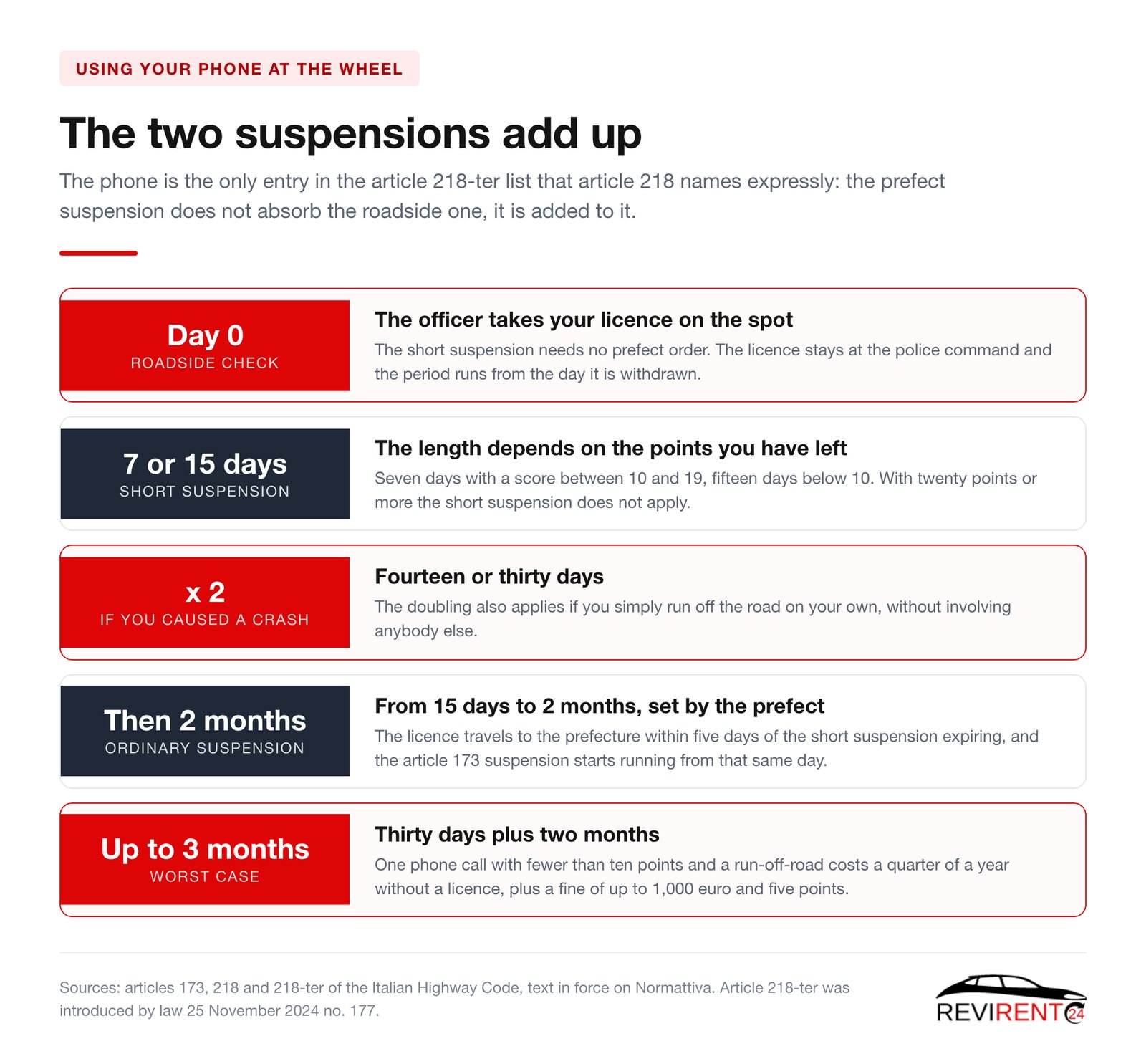
Day 0: roadside check, ticket, the officer takes your licence. The short suspension begins.
Days 1 to 7, or 1 to 15, doubled if there was a crash: short suspension, licence held at the police command.
On expiry: the licence travels to the prefecture, and from that same day the ordinary article 173 suspension starts running, from 15 days to 2 months, set by the prefect according to the seriousness of the case.
Worst case total: 30 days plus 2 months, that is three months without a licence for one phone call.
The only corrective is in paragraph 9 of article 218-ter, and it concerns repeat offences: where the same listed offence is committed more than once within two years, the short suspension applies only if the accessory suspension is not already provided for that offence.
In a rented car the immediate problem is not the fine, it is who drives now
Here the part that applies to everybody ends and the part that applies only to people holding a rental agreement begins.
When the officer takes your licence, article 218 paragraph 1 requires a temporary driving permit limited to the time needed to take the vehicle to the place of custody indicated by the person concerned, noted on the ticket. It is a permit to put the car somewhere safe, not to carry on with your trip. In a rented car the natural place of custody is the branch where you would hand it back.
The alternative is to pass the wheel to somebody else, and this is where the contract comes in. Only a person named as an authorised driver may drive: the friend sitting next to you is not one simply because they are there, and letting them drive puts the insurance cover at risk. Before you set off it is worth reading who may drive a rental car and how to add a second authorised driver: a five-minute formality at the desk that solves the problem on a bad day.
As for a driving permit for work reasons, article 218 paragraph 2 allows it within fifteen days of the withdrawal, for set time bands and in any case no more than three hours a day, only if the offence did not result in an accident, and it may be granted only once. During the short suspension it is issued not by the prefect but by the head of the office or command the officer belongs to. Driving during the suspension, or outside the limits of the permit, costs from 2,046 to 8,186 euro, revocation of the licence and impoundment of the vehicle for three months.
Why the fine reaches you weeks later anyway
If the ticket was not served on the spot, the mechanism that brings the points back to you is paragraph 2 of article 126-bis, and in a rented car it works in a particular way.
The notification to the register must be made in the name of the driver responsible for the offence. If the driver was not identified, the owner of the vehicle must supply the police, within sixty days of the ticket being served, with the personal and licence details of whoever was driving. The paragraph specifies that where the owner is a legal person the duty falls on its legal representative or a delegate, and that anyone failing to comply without a justified and documented reason pays from 291 to 1,166 euro.
In a rented car the owner is the company. This is not a commercial choice: it is a legal duty with a penalty attached. That is why the points and the ticket reach you anyway, even months later, even once you are back home. The full journey of a fine, from the notice served on the company to the letter that reaches you, is set out in the article on who pays fines on a rental car.
You may use the sat nav, you may not hold it
Navigation is the reason most people pick up their phone in the car, and since the ban is built around your hands, the answer lies entirely there.
Three practical steps that cost nothing.
Set the destination while stationary, before you leave or after pulling over somewhere safe. The roundabout outside Chiusi is not the place to type an address.
Bring your own holder. In a rented car you do not know in advance whether there will be a suitable socket, a free air vent or a screen compatible with your phone. A holder costing a few euro in your luggage solves the problem in whatever vehicle you are handed.
Position the holder without blocking your view. Article 169 of the Code requires the driver to have the widest freedom of movement and forbids anything that limits visibility: a screen stuck in the middle of the windscreen is a different problem, but it is still a problem.
One last point about the car being a rental: if the on-board screen will not pair, do not force it. No set-up should ever be done while moving.
Legal hands-free means leaving your data in a car that is not yours
There is a consequence of paragraph 2 that nobody talks about. The law pushes you towards hands-free, hands-free in a modern car means pairing your phone with the vehicle system, and that pairing leaves something behind: the imported contact list, the call log, sometimes messages, and in the on-board navigation the addresses you searched for, home included. In your own car that is convenient. In a car that somebody else will be driving in five days, it is a trail.
The European guidance on the subject, the Guidelines 01/2020 on processing personal data in the context of connected vehicles and mobility related applications adopted by the European Data Protection Board on 9 March 2021, does see the problem: paragraph 51 expressly mentions second-hand, leased, rented or borrowed vehicles among the cases where the data subject is not the owner, and paragraph 91 recommends that manufacturers provide a simple function, in substance a delete button, to quickly remove personal data stored on the car's dashboard, navigation history included. Paragraph 92 ties deletion to the sale of the vehicle and the change of ownership.
To be honest about it: that document is a recommendation aimed mainly at manufacturers, and it does not place any duty on the rental company to erase your data when you return the car. Which means it is worth doing yourself, and it takes two minutes.
On your phone, forget the connection to the vehicle.
In the car menu, remove the paired device from the list of phones.
Clear the destination history in the on-board navigation.
If you connected your phone by cable to a compatible screen, remove that profile too.
It is the same spirit as the checks worth doing at pick-up: have a look at the list of what to check before picking up a rental car, because the list works in reverse too, at the hand-back.
What to know before you set off, in order
The operational summary, without the padding.
A phone in your hand while the vehicle is moving costs from 250 to 1,000 euro, 5 points, 10 if the licence is under three years old, and a licence suspension of 15 days to 2 months even the first time.
If you have fewer than twenty points at the check, another suspension comes first, immediate, of 7 or 15 days, decided by the officer and not by the prefect. The two add up.
If you caused a crash, including running off the road on your own, the short suspension doubles and you cannot ask for a work driving permit.
Headphones are always banned, an earpiece and hands-free are allowed if they do not need your hands.
Set the sat nav while stationary and keep the phone in a holder. Bring one of your own.
At the hand-back, unpair your phone and clear the navigation history.
It is worth adding that the phone is not the only offence the 2024 reform made more expensive: the same law also rewrote the rules on drink driving, where in a rental car the suspension is doubled, for a reason that has nothing to do with the phone but is worth knowing before you set off.
The simple way not to get it wrong
Questions about what is allowed on board, about holders, about screens and about what happens if something goes wrong during the rental all have a single answer: ask the person handing you the car, before you leave. Our frequently asked questions cover the common cases, but not everything is written there, and one call clears up in a minute what a generic page cannot.
Revirent24 phone support answers every day from 8:30 to 19:00 on +39 378 303 5305. Pick-up and return take place at our branches in Montepulciano, Chiusi railway station and Città della Pieve, and you can return the car to any of the three. If you prefer to write, the contact page is the right place.
A call made while parked, before you set off, is the only one that does not cost 250 euro.