


Taking a rental car abroad from Italy: documents, the Green Card and vignettes tied to the plate

In summary
The things you need to know right away
- The document on board is not yoursArticle 180(4) allows the registration document to be replaced by a photocopy certified by the owner. At a check abroad that sheet names the company, not you: carry the rental contract.
- Beyond thirty days, name in a databaseWith a loan the name goes on the registration document, with a rental without a driver it goes into the national vehicle database with a receipt. Outside Italy nobody queries that database.
- Vignettes hang off the number plateIn Switzerland, Austria and Slovenia the title is linked to the plate, which you only learn at pick-up. The French Crit'Air arrives by post, so it has to be ordered early.
In this guide (14)
- 1No Italian rule forbids you from leaving the country
- 2The registration document on board is not in your name, and that is correct
- 3Beyond thirty days your name does not go on the registration document, it goes into a database
- 4What to ask the person handing over the car
- 5Insurance: nothing extra inside the EEA, a Green Card outside it
- 6The list of countries that require it, the real one
- 7The ticked box: a policy can exclude individual countries
- 8Switzerland: the sticker belongs to the car, the digital one to the plate
- 9Austria: from 1 February 2027 only the digital one survives, and there is the eighteen-day rule
- 10Slovenia: if the plate does not match, the toll is not paid
- 11France: Crit'Air is not a toll, it is a permit that arrives by post
- 12The right order of things
- 13Who may drive, and what happens if the fine comes from another country
- 14The simple way not to get it wrong
No Italian rule forbids taking a rental car abroad: the limit comes from the contract. The real problem is different, namely that insurance, motorway vignettes and the environmental sticker attach to the number plate or to the registration document, and in a rental car neither is yours. The documents on board, the Green Card and what to buy for Switzerland, Austria, Slovenia and France.
From the Valdichiana to the border is a couple of hours of motorway, and the question comes up every time a rental lasts longer than a weekend: can I take the car into Switzerland, Austria, France? The short answer is yes, but the reason people get into trouble is almost never a ban. It is that everything you need in order to drive across a border, the insurance, the motorway vignette, the environmental sticker, is not attached to the person driving. It is attached to the number plate or to the registration document. And in a rental car neither the plate nor the registration document is yours.
This article sorts out the two things to settle before you leave, namely which documents travel in the car and whose name is on them, and then what has to be bought country by country, with prices and dates taken from official sources. Every figure here comes with the rule or the authority that publishes it.
No Italian rule forbids you from leaving the country
It is worth starting here, because a popular belief says the law requires a written authorisation to take a rental car abroad. That obligation does not exist in the Italian Highway Code. The Code deals with which documents a driver must carry and how the availability of a vehicle registered to someone else is recorded, not with borders.
The constraint, where there is one, comes from two different places. The first is the rental contract, which may limit the countries the vehicle is allowed to enter: that is a commercial decision by the rental company, tied to insurance cover and roadside assistance, and it varies from company to company. The second is practical: at a roadside check abroad you need to be able to show that you hold the vehicle lawfully, and the document on board, on its own, does not say so.
In other words, you are not looking for a law. You are looking for a conversation with whoever hands you the keys. It helps to know exactly what to ask, which is the point of the next two sections.
The registration document on board is not in your name, and that is correct
Article 180 of the Italian Highway Code lists in paragraph 1 the documents a driver must carry: the vehicle registration document, a driving licence valid for the category of vehicle, and the compulsory insurance certificate.
Paragraph 4 of the same article then adds a specific rule. For vehicles used for public passenger transport services and for those used for rental without a driver, as well as for leasing with a purchase option, the registration document may be replaced by a photocopy certified by the owner itself and signed by the owner. A rental car falls precisely into this category.
So the sheet of paper you find in the glovebox is not the original registration document, it is a photocopy signed by the rental company, and it is not a makeshift solution: it is the document the law provides for this type of vehicle. The Italian Constitutional Court later widened the rule, ruling in judgment no. 280 of 23 July 2010 that paragraph 4 was unconstitutional in so far as it did not extend the same option to all vehicles of companies providing essential public services.
Driving without the documents required by article 180 carries the penalty in paragraph 7, from 42 to 173 euro. The amount is modest, but the problem abroad is not the Italian fine: it is that the photocopy carries the owner's name, that is the company's, and not yours.
Beyond thirty days your name does not go on the registration document, it goes into a database
This is the detail almost nobody explains, and it is exactly the one that matters to long-term renters.
Paragraph 4-bis of article 94 provides that deeds giving availability of a vehicle, for a period longer than thirty days, to someone other than the registered keeper, in the cases set out in the implementing regulation, must be declared by the acquiring party within thirty days, for the purpose of annotation on the registration document and registration in the national vehicle database. If this is omitted, the penalty in paragraph 3 applies, from 727 to 3,629 euro, and paragraph 5 provides that the registration document is withdrawn immediately by whoever establishes the breach.
Read like that, it would seem that on a three-month rental your name has to appear on the registration document. It does not, and the difference is written in the implementing regulation. Article 247-bis of Presidential Decree 495/1992 lists the cases in paragraph 2 and treats them differently:
point a) covers loans for use beyond thirty days and requires the registration document to be updated, with the borrower's name and the expiry of the contract annotated on it, with an exemption for cohabiting family members; point b) covers rental without a driver beyond thirty days and instead requires the national vehicle database to be updated, with a specific receipt issued, the database recording the lessee's name and the expiry of the contract.
The consequence is precise. If a friend lends you their car for two months, your name is printed on the registration document. If a company rents you the same car for two months, your name goes into an Italian database and what you hold is a receipt. The document travelling in the car still refers only to the rental company.
Inside Italy this works perfectly well, because that database can be consulted by road police, and paragraph 8 of article 180 itself takes account of the fact that certain data can be checked in accessible databases. Outside Italy nobody queries the Italian national vehicle database. That is why the practical answer is not a stamp on the registration document but carrying the rental contract, the only piece of paper that connects your name to that number plate.
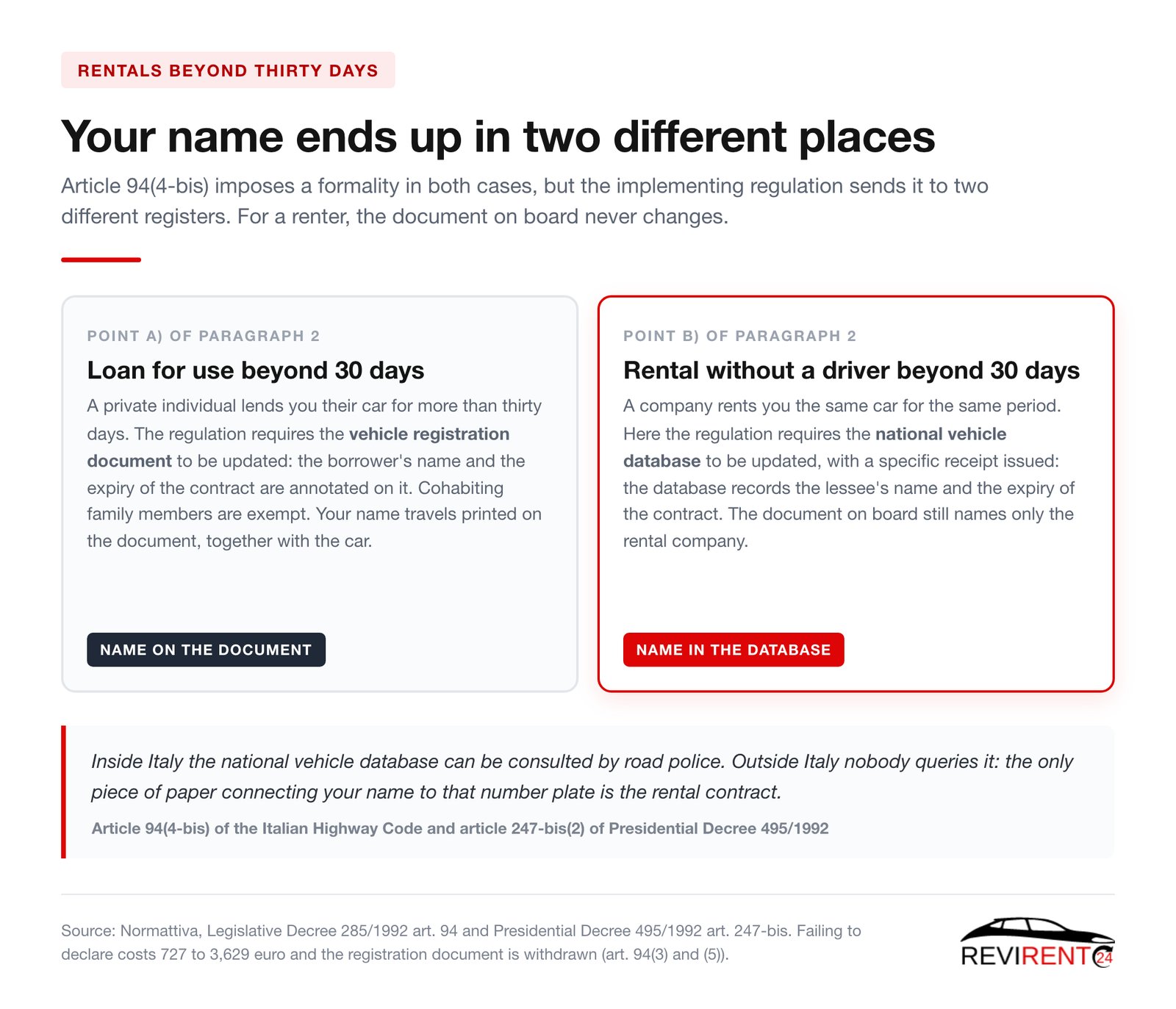
Beyond thirty days the formality exists in both cases, but it ends up in two different places.
What to ask the person handing over the car
Since the constraint is contractual rather than statutory, the useful questions are few and specific. Which countries the contract allows for the period you have booked. Whether the insurance cover applies in all of them or whether any are excluded. Whether you are given a letter or an authorisation to show at a check, in addition to the contract. And whether, for the length of your rental, the registration of a rental beyond thirty days applies, with the corresponding receipt.
These are questions that need an answer from the company, not an internet search, because they depend on that company's contract and policy. At Revirent24 the phone line is open every day from 8:30 to 19:00 on +39 378 303 5305, and the same goes for info@revirent24.it: it is the fastest way to get the right answer about the rental you actually hold, rather than a generic one.
Insurance: nothing extra inside the EEA, a Green Card outside it
The Green Card is the international insurance certificate that allows a vehicle to enter and drive in a foreign country while complying with the compulsory motor third-party liability insurance requirement. In Italy the system is run by UCI, the Ufficio Centrale Italiano, set up in 1953, which is the national insurance bureau for vehicles in international traffic and acts as the Italian Bureau within the Green Card System.
The certificate is issued under the responsibility of the national bureau of the country where the vehicle is registered and is released by the insurer together with the policy or on request. On a rental car that means one thing only: you cannot obtain it yourself, because the policy is not yours. It has to be requested from the rental company before you leave.
If a driver does not carry a valid Green Card where one is required, they have to buy a temporary policy at the border of the country they intend to visit, and UCI itself warns that this is far more expensive than the Green Card. That is why the question belongs before departure, not at the border.
One detail surprises anyone expecting something green: since 1 July 2020 many countries, Italy included, have adopted a simplified version of the certificate, printed on one side only and in black and white. It is still called the Green Card and its functions are unchanged, but it has lost the colour that defined it for seventy years. A black and white sheet is not a forgery.
The list of countries that require it, the real one
It is worth being pedantic here, because many pages publish lists including countries that no longer require the Green Card, or that never required it from Italian vehicles. The list that counts is UCI's, since UCI is the body that issues the certificate for Italy.
| Country | Position for a vehicle registered in Italy |
|---|---|
| Albania, Azerbaijan, Morocco, Moldova, Republic of North Macedonia, Tunisia, Turkey, Ukraine | Green Card required |
| Iran | Green Card required, agreement suspended since 1 January 2024 |
| Belarus, Russia | Green Card required, agreement no longer in force since 1 June 2023 |
| European Union and the rest of the European Economic Area | Not required |
For the trips people actually make from Tuscany, that is France, Switzerland, Austria, Slovenia and Germany, no Green Card is needed. It is needed if the itinerary genuinely leaves the European Economic Area, and in that case it has to be planned weeks ahead, because it does not depend on you.
The ticked box: a policy can exclude individual countries
There is a passage from UCI that anyone driving a car that is not theirs should read carefully. Insurance companies are free to exclude cover for certain non-EEA countries by ticking the relevant box on the Green Card, and UCI states that it holds no information on the exclusions applied by individual companies.
That means there are two separate questions, and answering the first does not settle the second. The first is whether that country requires a Green Card. The second is whether the policy on that specific car covers that country. The first has a public answer, the table above. The second is known only to whoever holds the insurance contract, that is the rental company.
So if you are considering an itinerary outside the EEA, having a Green Card is not in itself reassurance: somebody has to check whether that country is ticked out on it.
Switzerland: the sticker belongs to the car, the digital one to the plate
Switzerland has no toll booths like Italy: motorway use is paid through an annual vignette. It costs 40 francs and is valid from 1 December of the previous year until 31 January of the following year, so fourteen months, and it is due from every vehicle, registered in Switzerland or abroad.
It exists in two forms, and the difference is exactly the one that matters on a rental car. The Federal Office for Customs and Border Security puts it in a single line: the only difference in their use is that the adhesive vignette is linked to the vehicle, whereas the e-vignette is linked to the vehicle's licence plate.
For a renter the e-vignette is the convenient form, because buying it requires only three pieces of information: the vehicle category, the country of registration and the number plate. You do not need the registration document, which is precisely the one you do not hold in original, and it can be bought from anywhere through the official portal. Outside Switzerland the actual price depends on the exchange rate and any card fees.
Two limits remain, and on a rental they bite. First: the e-vignette can be transferred to a new number plate only if the vehicle and the holder remain identical, for instance after a move or the loss of a plate. If the rental company swaps your car, the plate changes and the vehicle is no longer the same one: those 40 francs do not move with you. Second, and this time in your favour: if the vehicle changes but the plate stays the same, the e-vignette is automatically valid for the new car, with nothing to do.
On the adhesive version the rule is blunt: it is forbidden to peel stickers off and transfer them to other vehicles, and a detached sticker is invalid. Buying one and sticking it on the windscreen of a car you hand back at the end of the rental means giving it away to the company. Anyone using the motorway without a valid vignette pays a fine.
Austria: from 1 February 2027 only the digital one survives, and there is the eighteen-day rule
Austria also works on vignettes, but here two things are worth knowing right now, because they are changing in these very weeks.
The first is the switch to digital. ASFINAG, the company that runs Austrian motorways and expressways, has announced that with the 2027 vignette year adhesive vignettes will no longer be offered and that from 1 February 2027 only the digital vignette will be valid on Austrian motorways and expressways. Adhesive vignettes have not been on sale since 1 December. More than 83 per cent of annual vignettes are already used in digital form. Anyone buying next year's digital vignette by 31 December 2026 pays the current price; from 1 January 2027 there is a two per cent adjustment and the annual one goes to 108.90 euro.
And the digital vignette, as in Switzerland and Slovenia, is linked to the vehicle's number plate. You cannot buy it in advance for a car you have not collected yet, because you only learn the plate on handover, and you cannot transfer it to another plate.
The second thing is the timing trap, and this is where people genuinely get caught. Car rates valid until 31 December 2026 are 9.60 euro for one day, 12.80 euro for ten days, 32.00 euro for two months and 106.80 euro for the annual one, including 20 per cent Austrian VAT. But validity on an online purchase is not the same for all of them: the one-day and ten-day vignettes can be bought online with immediate validity, whereas the two-month and annual ones bought online by a private individual can only start to be valid from the eighteenth day after purchase. The reason is the fourteen-day right of withdrawal, plus three days for possible postal delivery.
For a rental the conclusion is immediate: if you leave next week, the annual vignette bought online is useless to you, however good the per-day price looks. Take the day or the ten-day one. Vignettes bought physically from a sales partner, at a toll station or from a vending machine, on the other hand, are valid straight away.
Slovenia: if the plate does not match, the toll is not paid
Slovenia has replaced the adhesive vignette with the e-vinjeta, which is digital and is registered against the number plate and the country of registration. The operator DARS spells it out: if the registration number in the e-vignette system does not match the registration plate number of the vehicle driving on the motorway or expressway, the toll is not deemed to be paid. It is equally explicit that vehicles without a valid e-vignette may not enter a toll road.
It is the same car-swap trap, written even more plainly: the plate is the only identifier, so it has to be entered carefully at purchase and checked again if the vehicle is replaced during the rental.
Rates depend on vehicle height. Class 2A, up to 1.3 metres, costs 16.00 euro for a week, 32.00 euro for a month and 117.50 euro for a year. Class 2B, above 1.3 metres, costs roughly double: 32.00 euro for a week, 64.10 euro for a month and 235.00 euro for a year. Anyone renting an SUV or a van slips easily into the second class, and it is a common misjudgement because the threshold is low.
That threshold should ring a bell for anyone who has already read how tolls work in Italy: here too classes are decided on height, with a 1.30 metre threshold at the front axle. The full Italian picture is in the article on motorway tolls with a rental car.
France: Crit'Air is not a toll, it is a permit that arrives by post
In France motorways are paid at the toll booth and no vignette is needed. Something else is needed, though, which is not a toll and catches people out: the air quality certificate, the Crit'Air sticker, essential for driving in low-emission zones, the ZFE. As at 1 January 2025 there were twenty-five active in metropolitan France, including Paris, Lyon, Marseille, Toulouse, Grenoble, Strasbourg, Bordeaux, Nantes and Lille.
The obligation applies to foreign-registered vehicles too, and the official site of the French Ministry for Ecological Transition has a dedicated procedure. For a vehicle registered outside France the certificate costs 3.11 euro plus 2.00 euro postage outside France, so 5.11 euro per vehicle, and ordering it requires a legible photo or a scan of the vehicle registration certificate. For a French vehicle the total is 3.85 euro, because domestic postage costs less.
Two practical consequences for renters. The first is that the scan required is of the document on board, that is the certified photocopy under article 180: it needs to be photographed legibly, so it is better done calmly at pick-up than on the motorway. The second, and more important, is that there is postal delivery: the sticker arrives by post to the address you give, so this is not something you sort out on the day you leave or at the border. It has to be ordered in advance, and the official site explicitly warns against intermediaries and fraudulent websites.
Penalties are set by contravention class. The ministry's guidance indicates, for cars, light commercial vehicles and two-wheelers, that is categories M1, N1 and L, a third-class contravention of 68 euro, reduced to 45 euro and increased to 180 euro. For heavy vehicles, buses and coaches, that is M2, M3, N2 and N3, it moves to the fourth class: 135 euro, 90 euro reduced and 375 euro increased. Three offences are punished: driving in breach of the ZFE restrictions, driving in a ZFE without a certificate, and parking in a permanent ZFE, that is one in force twenty-four hours a day, seven days a week.
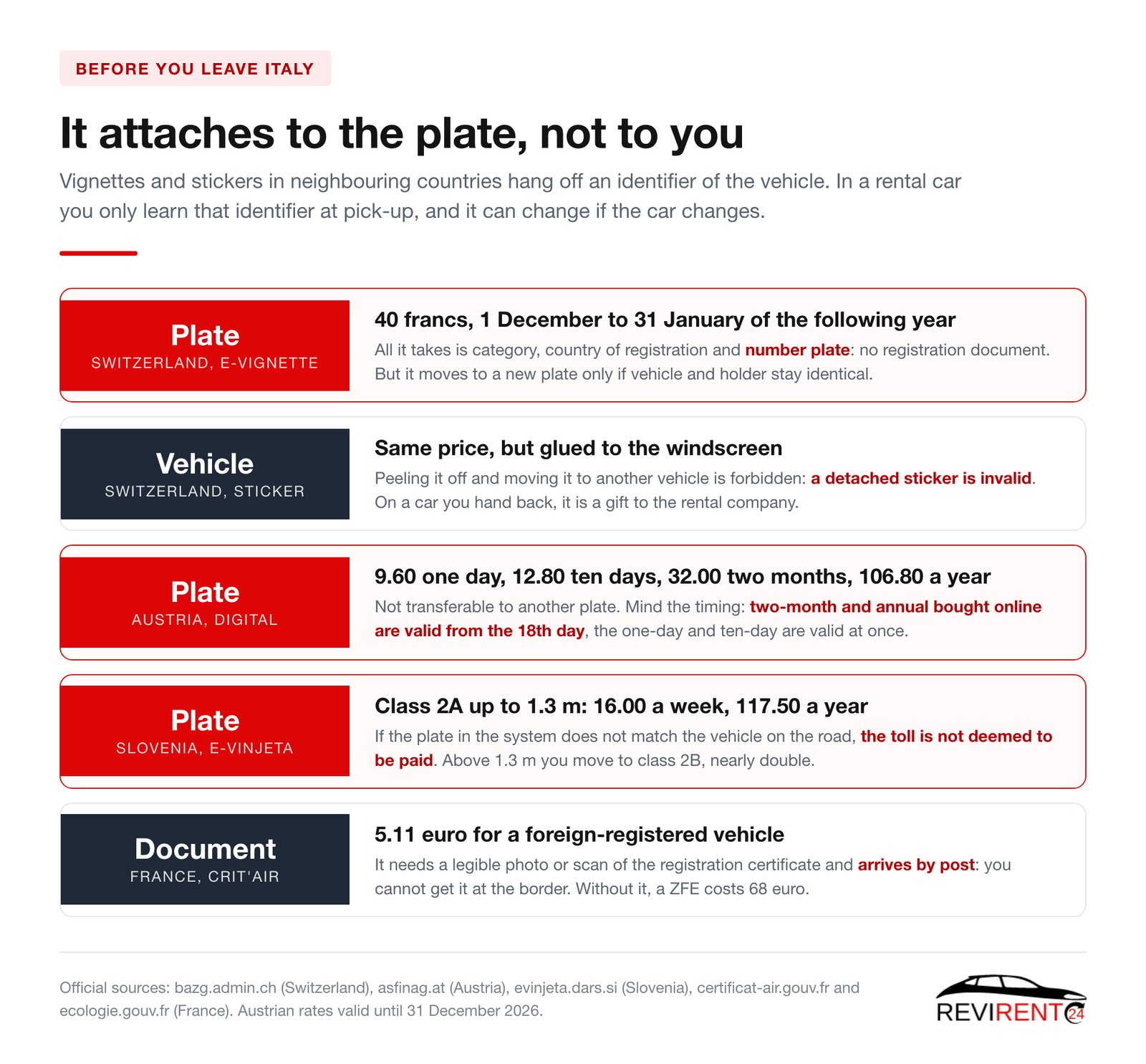
Lined up, the four situations tell the same story from four different angles.
| Country | What you need | What it is linked to | Cost for a car |
|---|---|---|---|
| Switzerland | Motorway vignette, adhesive or e-vignette | Adhesive to the vehicle, e-vignette to the plate | 40 francs, valid 1 December to 31 January of the following year |
| Austria | Digital vignette, adhesive ones being phased out | To the plate, not transferable | 9.60 euro one day, 12.80 ten days, 32.00 two months, 106.80 a year |
| Slovenia | E-vinjeta | To the plate and the country of registration | Class 2A up to 1.3 m: 16.00 a week, 32.00 a month, 117.50 a year |
| France | Crit'Air sticker for ZFE, tolls at the booth | To the vehicle via its registration certificate, posted to you | 5.11 euro for a foreign-registered vehicle |
The right order of things
People who set off relaxed do not do more than everyone else. They do it earlier, and in the right order.
Before the rental, settle the itinerary and ask the company which countries the contract allows and where the cover applies. At pick-up, check that the certified photocopy of the registration document and the insurance certificate are in the car, take the contract, and if the rental runs beyond thirty days ask for the receipt of the rental registration. Still at pick-up, photograph the plate and, if France is on the route, scan the document legibly. Only then, with the plate in hand, buy the vignettes for the countries you will cross, choosing the duration on the basis of your departure date rather than the price per day.
Two things cannot be fixed afterwards. The French sticker, because it travels by post. And the Austrian two-month or annual vignette bought online, because of the eighteen-day rule. Everything else can be handled at the last minute, as long as you have the right plate.
Worth remembering that the rules of the country you cross are not only about tolls: winter obligations and onboard equipment change too. What comes with the car is covered in the article on winter tyres and snow chains in car rental, and the pick-up check is in the guide on what to check before picking up a rental car.
Who may drive, and what happens if the fine comes from another country
Two questions remain open and already have answers elsewhere on the site, because they apply inside Italy too.
The first is who is authorised to take the wheel. On a long trip people share the driving, and more than one name can appear on the contract: the point is that it has to appear. The full picture is in the article on who can drive a rental car. If the driver holds a non-Italian licence, the rules on recognition and on the international driving permit are collected in the article on a foreign driving licence and the international driving permit.
The second is how a ticket issued far from home reaches you. The mechanism is the same as for Italian fines on a rental car: enforcement starts from the plate, therefore from the company, which passes on the details of whoever was driving. Timescales, amounts and what to do when the notice arrives months later are explained in the article on fines with a rental car and who pays.
The simple way not to get it wrong
In the end the difference is not made by remembering what a vignette costs, which changes every year anyway. It is made by knowing that everything hangs off a number plate and a document that are not yours, and that the order of operations therefore matters more than the choice of product.
We are between Tuscany and Umbria, with branches in Montepulciano, Chiusi railway station and Città della Pieve, and the car can be returned to any of them: you can look at our locations and pick the most convenient collection point, or go straight to the available fleet. If the trip is a long one and you are considering a period of months, it is worth a look at the long-term rental offers, where the thirty-day threshold of article 94 becomes relevant.
Above all: before booking an itinerary that leaves Italy, call us. The phone line is open every day from 8:30 to 19:00 on +39 378 303 5305, or write to info@revirent24.it or through the contact page. Telling us where you want to go before you sign costs one phone call and settles in advance the one thing that genuinely cannot be sorted out at the border.